 |
PDBsum entry 4mjs

|
|
|
|
|
|

|

|

|

|
|

|
|

|
|

|
|

|
|
|
 |

|

|
|
|
|
|
|
|
|
|
|
|
|
|
|
|
|
|
|
|
|
|
|
|
|
|
|
|
|
|
|
|
|
|
Transferase/protein binding
|
PDB id
|
|
|
|
4mjs
|
|
|
|
|
|
|
|
|
|
|
|
|
|
|

|

|

|
|
|
|
|
|
|
|
 |
Contents |
 |
|
|
|
|
|
|
|
|
|
|
|


 (+ 6 more)
88 a.a.
(+ 6 more)
88 a.a.
|
|
|
|
|
|
|
|
|
|
|


 82 a.a.
|
|
|
|
|
|
|
|
|
|
|

 84 a.a.
|
|
|
|
|
|
|
|
|
|
|


 87 a.a.
|
|
|
|
|
|
|
|
|
|
|
|
|
|
|
PDB id:
|
|
|
|
| Name: |
|
Transferase/protein binding
|
|
|
Title:
|
|
Crystal structure of a pb1 complex
|
|
Structure:
|
|
Protein kinasE C zeta type. Chain: a, c, e, g, i, k, m, o, q, s, u, w. Fragment: pb1 domain, unp residues 15-101. Synonym: npkc-zeta. Engineered: yes. Sequestosome-1. Chain: b, d, f, h, j, l, n, p, r, t, v, x. Fragment: pb1 domain, unp residues 3-102. Synonym: ebi3-associated protein of 60 kda, ebiap, p60,
|
|
Source:
|
|
Rattus norvegicus. Brown rat,rat,rats. Organism_taxid: 10116. Gene: pkcz, prkcz. Expressed in: escherichia coli. Expression_system_taxid: 562. Homo sapiens. Human. Organism_taxid: 9606.
|
|
Resolution:
|
|
|
2.50Å
|
R-factor:
|
0.240
|
R-free:
|
0.287
|
|
|
Authors:
|
|
J.Ren,Z.X.Wang,J.W.Wu
|
|
Key ref:
|
|
J.Ren
et al.
(2014).
Structural and biochemical insights into the homotypic PB1-PB1 complex between PKCζ and p62.
Sci China Life Sci,
57,
69-80.
PubMed id:
DOI:
|
|
|
Date:
|
|
|
04-Sep-13
|
Release date:
|
27-Aug-14
|
|
|
|
|
|
|
PROCHECK
|

|
|
|
|
|
Headers
|
|
|
|
References
|
|
|
|
|
|

|
|
P09217
(KPCZ_RAT) -
Protein kinase C zeta type from Rattus norvegicus
|
|
|
|
Seq:
Struc:
|
|
|
|
592 a.a.
88 a.a.*
|
|

|

|
|
|
|
|
|
|
|
|
|
|
|
|

|
|
Q13501
(SQSTM_HUMAN) -
Sequestosome-1 from Homo sapiens
|
|
|
|
Seq:
Struc:
|
|
|
|
440 a.a.
82 a.a.*
|
|
|

|

|
|
|
|
|
|
|
|
|
|
|
|
|
|
|
|
|
Enzyme class:
|
|
Chains A, C, E, G, I, K, M, O, Q, S, U, W:
E.C.2.7.11.13
- protein kinase C.
|
|
|
|
|
|
|
Reaction:
|
|
|
1.
|
L-seryl-[protein] + ATP = O-phospho-L-seryl-[protein] + ADP + H+
|
|
2.
|
L-threonyl-[protein] + ATP = O-phospho-L-threonyl-[protein] + ADP + H+
|
|
|
|
|
|
|
L-seryl-[protein]
|
+
|
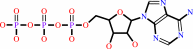 ATP
ATP
|
=
|
O-phospho-L-seryl-[protein]
|
+
|
 ADP
ADP
|
+
|
H(+)
|
|
|
|
|
|
|
L-threonyl-[protein]
|
+
|
ATP
|
=
|
O-phospho-L-threonyl-[protein]
|
+
|
ADP
|
+
|
H(+)
|
|
|
|
|
|
|
|
|
|
|
|
|
Molecule diagrams generated from .mol files obtained from the
KEGG ftp site
|
|
|
|
|
|
|
|
|
|
|
|
|
|
 |
|
|
|
|
|
|
| |
|
|
| |
|
DOI no:
|
Sci China Life Sci
57:69-80
(2014)
|
|
PubMed id:
|
|
|
|
|
|
| |
|
Structural and biochemical insights into the homotypic PB1-PB1 complex between PKCζ and p62.
|
|
J.Ren,
J.Wang,
Z.Wang,
J.Wu.
|
|
|
|
|
| |
ABSTRACT
|
|
|
|
| |
|
|
The atypical PKC isoforms (ζ and ı) play essential roles in regulating various
cellular processes. Both the hetero-interaction between PKCζ and p62 through
their N-terminal PB1 domains and the homo-oligomerization of p62 via its PB1
domain are critical for the activation of NF-κB signaling; however, the
molecular mechanisms concerning the formation and regulation of these homotypic
complexes remain unclear. Here we determined the crystal structure of PKCζ-PB1
in complex with a monomeric p62-PB1 mutant, where the massive electrostatic
interactions between the acidic OPCA motif of PKCζ-PB1 and the basic surface of
p62-PB1, as well as additional hydrogen bonds, ensure the formation of a stable
and specific complex. The PKCζ-p62 interaction is interfered with the
modification of a specific Cys of PKCζ by the antiarthritis drug
aurothiomalate, though all four cysteine residues in the PKCζ-PB1 domain can be
modified in in vitro assay. In addition, detailed structural and biochemical
analyses demonstrate that the PB1 domains of aPKCs belong to the type I group,
which can depolymerize the high-molecular-weight p62 aggregates into
homo-oligomers of lower order. These data together unravel the molecular
mechanisms of the homo-or hetero-interactions between p62 and PKCζ and provide
the basis for designing inhibitors of NF-κB signaling.
|
|
|
|
|
|
|
|
|
|
|
|
|
|
|
|
|
|
 |
 |
 |
| | |


 Links
Links


