 |
PDBsum entry 4lyh

|
|
|
|
|
|

|

|

|

|
|

|
|

|
|

|
|

|
|

|
|

|
|
|
 |

|

|
|
|
|
|
|
|
|
|
|
|
|
|
|
|
|
|
|
|
|
|
|
|
|
|
|
|
|
|
|
|
|
|
|
|
Signaling protein/inhibitor
|
PDB id
|
|
|
|
4lyh
|
|
|
|
|
|
|
|
|
|
|
|
|
|
|

|

|

|
|
|
|
|
|
|
PDB id:
|
|
|
|
| Name: |
|
Signaling protein/inhibitor
|
|
|
Title:
|
|
Crystal structure of small molecule vinylsulfonamide 9 covalently bound to k-ras g12c
|
|
Structure:
|
|
Gtpase kras. Chain: a, b, c. Fragment: unp residues 1-169. Synonym: k-ras 2, ki-ras, c-k-ras, c-ki-ras, gtpase kras, n- terminally processed. Engineered: yes
|
|
Source:
|
|
Homo sapiens. Human. Organism_taxid: 9606. Gene: kras, kras isoform 2b, kras2, rask2. Expressed in: escherichia coli. Expression_system_taxid: 469008.
|
|
Resolution:
|
|
|
1.37Å
|
R-factor:
|
0.165
|
R-free:
|
0.188
|
|
|
Authors:
|
|
J.M.Ostrem,U.Peters,M.L.Sos,J.A.Wells,K.M.Shokat
|
|
Key ref:
|
|
J.M.Ostrem
et al.
(2013).
K-Ras(G12C) inhibitors allosterically control GTP affinity and effector interactions.
Nature,
503,
548-551.
PubMed id:
DOI:
|
|
|
Date:
|
|
|
31-Jul-13
|
Release date:
|
27-Nov-13
|
|
|
|
|
|
|
PROCHECK
|

|
|
|
|
|
Headers
|
|
|
|
References
|
|
|
|
|
|

|
|
P01116
(RASK_HUMAN) -
GTPase KRas from Homo sapiens
|
|
|
|
Seq:
Struc:
|
|
|
|
189 a.a.
163 a.a.*
|
|

|

|
|
|
|
|
|
|
|
|
|
|
|
Key: |
 |
PfamA domain |
|
|
 |
Secondary structure |
|
 |
CATH domain |
|
|
*
PDB and UniProt seqs differ
at 10 residue positions (black
crosses)
|
|
|
|
|
|
|
|
|
|
|
|
|
Enzyme class:
|
|
E.C.3.6.5.2
- small monomeric GTPase.
|
|
|
|
|
|
|
Reaction:
|
|
GTP + H2O = GDP + phosphate + H+
|
|
|
|
|
|
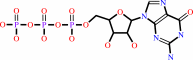 GTP
GTP
|
+
|
H2O
|
=
|
GDP
Bound ligand (Het Group name = )
corresponds exactly
|
+
|
 phosphate
|
+
|
H(+)
|
|
|
|
|
|
|
|
|
|
|
|
|
Molecule diagrams generated from .mol files obtained from the
KEGG ftp site
|
|
|
|
|
|
|
|
|
|
|
|
|
|
 |
|
|
|
|
|
|
| |
|
|
| |
|
DOI no:
|
Nature
503:548-551
(2013)
|
|
PubMed id:
|
|
|
|
|
|
| |
|
K-Ras(G12C) inhibitors allosterically control GTP affinity and effector interactions.
|
|
J.M.Ostrem,
U.Peters,
M.L.Sos,
J.A.Wells,
K.M.Shokat.
|
|
|
|
|
| |
ABSTRACT
|
|
|
|
| |
|
|
Somatic mutations in the small GTPase K-Ras are the most common activating
lesions found in human cancer, and are generally associated with poor response
to standard therapies. Efforts to target this oncogene directly have faced
difficulties owing to its picomolar affinity for GTP/GDP and the absence of
known allosteric regulatory sites. Oncogenic mutations result in functional
activation of Ras family proteins by impairing GTP hydrolysis. With diminished
regulation by GTPase activity, the nucleotide state of Ras becomes more
dependent on relative nucleotide affinity and concentration. This gives GTP an
advantage over GDP and increases the proportion of active GTP-bound Ras. Here we
report the development of small molecules that irreversibly bind to a common
oncogenic mutant, K-Ras(G12C). These compounds rely on the mutant cysteine for
binding and therefore do not affect the wild-type protein. Crystallographic
studies reveal the formation of a new pocket that is not apparent in previous
structures of Ras, beneath the effector binding switch-II region. Binding of
these inhibitors to K-Ras(G12C) disrupts both switch-I and switch-II, subverting
the native nucleotide preference to favour GDP over GTP and impairing binding to
Raf. Our data provide structure-based validation of a new allosteric regulatory
site on Ras that is targetable in a mutant-specific manner.
|
|
|
|
|
|
|
|
|
|
|
|
|
|
|
|
|
|
 |
 |
 |
|


 Links
Links


