 |
PDBsum entry 4l1l
|
|

|
|
PDB id:
|
|
|
|
| Name: |
|
Transferase
|
|
|
Title:
|
|
Rat pkc c2 domain bound to cd
|
|
Structure:
|
|
Protein kinasE C alpha type. Chain: a. Fragment: unp residues 155-293. Synonym: pkc-a, pkc-alpha. Engineered: yes
|
|
Source:
|
|
Rattus norvegicus. Rat. Organism_taxid: 10116. Gene: pkca, prkca. Expressed in: escherichia coli. Expression_system_taxid: 562.
|
|
Resolution:
|
|
|
1.60Å
|
R-factor:
|
0.160
|
R-free:
|
0.195
|
|
|
Authors:
|
|
K.M.Morales,Y.Yang,Z.Long,P.Li,A.B.Taylor,P.J.Hart,T.I.Igumenova
|
|
Key ref:
|
|
K.A.Morales
et al.
(2013).
Cd2+ as a Ca2+ surrogate in protein-membrane interactions: isostructural but not isofunctional.
J Am Chem Soc,
135,
12980-12983.
PubMed id:
DOI:
|
|
|
Date:
|
|
|
03-Jun-13
|
Release date:
|
28-Aug-13
|
|
|
|
|
|
|
PROCHECK
|

|
|
|
|
|
Headers
|
|
|
|
References
|
|
|
|
|
|

|
|
P05696
(KPCA_RAT) -
Protein kinase C alpha type from Rattus norvegicus
|
|
|
|
Seq:
Struc:
|
|
|
|
672 a.a.
138 a.a.
|
|

|

|
|
|
|
|
|
|
|
|
|
|
|
Key: |
 |
PfamA domain |
|
|
 |
Secondary structure |
|
 |
CATH domain |
|
|
|
|
|
|
|
|
|
|
|
|
|
Enzyme class:
|
|
E.C.2.7.11.13
- protein kinase C.
|
|
|
|
|
|
|
Reaction:
|
|
|
1.
|
L-seryl-[protein] + ATP = O-phospho-L-seryl-[protein] + ADP + H+
|
|
2.
|
L-threonyl-[protein] + ATP = O-phospho-L-threonyl-[protein] + ADP + H+
|
|
|
|
|
|
|
L-seryl-[protein]
|
+
|
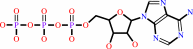 ATP
ATP
|
=
|
O-phospho-L-seryl-[protein]
|
+
|
 ADP
ADP
|
+
|
H(+)
|
|
|
|
|
|
|
L-threonyl-[protein]
|
+
|
ATP
|
=
|
O-phospho-L-threonyl-[protein]
|
+
|
ADP
|
+
|
H(+)
|
|
|
|
|
|
|
|
|
|
|
|
|
Molecule diagrams generated from .mol files obtained from the
KEGG ftp site
|
|
|
|
|
|
|
|
|
|
|
|
|
|
 |
|
|
|
|
|
|
| |
|
|
| |
|
DOI no:
|
J Am Chem Soc
135:12980-12983
(2013)
|
|
PubMed id:
|
|
|
|
|
|
| |
|
Cd2+ as a Ca2+ surrogate in protein-membrane interactions: isostructural but not isofunctional.
|
|
K.A.Morales,
Y.Yang,
Z.Long,
P.Li,
A.B.Taylor,
P.J.Hart,
T.I.Igumenova.
|
|
|
|
|
| |
ABSTRACT
|
|
|
|
| |
|
|
Due to its favorable spectroscopic properties, Cd(2+) is frequently used as a
probe of Ca(2+) sites in proteins. We investigate the ability of Cd(2+) to act
as a structural and functional surrogate of Ca(2+) in protein-membrane
interactions. C2 domain from protein kinase Cα (C2α) was chosen as a paradigm
for the Ca(2+)-dependent phosphatidylserine-binding peripheral membrane domains.
We identified the Cd(2+)-binding sites of C2α using NMR spectroscopy,
determined the 1.6 Å crystal structure of Cd(2+)-bound C2α, and characterized
metal-ion-dependent interactions between C2α and phospholipid membranes using
fluorescence spectroscopy and ultracentrifugation experiments. We show that
Cd(2+) forms a tight complex with the membrane-binding loops of C2α but is
unable to support its membrane-binding function. This is in sharp contrast with
Pb(2+), which is almost as effective as Ca(2+) in driving the C2α-membrane
association process. Our results provide the first direct evidence for the
specific role of divalent metal ions in mediating protein-membrane interactions,
have important implications for metal substitution studies in proteins, and
illustrate the potential diversity of functional responses caused by toxic metal
ions.
|
|
|
|
|
|
|
|
|
|
|
|
|
|
|
|
|
|
 |
 |
 |
|


 Links
Links


