 |
PDBsum entry 4gl2

|
|
|
|
|
|

|

|

|

|
|

|
|

|
|

|
|

|
|

|
|

|
|

|
|

|
|

|
|
|
 |

|

|
|
|
|
|
|
|
|
|
|
|
|
|
|
|
|
|
|
|
|
|
|
|
|
|
|
|
|
|
|
|
|
|
|
|
|
|
|
RNA binding protein/RNA
|
PDB id
|
|
|
|
4gl2
|
|
|
|
|
|
|
|
|
|
|
|
|
|
|

|

|

|
|
|
|
|
|
|
PDB id:
|
|
|
|
| Name: |
|
RNA binding protein/RNA
|
|
|
Title:
|
|
Structural basis for dsrna duplex backbone recognition by mda5
|
|
Structure:
|
|
Interferon-induced helicasE C domain-containing protein 1. Chain: a, b. Synonym: clinically amyopathic dermatomyositis autoantigen 140 kda, cadm-140 autoantigen, helicase with 2 card domains, helicard, interferon-induced with helicasE C domain protein 1, melanoma differentiation-associated protein 5, mda-5, murabutide down- regulated protein, rig-i-like receptor 2, rlr-2, RNA helicase-dead box protein 116. Engineered: yes.
|
|
Source:
|
|
Homo sapiens. Human. Organism_taxid: 9606. Gene: ifih1, mda5, rh116. Expressed in: escherichia coli. Expression_system_taxid: 562. Synthetic: yes. Synthetic: yes
|
|
Resolution:
|
|
|
3.56Å
|
R-factor:
|
0.278
|
R-free:
|
0.320
|
|
|
Authors:
|
|
B.Wu,S.Hur
|
|
Key ref:
|
|
B.Wu
et al.
(2013).
Structural basis for dsRNA recognition, filament formation, and antiviral signal activation by MDA5.
Cell,
152,
276-289.
PubMed id:
|
|
|
Date:
|
|
|
13-Aug-12
|
Release date:
|
09-Jan-13
|
|
|
|
|
|
|
PROCHECK
|

|
|
|
|
|
Headers
|
|
|
|
References
|
|
|
|
|
|

|
|
Q9BYX4
(IFIH1_HUMAN) -
Interferon-induced helicase C domain-containing protein 1 from Homo sapiens
|
|
|
|
Seq:
Struc:
|
|
|
|
1025 a.a.
617 a.a.*
|
|

|

|
|
|
|
|
|
|
|
|
|
|
|
Key: |
 |
PfamA domain |
|
|
 |
Secondary structure |
|
 |
CATH domain |
|
|
*
PDB and UniProt seqs differ
at 2 residue positions (black
crosses)
|
|
|
|
|
|
|
|

|
|
|
|
A-U-C-C-G-C-G-G-C-C-C-U
12 bases
|
|
|
|
A-U-C-C-G-C-G-G-C-C-C-U
12 bases
|
|
|
|
A-G-G-G-C-C-G-C-G-G-A-U
12 bases
|
|
|
|
A-G-G-G-C-C-G-C-G-G-A-U
12 bases
|
|
|
|
|
|
|
|
|
|
|
|
|
|
Enzyme class:
|
|
E.C.3.6.4.13
- Rna helicase.
|
|
|
|
|
|
|
Reaction:
|
|
ATP + H2O = ADP + phosphate + H+
|
|
|
|
|
|
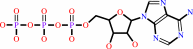 ATP
ATP
|
+
|
H2O
|
=
|
ADP
Bound ligand (Het Group name = )
matches with 81.25% similarity
|
+
|
 phosphate
|
+
|
H(+)
|
|
|
|
|
|
|
|
|
|
|
|
|
Molecule diagrams generated from .mol files obtained from the
KEGG ftp site
|
|
|
|
|
|
|
|
|
|
|
|
|
|
 |
|
|
|
|
|
|
| |
|
|
| |
|
|
Cell
152:276-289
(2013)
|
|
PubMed id:
|
|
|
|
|
|
| |
|
Structural basis for dsRNA recognition, filament formation, and antiviral signal activation by MDA5.
|
|
B.Wu,
A.Peisley,
C.Richards,
H.Yao,
X.Zeng,
C.Lin,
F.Chu,
T.Walz,
S.Hur.
|
|
|
|
|
| |
ABSTRACT
|
|
|
|
| |
|
|
MDA5, a viral double-stranded RNA (dsRNA) receptor, shares sequence similarity
and signaling pathways with RIG-I yet plays essential functions in antiviral
immunity through distinct specificity for viral RNA. Revealing the molecular
basis for the functional divergence, we report here the crystal structure
of MDA5 bound to dsRNA, which shows how, using the same domain architecture,
MDA5 recognizes the internal duplex structure, whereas RIG-I recognizes the
terminus of dsRNA. We further show that MDA5 uses direct protein-protein
contacts to stack along dsRNA in a head-to-tail arrangement, and that the
signaling domain (tandem CARD), which decorates the outside of the core MDA5
filament, also has an intrinsic propensity to oligomerize into an elongated
structure that activates the signaling adaptor, MAVS. These data support a model
in which MDA5 uses long dsRNA as a signaling platform to cooperatively assemble
the core filament, which in turn promotes stochastic assembly of the tandem CARD
oligomers for signaling.
|
|
|
|
|
|
|
|
|
|
|
|
|
|
|
|
|
|
 |
 |
 |
|


 Links
Links


