 |
PDBsum entry 3w3a

|
|
|
|
|
 |
Contents |
 |
|
|
|
|
|
|
|
|
|
|
|


 (+ 0 more)
577 a.a.
(+ 0 more)
577 a.a.
|
|
|
|
|
|
|
|
|
|
|


 (+ 0 more)
457 a.a.
(+ 0 more)
457 a.a.
|
|
|
|
|
|
|
|
|
|
|

 210 a.a.
|
|
|
|
|
|
|
|
|
|
|

 100 a.a.
|
|
|
|
|
|
|
|
|
|
|
|
|
PDB id:
|
|
|
|
| Name: |
|
Hydrolase
|
|
|
Title:
|
|
Crystal structure of v1-atpase at 3.9 angstrom resolution
|
|
Structure:
|
|
V-type atp synthase alpha chain. Chain: a, b, c, i, j, k. Fragment: subunit a. Synonym: v-atpase subunit a. V-type atp synthase beta chain. Chain: d, e, f, l, m, n. Fragment: subunit b. Synonym: v-atpase subunit b. V-type atp synthase subunit d.
|
|
Source:
|
|
Thermus thermophilus. Organism_taxid: 300852. Strain: hb8 / atcc 27634 / dsm 579. Strain: hb8 / atcc 27634 / dsm 579
|
|
Resolution:
|
|
|
3.90Å
|
R-factor:
|
0.328
|
R-free:
|
0.381
|
|
|
Authors:
|
|
Y.Nagamatsu,K.Takeda,T.Kuranaga,N.Numoto,K.Miki
|
|
Key ref:
|
|
Y.Nagamatsu
et al.
(2013).
Origin of asymmetry at the intersubunit interfaces of V1-ATPase from Thermus thermophilus.
J Mol Biol,
425,
2699-2708.
PubMed id:
DOI:
|
|
|
Date:
|
|
|
14-Dec-12
|
Release date:
|
15-May-13
|
|
|
|
|
|
|
PROCHECK
|

|
|
|
|
|
Headers
|
|
|
|
References
|
|
|
|
|
|

|
|
Q56403
(VATA_THET8) -
V-type ATP synthase alpha chain from Thermus thermophilus (strain ATCC 27634 / DSM 579 / HB8)
|
|
|
|
Seq:
Struc:
|
|
|
|
578 a.a.
577 a.a.
|
|

|

|
|
|
|
|
|
|
|
|
|
|
|
|

|
|
Q56404
(VATB_THET8) -
V-type ATP synthase beta chain from Thermus thermophilus (strain ATCC 27634 / DSM 579 / HB8)
|
|
|
|
Seq:
Struc:
|
|
|
|
478 a.a.
457 a.a.
|
|
|

|

|
|
|
|
|
|
|
|
|
|
|
|
|
|
|
|
|
Enzyme class 2:
|
|
Chains A, B, C, I, J, K:
E.C.7.1.2.2
- H(+)-transporting two-sector ATPase.
|
|
|
|
|
|
|
Reaction:
|
|
ATP + H2O + 4 H+(in) = ADP + phosphate + 5 H+(out)
|
|
|
|
|
|
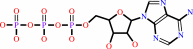 ATP
ATP
|
+
|
H2O
|
+
|
4
×
H(+)(in)
|
=
|
ADP
Bound ligand (Het Group name = )
corresponds exactly
|
+
|
 phosphate
|
+
|
5
×
H(+)(out)
|
|
|
|
|
|
|
|
|
|
Enzyme class 3:
|
|
Chains D, E, F, G, H, L, M, N, O, P:
E.C.3.6.3.14
- Transferred entry: 7.1.2.2.
|
|
|
|
|
|
|
Reaction:
|
|
ATP + H2O + H+(In) = ADP + phosphate + H+(Out)
|
|
|
|
|
|
 ATP
ATP
|
+
|
H(2)O
|
+
|
4
×
H(+)(In)
|
=
|
ADP
Bound ligand (Het Group name = )
corresponds exactly
|
+
|
phosphate
|
+
|
5
×
H(+)(Out)
|
|
|
|
|
|
|
|
|
|
|
|
|
Note, where more than one E.C. class is given (as above), each may
correspond to a different protein domain or, in the case of polyprotein
precursors, to a different mature protein.
|
|
|
|
Molecule diagrams generated from .mol files obtained from the
KEGG ftp site
|
|
|
|
|
|
|
|
|
|
|
|
|
|
 |
|
|
|
|
|
|
| |
|
|
| |
|
DOI no:
|
J Mol Biol
425:2699-2708
(2013)
|
|
PubMed id:
|
|
|
|
|
|
| |
|
Origin of asymmetry at the intersubunit interfaces of V1-ATPase from Thermus thermophilus.
|
|
Y.Nagamatsu,
K.Takeda,
T.Kuranaga,
N.Numoto,
K.Miki.
|
|
|
|
|
| |
ABSTRACT
|
|
|
|
| |
|
|
V-type ATPase (V-ATPase) is one of the rotary ATPase complexes that mediate
energy conversion between the chemical energy of ATP and the ion gradient across
the membrane through a rotary catalytic mechanism. Because V-ATPase has
structural features similar to those of well-studied F-type ATPase, the
structure is expected to highlight the common essence of the torque generation
of rotary ATPases. Here, we report a complete model of the extra-membrane domain
of the V-ATPase (V1-ATPase) of a thermophilic bacterium, Thermus thermophilus,
consisting of three A subunits, three B subunits, one D subunit, and one F
subunit. The X-ray structure at 3.9Å resolution provides detailed information
about the interactions between A3B3 and DF subcomplexes as well as interactions
among the respective subunits, which are defined by the properties of side
chains. Asymmetry at the intersubunit interfaces was detected from the
structural differences among the three AB pairs in the different reaction
states, while the large interdomain motion in the catalytic A subunits was not
observed unlike F1 from various species and V1 from Enterococcus hirae.
Asymmetry is mainly realized by rigid-body rearrangements of the relative
position between A and B subunits. This is consistent with the previous
observations by the high-resolution electron microscopy for the whole V-ATPase
complexes. Therefore, our result plausibly implies that the essential motion for
the torque generation is not the large interdomain movement of the catalytic
subunits but the rigid-body rearrangement of subunits.
|
|
|
|
|
|
|
|
|
|
|
|
|
|
|
|
|
|
 |
 |
 |
| | |


 Links
Links


