 |
PDBsum entry 3vb8

|
|
|
|
|
|

|

|

|

|
|

|
|

|
|

|
|

|
|
|
 |

|

|
|
|
|
|
|
|
|
|
|
|
|
|
|
|
|
|
|
|
|
|
|
|
|
|
|
|
|
|
|
|
|
|
De novo protein
|
PDB id
|
|
|
|
3vb8
|
|
|
|
|
|
|
|
|
|
|
|
|
|
|

|

|

|
|
|
|
|
|
|
PDB id:
|
|
|
|
| Name: |
|
De novo protein
|
|
|
Title:
|
|
Crystal structure of engineered protein, northeast structural genomics consortium target or43
|
|
Structure:
|
|
Engineered protein. Chain: a, b. Engineered: yes
|
|
Source:
|
|
Artificial gene. Organism_taxid: 32630. Expressed in: escherichia coli. Expression_system_taxid: 562
|
|
Resolution:
|
|
|
2.90Å
|
R-factor:
|
0.244
|
R-free:
|
0.290
|
|
|
Authors:
|
|
J.Seetharaman,M.Su,E.Procko,D.Baker,C.Ciccosanti,S.Sahdev,R.Xiao, J.K.Everett,T.B.Acton,G.T.Montelione,J.F.Hunt,L.Tong,Northeast Structural Genomics Consortium (Nesg)
|
|
Key ref:
|
|
E.Procko
et al.
(2013).
Computational design of a protein-based enzyme inhibitor.
J Mol Biol,
425,
3563-3575.
PubMed id:
DOI:
|
|
|
Date:
|
|
|
31-Dec-11
|
Release date:
|
06-Jun-12
|
|
|
|
|
|
|
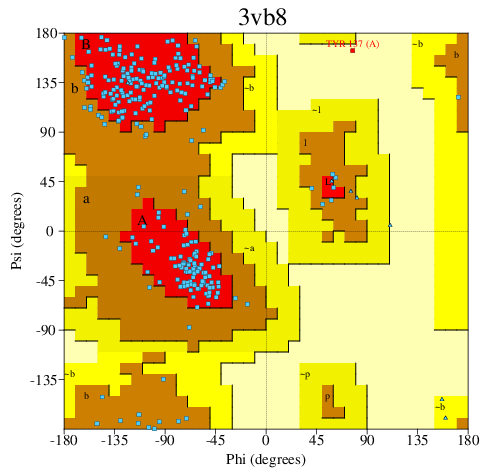
PROCHECK
|
|
|
|
|
|
Headers
|
|
|
|
References
|
|
|
|
|
|

|
|
No UniProt id for this chain
|
|
|
|
|
|
|
|
|
|
|
|
|
|
|
Key: |
|
 |
Secondary structure |
|
 |
CATH domain |
|
|
|
|
|
|
|
|
|
|
|
|
|
|
|
|
|
 |
|
|
|
|
|
|
| |
|
DOI no:
|
J Mol Biol
425:3563-3575
(2013)
|
|
PubMed id:
|
|
|
|
|
|
| |
|
Computational design of a protein-based enzyme inhibitor.
|
|
E.Procko,
R.Hedman,
K.Hamilton,
J.Seetharaman,
S.J.Fleishman,
M.Su,
J.Aramini,
G.Kornhaber,
J.F.Hunt,
L.Tong,
G.T.Montelione,
D.Baker.
|
|
|
|
|
| |
ABSTRACT
|
|
|
|
| |
|
|
While there has been considerable progress in designing protein-protein
interactions, the design of proteins that bind polar surfaces is an unmet
challenge. We describe the computational design of a protein that binds the
acidic active site of hen egg lysozyme and inhibits the enzyme. The design
process starts with two polar amino acids that fit deep into the enzyme active
site, identifies a protein scaffold that supports these residues and is
complementary in shape to the lysozyme active-site region, and finally optimizes
the surrounding contact surface for high-affinity binding. Following affinity
maturation, a protein designed using this method bound lysozyme with low
nanomolar affinity, and a combination of NMR studies, crystallography, and
knockout mutagenesis confirmed the designed binding surface and orientation.
Saturation mutagenesis with selection and deep sequencing demonstrated that
specific designed interactions extending well beyond the centrally grafted polar
residues are critical for high-affinity binding.
|
|
|
|
|
|
|
|
|
|
|
|
|
|
|
|
|
|
 |
 |
 |
|


 Links
Links


