|
PDBsum entry 3og7

|
|
|
|
|
|

|

|

|

|
|

|
|

|
|

|
|

|
|

|
|
|
 |

|

|
|
|
|
|
|
|
|
|
|
|
|
|
|
|
|
|
|
|
|
|
|
|
|
|
|
|
|
|
|
|
|
|
|
Transferase/transferase inhibitor
|
PDB id
|
|
|
|
3og7
|
|
|
|
|
|
|
|
|
|
|
|
|
|
|

|

|

|
|
|
|
|
|
|
|
 |
Contents |
 |
|
|
|
|
|
|
|
|
|
|
|
|
* Residue conservation analysis
|
|
|
|
|
|
|
|
|
|
|
Enzyme class:
|
|
E.C.2.7.11.1
- non-specific serine/threonine protein kinase.
|
|
|
|
|
|
|
Reaction:
|
|
|
1.
|
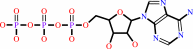
L-seryl-[protein] + ATP = O-phospho-L-seryl-[protein] + ADP + H+
|
|
2.
|
L-threonyl-[protein] + ATP = O-phospho-L-threonyl-[protein] + ADP + H+
|
|
|
|
|
|
|
L-seryl-[protein]
|
+
|
 ATP
ATP
|
=
|
O-phospho-L-seryl-[protein]
|
+
|
 ADP
ADP
|
+
|
H(+)
|
|
|
|
|
|
|
L-threonyl-[protein]
|
+
|
ATP
|
=
|
O-phospho-L-threonyl-[protein]
|
+
|
ADP
|
+
|
H(+)
|
|
|
|
|
|
|
|
|
|
|
|
|
Molecule diagrams generated from .mol files obtained from the
KEGG ftp site
|
|
|
|
|
|
|
|
|
|
|
|
|
|
 |
|
|
|
|
|
|
| |
|
|
| |
|
|
Nature
467:596-599
(2010)
|
|
PubMed id:
|
|
|
|
|
|
| |
|
Clinical efficacy of a RAF inhibitor needs broad target blockade in BRAF-mutant melanoma.
|
|
G.Bollag,
P.Hirth,
J.Tsai,
J.Zhang,
P.N.Ibrahim,
H.Cho,
W.Spevak,
C.Zhang,
Y.Zhang,
G.Habets,
E.A.Burton,
B.Wong,
G.Tsang,
B.L.West,
B.Powell,
R.Shellooe,
A.Marimuthu,
H.Nguyen,
K.Y.Zhang,
D.R.Artis,
J.Schlessinger,
F.Su,
B.Higgins,
R.Iyer,
K.D'Andrea,
A.Koehler,
M.Stumm,
P.S.Lin,
R.J.Lee,
J.Grippo,
I.Puzanov,
K.B.Kim,
A.Ribas,
G.A.McArthur,
J.A.Sosman,
P.B.Chapman,
K.T.Flaherty,
X.Xu,
K.L.Nathanson,
K.Nolop.
|
|
|
|
|
| |
ABSTRACT
|
|
|
|
| |
|
|
B-RAF is the most frequently mutated protein kinase in human cancers. The
finding that oncogenic mutations in BRAF are common in melanoma, followed by the
demonstration that these tumours are dependent on the RAF/MEK/ERK pathway,
offered hope that inhibition of B-RAF kinase activity could benefit melanoma
patients. Herein, we describe the structure-guided discovery of PLX4032
(RG7204), a potent inhibitor of oncogenic B-RAF kinase activity. Preclinical
experiments demonstrated that PLX4032 selectively blocked the RAF/MEK/ERK
pathway in BRAF mutant cells and caused regression of BRAF mutant xenografts.
Toxicology studies confirmed a wide safety margin consistent with the high
degree of selectivity, enabling Phase 1 clinical trials using a crystalline
formulation of PLX4032 (ref. 5). In a subset of melanoma patients, pathway
inhibition was monitored in paired biopsy specimens collected before treatment
initiation and following two weeks of treatment. This analysis revealed
substantial inhibition of ERK phosphorylation, yet clinical evaluation did not
show tumour regressions. At higher drug exposures afforded by a new amorphous
drug formulation, greater than 80% inhibition of ERK phosphorylation in the
tumours of patients correlated with clinical response. Indeed, the Phase 1
clinical data revealed a remarkably high 81% response rate in metastatic
melanoma patients treated at an oral dose of 960 mg twice daily. These data
demonstrate that BRAF-mutant melanomas are highly dependent on B-RAF kinase
activity.
|
|
|
|
|
|
|
|
|
|
|
|
|
|
|
|
|
|
 |
 |
 |
|
Literature references that cite this PDB file's key reference
|
|
|
| |
PubMed id
|
|
Reference
|
|
|
|
|
|
D.W.McMillin,
J.M.Negri,
and
C.S.Mitsiades
(2013).
The role of tumour-stromal interactions in modifying drug response: challenges and opportunities.
|
| |
Nat Rev Drug Discov,
12,
217-228.
|
|
|
|
|
|
|
J.Rodon,
R.Dienstmann,
V.Serra,
and
J.Tabernero
(2013).
Development of PI3K inhibitors: lessons learned from early clinical trials.
|
| |
Nat Rev Clin Oncol,
10,
143-153.
|
|
|
|
|
|
|
M.Das Thakur,
F.Salangsang,
A.S.Landman,
W.R.Sellers,
N.K.Pryer,
M.P.Levesque,
R.Dummer,
M.McMahon,
and
D.D.Stuart
(2013).
Modelling vemurafenib resistance in melanoma reveals a strategy to forestall drug resistance.
|
| |
Nature,
494,
251-255.
|
|
|
|
|
|
|
S.Yao,
Y.Zhu,
and
L.Chen
(2013).
Advances in targeting cell surface signalling molecules for immune modulation.
|
| |
Nat Rev Drug Discov,
12,
130-146.
|
|
|
|
|
|
|
E.L.Carpenter,
and
Y.P.Mossé
(2012).
Targeting ALK in neuroblastoma--preclinical and clinical advancements.
|
| |
Nat Rev Clin Oncol,
9,
391-399.
|
|
|
|
|
|
|
G.Bollag,
J.Tsai,
J.Zhang,
C.Zhang,
P.Ibrahim,
K.Nolop,
and
P.Hirth
(2012).
Vemurafenib: the first drug approved for BRAF-mutant cancer.
|
| |
Nat Rev Drug Discov,
11,
873-886.
|
|
|
|
|
|
|
M.Krauthammer,
Y.Kong,
B.H.Ha,
P.Evans,
A.Bacchiocchi,
J.P.McCusker,
E.Cheng,
M.J.Davis,
G.Goh,
M.Choi,
S.Ariyan,
D.Narayan,
K.Dutton-Regester,
A.Capatana,
E.C.Holman,
M.Bosenberg,
M.Sznol,
H.M.Kluger,
D.E.Brash,
D.F.Stern,
M.A.Materin,
R.S.Lo,
S.Mane,
S.Ma,
K.K.Kidd,
N.K.Hayward,
R.P.Lifton,
J.Schlessinger,
T.J.Boggon,
and
R.Halaban
(2012).
Exome sequencing identifies recurrent somatic RAC1 mutations in melanoma.
|
| |
Nat Genet,
44,
1006-1014.
|
|
|
PDB codes:
|
|
|
|
|
|
|
|
M.Martini,
L.Vecchione,
S.Siena,
S.Tejpar,
and
A.Bardelli
(2012).
Targeted therapies: how personal should we go?
|
| |
Nat Rev Clin Oncol,
9,
87-97.
|
|
|
|
|
|
|
R.Straussman,
T.Morikawa,
K.Shee,
M.Barzily-Rokni,
Z.R.Qian,
J.Du,
A.Davis,
M.M.Mongare,
J.Gould,
D.T.Frederick,
Z.A.Cooper,
P.B.Chapman,
D.B.Solit,
A.Ribas,
R.S.Lo,
K.T.Flaherty,
S.Ogino,
J.A.Wargo,
and
T.R.Golub
(2012).
Tumour micro-environment elicits innate resistance to RAF inhibitors through HGF secretion.
|
| |
Nature,
487,
500-504.
|
|
|
|
|
|
|
A.J.Cameron
(2011).
Occupational hazards: allosteric regulation of protein kinases through the nucleotide-binding pocket.
|
| |
Biochem Soc Trans,
39,
472-476.
|
|
|
|
|
|
|
A.Ribas,
and
K.T.Flaherty
(2011).
BRAF targeted therapy changes the treatment paradigm in melanoma.
|
| |
Nat Rev Clin Oncol,
8,
426-433.
|
|
|
|
|
|
|
B.D.Gelb,
and
M.Tartaglia
(2011).
RAS signaling pathway mutations and hypertrophic cardiomyopathy: getting into and out of the thick of it.
|
| |
J Clin Invest,
121,
844-847.
|
|
|
|
|
|
|
B.S.Taylor,
J.Barretina,
R.G.Maki,
C.R.Antonescu,
S.Singer,
and
M.Ladanyi
(2011).
Advances in sarcoma genomics and new therapeutic targets.
|
| |
Nat Rev Cancer,
11,
541-557.
|
|
|
|
|
|
|
B.S.Taylor,
and
M.Ladanyi
(2011).
Clinical cancer genomics: how soon is now?
|
| |
J Pathol,
223,
318-326.
|
|
|
|
|
|
|
C.Robert,
J.P.Arnault,
and
C.Mateus
(2011).
RAF inhibition and induction of cutaneous squamous cell carcinoma.
|
| |
Curr Opin Oncol,
23,
177-182.
|
|
|
|
|
|
|
D.Dias-Santagata,
Q.Lam,
K.Vernovsky,
N.Vena,
J.K.Lennerz,
D.R.Borger,
T.T.Batchelor,
K.L.Ligon,
A.J.Iafrate,
A.H.Ligon,
D.N.Louis,
and
S.Santagata
(2011).
BRAF V600E mutations are common in pleomorphic xanthoastrocytoma: diagnostic and therapeutic implications.
|
| |
PLoS One,
6,
e17948.
|
|
|
|
|
|
|
D.H.Roukos
(2011).
PLX4032 and melanoma: resistance, expectations and uncertainty.
|
| |
Expert Rev Anticancer Ther,
11,
325-328.
|
|
|
|
|
|
|
E.Vakiani,
and
D.B.Solit
(2011).
KRAS and BRAF: drug targets and predictive biomarkers.
|
| |
J Pathol,
223,
219-229.
|
|
|
|
|
|
|
F.Kern,
T.Niault,
and
M.Baccarini
(2011).
Ras and Raf pathways in epidermis development and carcinogenesis.
|
| |
Br J Cancer,
104,
229-234.
|
|
|
|
|
|
|
G.Caponigro,
and
W.R.Sellers
(2011).
Advances in the preclinical testing of cancer therapeutic hypotheses.
|
| |
Nat Rev Drug Discov,
10,
179-187.
|
|
|
|
|
|
|
I.J.Majewski,
and
R.Bernards
(2011).
Taming the dragon: genomic biomarkers to individualize the treatment of cancer.
|
| |
Nat Med,
17,
304-312.
|
|
|
|
|
|
|
I.Puzanov,
P.Burnett,
and
K.T.Flaherty
(2011).
Biological challenges of BRAF inhibitor therapy.
|
| |
Mol Oncol,
5,
116-123.
|
|
|
|
|
|
|
J.Urosevic,
V.Sauzeau,
M.L.Soto-Montenegro,
S.Reig,
M.Desco,
E.M.Wright,
M.Cañamero,
F.Mulero,
S.Ortega,
X.R.Bustelo,
and
M.Barbacid
(2011).
Constitutive activation of B-Raf in the mouse germ line provides a model for human cardio-facio-cutaneous syndrome.
|
| |
Proc Natl Acad Sci U S A,
108,
5015-5020.
|
|
|
|
|
|
|
K.T.Flaherty,
U.Yasothan,
and
P.Kirkpatrick
(2011).
Vemurafenib.
|
| |
Nat Rev Drug Discov,
10,
811-812.
|
|
|
|
|
|
|
M.Allison
(2011).
Can cancer clinical trials be fixed?
|
| |
Nat Biotechnol,
29,
13-15.
|
|
|
|
|
|
|
M.McMahon
(2011).
Parsing out the complexity of RAF inhibitor resistance.
|
| |
Pigment Cell Melanoma Res,
24,
361-365.
|
|
|
|
|
|
|
M.Sznol
(2011).
Molecular markers of response to treatment for melanoma.
|
| |
Cancer J,
17,
127-133.
|
|
|
|
|
|
|
N.Sethi,
and
Y.Kang
(2011).
Unravelling the complexity of metastasis - molecular understanding and targeted therapies.
|
| |
Nat Rev Cancer,
11,
735-748.
|
|
|
|
|
|
|
P.I.Poulikakos,
Y.Persaud,
M.Janakiraman,
X.Kong,
C.Ng,
G.Moriceau,
H.Shi,
M.Atefi,
B.Titz,
M.T.Gabay,
M.Salton,
K.B.Dahlman,
M.Tadi,
J.A.Wargo,
K.T.Flaherty,
M.C.Kelley,
T.Misteli,
P.B.Chapman,
J.A.Sosman,
T.G.Graeber,
A.Ribas,
R.S.Lo,
N.Rosen,
and
D.B.Solit
(2011).
RAF inhibitor resistance is mediated by dimerization of aberrantly spliced BRAF(V600E).
|
| |
Nature,
480,
387-390.
|
|
|
|
|
|
|
S.E.Kern,
C.Shi,
and
R.H.Hruban
(2011).
The complexity of pancreatic ductal cancers and multidimensional strategies for therapeutic targeting.
|
| |
J Pathol,
223,
295-306.
|
|
|
|
|
|
|
Y.Asaoka,
T.Ikenoue,
and
K.Koike
(2011).
New targeted therapies for gastric cancer.
|
| |
Expert Opin Investig Drugs,
20,
595-604.
|
|
|
|
|
|
|
A.Flemming
(2010).
Cancer: Targeting mutant BRAF in metastatic melanoma.
|
| |
Nat Rev Drug Discov,
9,
841.
|
|
|
|
|
|
|
D.Solit,
and
C.L.Sawyers
(2010).
Drug discovery: How melanomas bypass new therapy.
|
| |
Nature,
468,
902-903.
|
|
|
|
|
|
|
D.Solit,
and
N.Rosen
(2010).
Oncogenic RAF: a brief history of time.
|
| |
Pigment Cell Melanoma Res,
23,
760-762.
|
|
|
|
|
|
|
J.Hall,
P.Dennler,
S.Haller,
A.Pratsinis,
K.Säuberli,
H.Towbin,
K.Walthe,
and
J.Woytschak
(2010).
Genomics drugs in clinical trials.
|
| |
Nat Rev Drug Discov,
9,
988.
|
|
|
|
|
|
|
R.Nazarian,
H.Shi,
Q.Wang,
X.Kong,
R.C.Koya,
H.Lee,
Z.Chen,
M.K.Lee,
N.Attar,
H.Sazegar,
T.Chodon,
S.F.Nelson,
G.McArthur,
J.A.Sosman,
A.Ribas,
and
R.S.Lo
(2010).
Melanomas acquire resistance to B-RAF(V600E) inhibition by RTK or N-RAS upregulation.
|
| |
Nature,
468,
973-977.
|
|
|
|
|
|
|
S.Jones
(2010).
Bad seeds, bad science, and fairly black cats?
|
| |
Lancet,
376,
1384-1385.
|
|
|
|
|
|
The most recent references are shown first.
Citation data come partly from CiteXplore and partly
from an automated harvesting procedure. Note that this is likely to be
only a partial list as not all journals are covered by
either method. However, we are continually building up the citation data
so more and more references will be included with time.
Where a reference describes a PDB structure, the PDB
codes are
shown on the right.
|
|


 Links
Links