 |
PDBsum entry 3mss

|
|
|
|
|
|

|

|

|

|
|

|
|

|
|

|
|

|
|

|
|

|
|
|
 |

|

|
|
|
|
|
|
|
|
|
|
|
|
|
|
|
|
|
|
|
|
|
|
|
|
|
|
|
|
|
|
|
|
|
|
|
Transferase/transferase inhibitor
|
PDB id
|
|
|
|
3mss
|
|
|
|
|
|
|
|
|
|
|
|
|
|
|

|

|

|
|
|
|
|
|
|
|
 |
Contents |
 |
|
|
|
|
|
|
|
|
|
|
|
|
* Residue conservation analysis
|
|
|
|
|
|
PDB id:
|
|
|
|
| Name: |
|
Transferase/transferase inhibitor
|
|
|
Title:
|
|
Abl kinase in complex with imatinib and fragment (frag2) in the myristate site
|
|
Structure:
|
|
Tyrosine-protein kinase abl1. Chain: a, b, c, d. Fragment: kinase domain, residues 229-515. Synonym: abelson murine leukemia viral oncogene homolog 1, proto- oncogenE C-abl, p150. Engineered: yes
|
|
Source:
|
|
Mus musculus. Mouse. Organism_taxid: 10090. Expressed in: spodoptera frugiperda. Expression_system_taxid: 7108
|
|
Resolution:
|
|
|
1.95Å
|
R-factor:
|
0.172
|
R-free:
|
0.220
|
|
|
Authors:
|
|
S.W.Cowan-Jacob,G.Rummel,G.Fendrich
|
|
Key ref:
|
|
W.Jahnke
et al.
(2010).
Binding or bending: distinction of allosteric Abl kinase agonists from antagonists by an NMR-based conformational assay.
J Am Chem Soc,
132,
7043-7048.
PubMed id:
|
|
|
Date:
|
|
|
29-Apr-10
|
Release date:
|
26-May-10
|
|
|
|
|
|
|
PROCHECK
|

|
|
|
|
|
Headers
|
|
|
|
References
|
|
|
|
|
|

|
|
P00520
(ABL1_MOUSE) -
Tyrosine-protein kinase ABL1 from Mus musculus
|
|
|
|
Seq:
Struc:
|
|
|
|
1123 a.a.
264 a.a.*
|
|

|

|
|
|
|
|
|
|
|
|
|
|
|
Key: |
 |
PfamA domain |
|
|
 |
Secondary structure |
|
 |
CATH domain |
|
|
*
PDB and UniProt seqs differ
at 3 residue positions (black
crosses)
|
|
|
|
|
|
|
|
|
|
|
|
|
Enzyme class:
|
|
E.C.2.7.10.2
- non-specific protein-tyrosine kinase.
|
|
|
|
|
|
|
Reaction:
|
|
L-tyrosyl-[protein] + ATP = O-phospho-L-tyrosyl-[protein] + ADP + H+
|
|
|
|
|
|
L-tyrosyl-[protein]
|
+
|
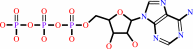 ATP
ATP
|
=
|
O-phospho-L-tyrosyl-[protein]
|
+
|
 ADP
ADP
|
+
|
H(+)
|
|
|
|
|
|
|
|
|
|
|
|
|
Molecule diagrams generated from .mol files obtained from the
KEGG ftp site
|
|
|
|
|
|
|
|
|
|
|
|
|
|
 |
|
|
|
|
|
|
| |
|
|
| |
|
|
J Am Chem Soc
132:7043-7048
(2010)
|
|
PubMed id:
|
|
|
|
|
|
| |
|
Binding or bending: distinction of allosteric Abl kinase agonists from antagonists by an NMR-based conformational assay.
|
|
W.Jahnke,
R.M.Grotzfeld,
X.Pellé,
A.Strauss,
G.Fendrich,
S.W.Cowan-Jacob,
S.Cotesta,
D.Fabbro,
P.Furet,
J.Mestan,
A.L.Marzinzik.
|
|
|
|
|
| |
ABSTRACT
|
|
|
|
| |
|
|
Allosteric inhibitors of Bcr-Abl have emerged as a novel therapeutic option for
the treatment of CML. Using fragment-based screening, a search for novel Abl
inhibitors that bind to the myristate pocket was carried out. Here we show that
not all myristate ligands are functional inhibitors, but that the conformational
state of C-terminal helix_I is a structural determinant for functional activity.
We present an NMR-based conformational assay to monitor the conformation of this
crucial helix_I and show that myristate ligands that bend helix_I are functional
antagonists, whereas ligands that bind to the myristate pocket but do not induce
this conformational change are kinase agonists. Activation of c-Abl by
allosteric agonists has been confirmed in a biochemical assay.
|
|
|
|
|
|
|
|
|
|
|
|
|
|
|
|
|
|
 |
 |
 |
|
Literature references that cite this PDB file's key reference
|
|
|
| |
PubMed id
|
|
Reference
|
|
|
|
|
|
W.Yin,
Z.Wang,
Y.Liang,
and
Z.W.Yang
(2012).
(E)-(2-Chloro-benzyl-idene)amino 2-amino-4-chloro-benzoate.
|
| |
Acta Crystallogr Sect E Struct Rep Online,
68,
o770.
|
|
|
|
|
|
|
J.Yang,
N.Campobasso,
M.P.Biju,
K.Fisher,
X.Q.Pan,
J.Cottom,
S.Galbraith,
T.Ho,
H.Zhang,
X.Hong,
P.Ward,
G.Hofmann,
B.Siegfried,
F.Zappacosta,
Y.Washio,
P.Cao,
J.Qu,
S.Bertrand,
D.Y.Wang,
M.S.Head,
H.Li,
S.Moores,
Z.Lai,
K.Johanson,
G.Burton,
C.Erickson-Miller,
G.Simpson,
P.Tummino,
R.A.Copeland,
and
A.Oliff
(2011).
Discovery and characterization of a cell-permeable, small-molecule c-Abl kinase activator that binds to the myristoyl binding site.
|
| |
Chem Biol,
18,
177-186.
|
|
|
PDB code:
|
|
|
|
|
|
|
The most recent references are shown first.
Citation data come partly from CiteXplore and partly
from an automated harvesting procedure. Note that this is likely to be
only a partial list as not all journals are covered by
either method. However, we are continually building up the citation data
so more and more references will be included with time.
Where a reference describes a PDB structure, the PDB
code is
shown on the right.
|
|


 Links
Links


