 |
PDBsum entry 3mjh

|
|
|
|
|
|

|

|

|

|
|

|
|

|
|

|
|

|
|

|
|

|
|

|
|
|
 |

|

|
|
|
|
|
|
|
|
|
|
|
|
|
|
|
|
|
|
|
|
|
|
|
|
|
|
|
|
|
|
|
|
|
|
|
|
Protein transport
|
PDB id
|
|
|
|
3mjh
|
|
|
|
|
|
|
|
|
|
|
|
|
|
|

|

|

|
|
|
|
|
|
|
|
 |
Contents |
 |
|
|
|
|
|
|
|
|
|
|
|
|
|
|
* Residue conservation analysis
|
|
|
|
|
|
PDB id:
|
|
|
|
| Name: |
|
Protein transport
|
|
|
Title:
|
|
Crystal structure of human rab5a in complex with the c2h2 zinc finger of eea1
|
|
Structure:
|
|
Ras-related protein rab-5a. Chain: a, c. Fragment: residues 16-183. Engineered: yes. Early endosome antigen 1. Chain: b, d. Fragment: c2h2-type, residues 36-69. Synonym: endosome-associated protein p162, zinc finger fyve domain- containing protein 2.
|
|
Source:
|
|
Homo sapiens. Human. Organism_taxid: 9606. Gene: rab5, rab5a. Expressed in: escherichia coli. Expression_system_taxid: 562. Gene: early endosomal antigen1(eea1), eea1, zfyve2.
|
|
Resolution:
|
|
|
2.03Å
|
R-factor:
|
0.196
|
R-free:
|
0.260
|
|
|
Authors:
|
|
A.K.Mishra,S.Eathiraj,D.G.Lambright
|
|
Key ref:
|
|
A.Mishra
et al.
(2010).
Structural basis for Rab GTPase recognition and endosome tethering by the C2H2 zinc finger of Early Endosomal Autoantigen 1 (EEA1).
Proc Natl Acad Sci U S A,
107,
10866-10871.
PubMed id:
|
|
|
Date:
|
|
|
12-Apr-10
|
Release date:
|
05-May-10
|
|
|
|
|
|
|
PROCHECK
|

|
|
|
|
|
Headers
|
|
|
|
References
|
|
|
|
|
|

|
|
P20339
(RAB5A_HUMAN) -
Ras-related protein Rab-5A from Homo sapiens
|
|
|
|
Seq:
Struc:
|
|
|
|
215 a.a.
168 a.a.*
|
|

|

|
|
|
|
|
|
|
|
|
|
|
|
|
|
|
|
|
|
Enzyme class 1:
|
|
Chains A, C:
E.C.3.6.5.2
- small monomeric GTPase.
|
|
|
|
|
|
|
Reaction:
|
|
GTP + H2O = GDP + phosphate + H+
|
|
|
|
|
|
GTP
Bound ligand (Het Group name = )
corresponds exactly
|
+
|
H2O
|
=
|
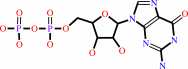 GDP
GDP
|
+
|
 phosphate
|
+
|
H(+)
|
|
|
|
|
|
|
|
|
|
Enzyme class 2:
|
|
Chains B, D:
E.C.?
|
|
|
|
|
|
|
|
|
|
Note, where more than one E.C. class is given (as above), each may
correspond to a different protein domain or, in the case of polyprotein
precursors, to a different mature protein.
|
|
|
|
Molecule diagrams generated from .mol files obtained from the
KEGG ftp site
|
|
|
|
|
|
|
|
|
|
|
|
|
|
 |
|
|
|
|
|
|
| |
|
|
| |
|
|
Proc Natl Acad Sci U S A
107:10866-10871
(2010)
|
|
PubMed id:
|
|
|
|
|
|
| |
|
Structural basis for Rab GTPase recognition and endosome tethering by the C2H2 zinc finger of Early Endosomal Autoantigen 1 (EEA1).
|
|
A.Mishra,
S.Eathiraj,
S.Corvera,
D.G.Lambright.
|
|
|
|
|
| |
ABSTRACT
|
|
|
|
| |
|
|
Regulation of endosomal trafficking by Rab GTPases depends on selective
interactions with multivalent effectors, including EEA1 and Rabenosyn-5, which
facilitate endosome tethering, sorting, and fusion. Both EEA1 and Rabenosyn-5
contain a distinctive N-terminal C(2)H(2) zinc finger that binds Rab5. How these
C(2)H(2) zinc fingers recognize Rab GTPases remains unknown. Here, we report the
crystal structure of Rab5A in complex with the EEA1 C(2)H(2) zinc finger. The
binding interface involves all elements of the zinc finger as well as a short
N-terminal extension but is restricted to the switch and interswitch regions of
Rab5. High selectivity for Rab5 and, to a lesser extent Rab22, is observed in
quantitative profiles of binding to Rab family GTPases. Although critical
determinants are identified in both switch regions, Rab4-to-Rab5
conversion-of-specificity mutants reveal an essential requirement for additional
substitutions in the proximal protein core that are predicted to indirectly
influence recognition through affects on the structure and conformational
stability of the switch regions.
|
|
|
|
|
|
|
|
|
|
|
|
|
|
|
|
|
|
 |
 |
 |
|
Literature references that cite this PDB file's key reference
|
|
|
| |
PubMed id
|
|
Reference
|
|
|
|
|
|
X.Hou,
N.Hagemann,
S.Schoebel,
W.Blankenfeldt,
R.S.Goody,
K.S.Erdmann,
and
A.Itzen
(2011).
A structural basis for Lowe syndrome caused by mutations in the Rab-binding domain of OCRL1.
|
| |
EMBO J,
30,
1659-1670.
|
|
|
PDB code:
|
|
|
|
|
|
|
The most recent references are shown first.
Citation data come partly from CiteXplore and partly
from an automated harvesting procedure. Note that this is likely to be
only a partial list as not all journals are covered by
either method. However, we are continually building up the citation data
so more and more references will be included with time.
Where a reference describes a PDB structure, the PDB
code is
shown on the right.
|
|
| |


 Links
Links


