 |
PDBsum entry 3kwc

|
|
|
|
|
|

|

|

|

|
|

|
|

|
|

|
|

|
|

|
|

|
|
|
 |

|

|
|
|
|
|
|
|
|
|
|
|
|
|
|
|
|
|
|
|
|
|
|
|
|
|
|
|
|
|
|
|
|
|
|
|
Lyase, protein binding, photosynthesis
|
PDB id
|
|
|
|
3kwc
|
|
|
|
|
|
|
|
|
|
|
|
|
|
|

|

|

|
|
|
|
|
|
|
|
 |
Contents |
 |
|
|
|
|
|
|
|
|
|
|
|
|
|
|
* Residue conservation analysis
|
|
|
|
|
|
PDB id:
|
|
|
|
| Name: |
|
Lyase, protein binding, photosynthesis
|
|
|
Title:
|
|
Oxidized, active structure of the beta-carboxysomal gamma-carbonic anhydrase, ccmm
|
|
Structure:
|
|
Carbon dioxide concentrating mechanism protein. Chain: a, b, c, d, e, f. Fragment: n-terminal, gamma-carbonic anhydrase domain (unp residues 1-209). Engineered: yes
|
|
Source:
|
|
Thermosynechococcus elongatus. Organism_taxid: 197221. Strain: bp-1. Gene: ccmm, tll0944. Expressed in: escherichia coli. Expression_system_taxid: 562.
|
|
Resolution:
|
|
|
2.00Å
|
R-factor:
|
0.202
|
R-free:
|
0.247
|
|
|
Authors:
|
|
M.S.Kimber,S.E.Castel,K.L.Pena
|
Key ref:

|
|
K.L.Peña
et al.
(2010).
Structural basis of the oxidative activation of the carboxysomal gamma-carbonic anhydrase, CcmM.
Proc Natl Acad Sci U S A,
107,
2455-2460.
PubMed id:
DOI:

|
|
|
Date:
|
|
|
01-Dec-09
|
Release date:
|
23-Feb-10
|
|
|
|
|
|
|
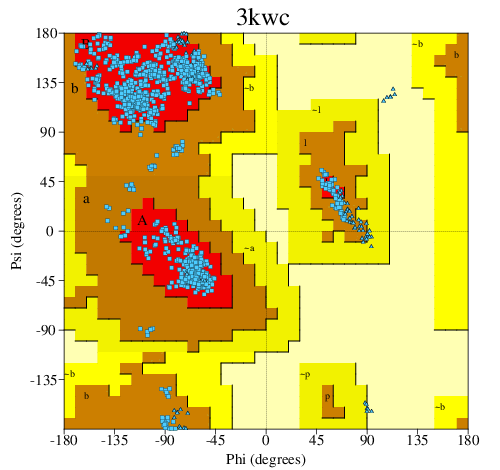
PROCHECK
|
|
|
|
|
|
Headers
|
|
|
|
References
|
|
|
|
|
|

|
|
Q8DKB5
(Q8DKB5_THEEB) -
Carboxysome assembly protein CcmM from Thermosynechococcus vestitus (strain NIES-2133 / IAM M-273 / BP-1)
|
|
|
|
Seq:
Struc:
|
|
|
|
652 a.a.
205 a.a.
|
|

|

|
|
|
|
|
|
|
|
|
|
|
|
Key: |
 |
PfamA domain |
|
|
 |
Secondary structure |
|
 |
CATH domain |
|
|
|
|
|
|
|
|
|
|
|
|
|
Enzyme class:
|
|
E.C.4.2.1.1
- carbonic anhydrase.
|
|
|
|
|
|
|
Reaction:
|
|
hydrogencarbonate + H+ = CO2 + H2O
|
|
|
|
|
|
 hydrogencarbonate
|
+
|
H(+)
|
=
|
CO2
Bound ligand (Het Group name = )
matches with 40.00% similarity
|
+
|
H2O
|
|
|
|
|
|
|
|
|
|
Cofactor:
|
|
Zn(2+)
|
|
|
|
|
|
|
|
|
Molecule diagrams generated from .mol files obtained from the
KEGG ftp site
|
|
|
|
|
|
|
|
|
|
|
|
|
|
 |
|
|
|
|
|
|
| |
|
|
| |
|
DOI no:
|
Proc Natl Acad Sci U S A
107:2455-2460
(2010)
|
|
PubMed id:
|
|
|
|
|
|
| |
|
Structural basis of the oxidative activation of the carboxysomal gamma-carbonic anhydrase, CcmM.
|
|
K.L.Peña,
S.E.Castel,
C.de Araujo,
G.S.Espie,
M.S.Kimber.
|
|
|
|
|
| |
ABSTRACT
|
|
|
|
| |
|
|
Cyanobacterial RuBisCO is sequestered in large, icosahedral, protein-bounded
microcompartments called carboxysomes. Bicarbonate is pumped into the cytosol,
diffuses into the carboxysome through small pores in its shell, and is then
converted to CO(2) by carbonic anhydrase (CA) prior to fixation. Paradoxically,
many beta-cyanobacteria, including Thermosynechococcus elongatus BP-1, lack the
conventional carboxysomal beta-CA, ccaA. The N-terminal domain of the
carboxysomal protein CcmM is homologous to gamma-CA from Methanosarcina
thermophila (Cam) but recombinant CcmM derived from ccaA-containing
cyanobacteria show no CA activity. We demonstrate here that either full length
CcmM from T. elongatus, or a construct truncated after 209 residues (CcmM209),
is active as a CA-the first catalytically active bacterial gamma-CA reported.
The 2.0 A structure of CcmM209 reveals a trimeric, left-handed beta-helix
structure that closely resembles Cam, except that residues 198-207 form a third
alpha-helix stabilized by an essential Cys194-Cys200 disulfide bond. Deleting
residues 194-209 (CcmM193) results in an inactive protein whose 1.1 A structure
shows disordering of the N- and C-termini, and reorganization of the trimeric
interface and active site. Under reducing conditions, CcmM209 is similarly
partially disordered and inactive as a CA. CcmM protein in fresh E. coli cell
extracts is inactive, implying that the cellular reducing machinery can reduce
and inactivate CcmM, while diamide, a thiol oxidizing agent, activates the
enzyme. Thus, like membrane-bound eukaryotic cellular compartments, the
beta-carboxysome appears to be able to maintain an oxidizing interior by
precluding the entry of thioredoxin and other endogenous reducing agents.
|
|
|
|
|
|
| |
Selected figure(s)
|
|
|
|
| |
|
|

|
|

|
|
Figure 2.
The structure of CcmM (A) Structure of the CcmM209 monomer,
with secondary structure labeled. (B) CcmM209 trimer viewed down
the 3-fold axis. The zinc binding histidine residues, as well as
R121 (which binds a structural chloride ion), are shown in
sticks. The zinc ion is shown as a pink sphere. (C) The CcmM209
trimer viewed orthogonal to the 3-fold axis. Individual monomers
are arranged with the β-helical axis parallel to one another,
while αC interacts with the adjacent protomer. (D) Details of
the inset area, with σA weighted 2mF[o]-DF[c] electron density
contoured at 1.0σ (blue) shown for residues E171–L208 of
chain A (orange sticks), and for residues P9– L17 of chain B
(yellow sticks). Electron density in this region is well
defined, with temperature factors comparable to elsewhere in the
structure. Density is also contoured at 3.0σ (green surface)
for C194 and C200, showing the density associated with the
sulfur atoms participating in the disulfide bond. For
comparison, V182 is the last residue ordered in the CcmM193
structure. (E) Superposition of apo zinc Cam (1qrg; white and
yellow) on CcmM209 (blue, αC in orange). Aside from the
highlighted localized differences, the two structures are
overall very similar. (F) Ribbon diagram of CcmM193 (white)
superimposed on CcmM209 (blue) demonstrating that structural
differences are localized, but substantial. Residues 4–16
(orange in CcmM209) are disordered in the CcmM193 structure. Of
residues 172–208, which in CcmM209 comprise αB and αC
(brown), only residues 172–182 are partially ordered in the
CcmM193 structure (red), and these residues are displaced from
the position seen in CcmM209. (G) Inset showing electron density
for the CcmM193 structure. Density is contoured at 1σ (light
blue) and 4σ (dark blue). The electron density for αB is
considerably less defined than for the rest of the structure.
(H) The oligomeric organization differs between CcmM209 (blue)
and CcmM193 (white) structures. The structures were superimposed
with reference to the protomer on the right only. The motion the
CcmM193 and CcmM209 structures can be described as the rotation
of each protomer approximately 6° away from the 3-fold axis,
with the fulcrum located near R121. (I) Details of the CcmM209
catalytic site. The αB helix, which covers the catalytic site,
is shown in cyan in transparent cartoon representation. (J)
Details of the CcmM193 putative catalytic site. Residues labeled
“b” are contributed by a symmetry related molecule. (K)
Superposition of the CcmM209 active site (blue) on CcmM193
(white). Note that many of the residues contributed by the
“b” side of the pocket are misplaced in CcmM193 and fail to
form hydrogen bonds important for catalytic activity. (L)
Overlay of the CcmM209 (blue) and Cam (yellow) catalytic sites.
Note that, despite the low overall sequence identity (∼35%),
all catalytic site residues are conserved and adopt identical
conformations. See Fig. S3 for details of the metal ion
geometry, and Fig. S4 for further details of the catalytic site.
|
|
Figure 3.
Reduction of the Cys194–Cys200 disulfide bond inactivates
and partially disorders CcmM209. (A) Effect of 10 mM TCEP on the
catalytic activity of CcmM209 (0.02 mg·mL^-1) and
CcmMχ173 (0.01 mg·mL^-1). CcmMχ173 is constitutively
active under both oxidizing and reducing (10 mM TCEP)
conditions, whereas CcmM209 is active under oxidizing
conditions, but activity is reduced to uncatalyzed rates in the
presence of 10 mM TCEP. The CcmM209C200S variant is inactive
under both oxidizing and reducing conditions. Assay condition:
200 mM EPPS/NaOH, pH 7.8, 1 mM NaCl, 600 μM  at
30 °C. (B) Tryptophan fluorescence of CcmM193, CcmM209,
and CcmMχ173 under oxidizing and reducing (10 mM DTT)
conditions. The constitutively active CcmMχ173 chimera is
strongly fluorescent under both conditions, the constitutively
inactive construct CcmM193 is more weakly fluorescent under both
conditions, while the CcmM209 switches from strongly fluorescent
under oxidizing, to weakly fluorescent under reducing
conditions. This is consistent with the quenching of W13 caused
by the unstructuring of the β1–β2 loop and the α2 and α3
helices upon reduction of the C194–C200 disulfide bond. (C) E.
coli’s cytosolic reducing machinery keeps CcmM209 in an
inactive state. Activity traces for fresh cell lysate containing
over expressed CcmM209 in the absence and presence (25 mM) of
the thiol oxidizing agent diamide. Activation of CcmM209 also
occurs during the purification process due to oxidation of the
protein by molecular O[2]. Cell lysate containing the
CcmM209C200S variant remains inactive in the presence of
diamide, indicating that the activation mechanism is dependent
upon the potential to form a C194–C200 disulfide bond. (D)
Details showing the regions of the β1–β2 loop and α2–α3
helices that are necessary for stabilizing the protein in an
active conformation. (E) Excerpt of an alignment of CcmM
sequences. Species are abbreviated as Te,Thermosynechococcus
elongatus-BP1; Gv, Gloeobacter violaceus PCC 7421; Tric,
Trichodesmium erythraeum IMS101; Np, Nostoc punctiforme PCC
73102; Cw, Crocosphaera watsonii WH 8501; 6803, Synechocystis
sp. PCC 6803; 7942, Synechococcus elongatus PCC 7942; 7335,
Synechococcus sp. PCC 7335. Among the shown species, Te, Gv, and
Tric contain no ccaA homolog; the other species shown do. The
sequences for 6803, 7942, and 7335 do not conserve C194, C200
(green ellipses), the β1–β2 loop (cyan box with W13 marked
with a cyan ellipse), or critical elements in the α2 and α3
helices (orange box, N184 magenta ellipse). Consequently, they
(along with six other species not depicted) are unlikely to show
CA activity. at
30 °C. (B) Tryptophan fluorescence of CcmM193, CcmM209,
and CcmMχ173 under oxidizing and reducing (10 mM DTT)
conditions. The constitutively active CcmMχ173 chimera is
strongly fluorescent under both conditions, the constitutively
inactive construct CcmM193 is more weakly fluorescent under both
conditions, while the CcmM209 switches from strongly fluorescent
under oxidizing, to weakly fluorescent under reducing
conditions. This is consistent with the quenching of W13 caused
by the unstructuring of the β1–β2 loop and the α2 and α3
helices upon reduction of the C194–C200 disulfide bond. (C) E.
coli’s cytosolic reducing machinery keeps CcmM209 in an
inactive state. Activity traces for fresh cell lysate containing
over expressed CcmM209 in the absence and presence (25 mM) of
the thiol oxidizing agent diamide. Activation of CcmM209 also
occurs during the purification process due to oxidation of the
protein by molecular O[2]. Cell lysate containing the
CcmM209C200S variant remains inactive in the presence of
diamide, indicating that the activation mechanism is dependent
upon the potential to form a C194–C200 disulfide bond. (D)
Details showing the regions of the β1–β2 loop and α2–α3
helices that are necessary for stabilizing the protein in an
active conformation. (E) Excerpt of an alignment of CcmM
sequences. Species are abbreviated as Te,Thermosynechococcus
elongatus-BP1; Gv, Gloeobacter violaceus PCC 7421; Tric,
Trichodesmium erythraeum IMS101; Np, Nostoc punctiforme PCC
73102; Cw, Crocosphaera watsonii WH 8501; 6803, Synechocystis
sp. PCC 6803; 7942, Synechococcus elongatus PCC 7942; 7335,
Synechococcus sp. PCC 7335. Among the shown species, Te, Gv, and
Tric contain no ccaA homolog; the other species shown do. The
sequences for 6803, 7942, and 7335 do not conserve C194, C200
(green ellipses), the β1–β2 loop (cyan box with W13 marked
with a cyan ellipse), or critical elements in the α2 and α3
helices (orange box, N184 magenta ellipse). Consequently, they
(along with six other species not depicted) are unlikely to show
CA activity.
|
|
|
|
| |
Figures were
selected
by the author.
|
|
|
|
|
|
|
|
|
|
|
|
|
|
|
|
 |
 |
 |
|
Literature references that cite this PDB file's key reference
|
|
|
| |
PubMed id
|
|
Reference
|
|
|
|
|
|
T.O.Yeates,
M.C.Thompson,
and
T.A.Bobik
(2011).
The protein shells of bacterial microcompartment organelles.
|
| |
Curr Opin Struct Biol,
21,
223-231.
|
|
|
|
|
|
|
B.M.Long,
L.Tucker,
M.R.Badger,
and
G.D.Price
(2010).
Functional cyanobacterial beta-carboxysomes have an absolute requirement for both long and short forms of the CcmM protein.
|
| |
Plant Physiol,
153,
285-293.
|
|
|
|
|
|
|
O.Levitan,
S.Sudhaus,
J.LaRoche,
and
I.Berman-Frank
(2010).
The influence of pCO2 and temperature on gene expression of carbon and nitrogen pathways in Trichodesmium IMS101.
|
| |
PLoS One,
5,
e15104.
|
|
|
|
|
|
The most recent references are shown first.
Citation data come partly from CiteXplore and partly
from an automated harvesting procedure. Note that this is likely to be
only a partial list as not all journals are covered by
either method. However, we are continually building up the citation data
so more and more references will be included with time.
|
|


 Links
Links


