 |
PDBsum entry 3kpe

|
|
|
|
|
|

|

|

|

|
|

|
|

|
|

|
|

|
|
|
 |

|

|
|
|
|
|
|
|
|
|
|
|
|
|
|
|
|
|
|
|
|
|
|
|
|
|
|
|
|
|
|
|
|
|
Viral protein, fusion protein
|
PDB id
|
|
|
|
3kpe
|
|
|
|
|
|
|
|
|
|
|
|
|
|
|

|

|

|
|
|
|
|
|
|
|
 |
Contents |
 |
|
|
|
|
|
|
|
|
|
|
|
|
* Residue conservation analysis
|
|
|
|
|
|
PDB id:
|
|
|
|
| Name: |
|
Viral protein, fusion protein
|
|
|
Title:
|
|
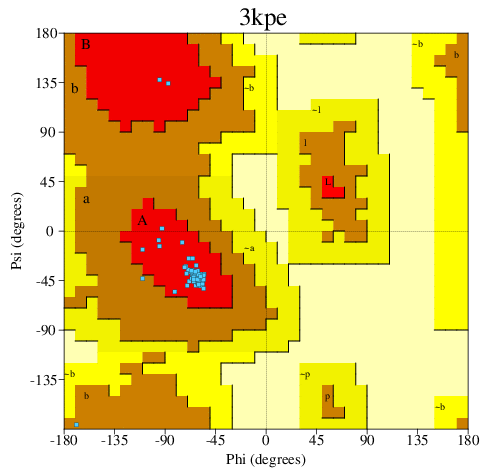
Solution structure of the respiratory syncytial virus (rsv)six-helix bundle complexed with tmc353121, a small-moleucule inhibitor of rsv
|
|
Structure:
|
|
Fusion glycoprotein f0. Chain: a. Fragment: proteinase k-resistant core of heptad repeat 1. Synonym: protein f, fusion glycoprotein f2, fusion glycoprotein f1. Fusion glycoprotein f0. Chain: b. Fragment: proteinase k-resistant core of heptad repeat 2. Synonym: protein f, fusion glycoprotein f2, fusion glycoprotein f1
|
|
Source:
|
|
Human respiratory syncytial virus. Organism_taxid: 11259. Strain: a2. Strain: a2
|
|
Resolution:
|
|
|
1.47Å
|
R-factor:
|
0.165
|
R-free:
|
0.196
|
|
|
Authors:
|
|
D.Roymans,H.De Bondt,E.Arnoult,M.D.Cummings,H.Van Vlijmen,K.Andries
|
Key ref:

|
|
D.Roymans
et al.
(2010).
Binding of a potent small-molecule inhibitor of six-helix bundle formation requires interactions with both heptad-repeats of the RSV fusion protein.
Proc Natl Acad Sci U S A,
107,
308-313.
PubMed id:
DOI:

|
|
|
Date:
|
|
|
16-Nov-09
|
Release date:
|
22-Dec-09
|
|
|
|
|
|
|
PROCHECK
|
|
|
|
|
|
Headers
|
|
|
|
References
|
|
|
|
|
|
|
|
|
|
|
|
|
|
|
|
 |
|
|
|
|
|
|
| |
|
DOI no:
|
Proc Natl Acad Sci U S A
107:308-313
(2010)
|
|
PubMed id:
|
|
|
|
|
|
| |
|
Binding of a potent small-molecule inhibitor of six-helix bundle formation requires interactions with both heptad-repeats of the RSV fusion protein.
|
|
D.Roymans,
H.L.De Bondt,
E.Arnoult,
P.Geluykens,
T.Gevers,
M.Van Ginderen,
N.Verheyen,
H.Kim,
R.Willebrords,
J.F.Bonfanti,
W.Bruinzeel,
M.D.Cummings,
H.van Vlijmen,
K.Andries.
|
|
|
|
|
| |
ABSTRACT
|
|
|
|
| |
|
|
Six-helix bundle (6HB) formation is an essential step for many viruses that rely
on a class I fusion protein to enter a target cell and initiate replication.
Because the binding modes of small molecule inhibitors of 6HB formation are
largely unknown, precisely how they disrupt 6HB formation remains unclear, and
structure-based design of improved inhibitors is thus seriously hampered. Here
we present the high resolution crystal structure of TMC353121, a potent
inhibitor of respiratory syncytial virus (RSV), bound at a hydrophobic pocket of
the 6HB formed by amino acid residues from both HR1 and HR2 heptad-repeats.
Binding of TMC353121 stabilizes the interaction of HR1 and HR2 in an alternate
conformation of the 6HB, in which direct binding interactions are formed between
TMC353121 and both HR1 and HR2. Rather than completely preventing 6HB formation,
our data indicate that TMC353121 inhibits fusion by causing a local disturbance
of the natural 6HB conformation.
|
|
|
|
|
|
| |
Selected figure(s)
|
|
|
|
| |
|
|

|
|

|
|
Figure 4.
Binding mode and interaction map of TMC353121 and effect of
the D486N mutation on the interactions. Binding mode of
TMC353121 in the complete 6HB (A). The RSV 6HB is composed of
three central HR1 helices (green surface) surrounded by three
antiparallel HR2 helices (blue surface). The 6HB axis is tilted
approximately 45 degrees from the plane of the page.
Superimposition of the TMC353121 cocrystal structure with the
1G2C RSV 6HB crystal structure (B). The HR1 and HR2 helices of
the cocrystal structure are dark green and blue, respectively,
and the HR1 and HR2 helices from the 1G2C 6HB structure are
shown in salmon and lilac, respectively. Displacement of
sidechains by TMC353121 is indicated by orange arrows.
Interaction map of TMC353121 with its 6HB target site (C).
H-bonds are drawn as black dotted lines. Distances (Å)
between interacting atoms are in black. TMC353121 makes a
π–π stacking interaction with Y198. Residues from two
neighboring HR1 or HR1’ and HR2 helices are indicated in green
and blue, respectively. Effect of the HR2 resistance mutation
D486N on electrostatic interactions in the TMC353121-bound 6HB
complex (D). HR1 or HR1’ and HR2 residues are indicated in
dark green and blue, respectively, and the calculated protein
surface of HR1 and HR2 in transparent green and blue,
respectively. HR2 residue 486 that causes resistance against
TMC353121 upon mutation is shown in red. Orange arrows indicate
hydrogen bonds. TMC353121 is colored by atom type (carbon =
gray; oxygen = red; nitrogen = blue).
|
|
Figure 5.
Effect of TMC353121 on HR1/HR2-peptide interaction. Schematic
representation of the different experimental conditions applied
in the 6HB-ELISA (A). Influence of different concentrations of
TMC353121 on the interaction between FITC-C39 with the HR1-CTC
(B). The bars present tha data generated with three different
experimental 6HB ELISA designs (orange = path 1; blue = path 2;
green = path 3). Interaction between FITC-C39 and the HR1-CTC in
the absence of TMC353121 was set at 100% (positive control), and
the relative HR2 interaction with the HR1-CTC in the other
conditions was normalized to this positive control condition.
Values are from three independent experiments. P values and 95%
confidence intervals are listed in Table S2.
|
|
|
|
| |
Figures were
selected
by an automated process.
|
|
|
|
|
|
|
|
|
|
|
|
|
|
|
|
 |
 |
 |
|
Literature references that cite this PDB file's key reference
|
|
|
| |
PubMed id
|
|
Reference
|
|
|
|
|
|
L.Cai,
and
S.Jiang
(2010).
Development of peptide and small-molecule HIV-1 fusion inhibitors that target gp41.
|
| |
ChemMedChem,
5,
1813-1824.
|
|
|
|
|
|
|
R.S.Harrison,
N.E.Shepherd,
H.N.Hoang,
G.Ruiz-Gómez,
T.A.Hill,
R.W.Driver,
V.S.Desai,
P.R.Young,
G.Abbenante,
and
D.P.Fairlie
(2010).
Downsizing human, bacterial, and viral proteins to short water-stable alpha helices that maintain biological potency.
|
| |
Proc Natl Acad Sci U S A,
107,
11686-11691.
|
|
|
|
|
|
|
Y.Zhu,
L.Lu,
L.Xu,
H.Yang,
S.Jiang,
and
Y.H.Chen
(2010).
Identification of a gp41 core-binding molecule with homologous sequence of human TNNI3K-like protein as a novel human immunodeficiency virus type 1 entry inhibitor.
|
| |
J Virol,
84,
9359-9368.
|
|
|
|
|
|
The most recent references are shown first.
Citation data come partly from CiteXplore and partly
from an automated harvesting procedure. Note that this is likely to be
only a partial list as not all journals are covered by
either method. However, we are continually building up the citation data
so more and more references will be included with time.
|
|
|


 Links
Links


