 |
PDBsum entry 3jtd

|
|
|
|
|
|

|

|

|

|
|

|
|

|
|

|
|

|
|

|
|

|
|
|
 |

|

|
|
|
|
|
|
|
|
|
|
|
|
|
|
|
|
|
|
|
|
|
|
|
|
|
|
|
|
|
|
|
|
|
|
|
Contractile protein
|
PDB id
|
|
|
|
3jtd
|
|
|
|
|
|
|
|
|
|
|
|
|
|
|

|

|

|
|
|
|
|
|
|
|
 |
Contents |
 |
|
|
|
|
|
|
|
|
|
|
|
 65 a.a.
|
|
|
|
|
|
|
|
|
|
|
 156 a.a.
|
|
|
|
|
|
|
|
|
|
|
 156 a.a.
|
|
|
|
|
|
|
|
|
|
|
* Residue conservation analysis
|
|
|
|
|
|
PDB id:
|
|
|
|
| Name: |
|
Contractile protein
|
|
|
Title:
|
|
Calcium-free scallop myosin regulatory domain with elc-d19a point mutation
|
|
Structure:
|
|
Myosin heavy chain, striated adductor muscle. Chain: a. Myosin regulatory light chain, striated adductor muscle. Chain: b. Synonym: r-lc. Myosin essential light chain, striated adductor muscle. Chain: c. Synonym: e-lc, sulfhydryl light chain, shlc. Engineered: yes.
|
|
Source:
|
|
Argopecten irradians. Bay scallop. Organism_taxid: 31199. Expressed in: escherichia coli. Expression_system_taxid: 469008.
|
|
Resolution:
|
|
|
2.57Å
|
R-factor:
|
0.233
|
R-free:
|
0.248
|
|
|
Authors:
|
|
D.M.Himmel,S.Mui,E.O'Neall-Hennessey,A.Szent-Gyorgyi,C.Cohen
|
Key ref:

|
|
D.M.Himmel
et al.
(2009).
The on-off switch in regulated myosins: different triggers but related mechanisms.
J Mol Biol,
394,
496-505.
PubMed id:
DOI:

|
|
|
Date:
|
|
|
11-Sep-09
|
Release date:
|
01-Dec-09
|
|
|
|
|
|
|
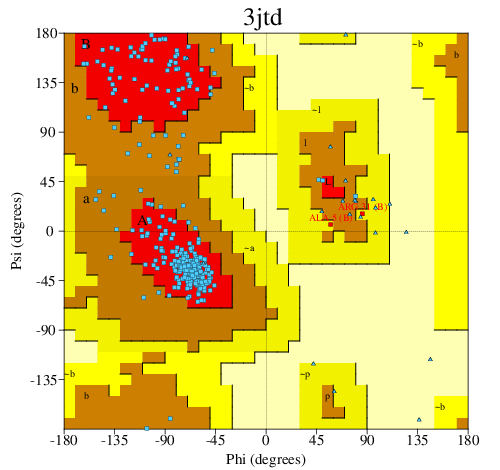
PROCHECK
|
|
|
|
|
|
Headers
|
|
|
|
References
|
|
|
|
|
|

|
|
P24733
(MYS_ARGIR) -
Myosin heavy chain, striated muscle from Argopecten irradians
|
|
|
|
Seq:
Struc:
|
|
|
|
1938 a.a.
65 a.a.
|
|

|

|

|
|
|
|
|
|
|
|
|
|
|
|
|
|
|
|
|
|
|
|
|
 |
|
|
|
|
|
|
| |
|
DOI no:
|
J Mol Biol
394:496-505
(2009)
|
|
PubMed id:
|
|
|
|
|
|
| |
|
The on-off switch in regulated myosins: different triggers but related mechanisms.
|
|
D.M.Himmel,
S.Mui,
E.O'Neall-Hennessey,
A.G.Szent-Györgyi,
C.Cohen.
|
|
|
|
|
| |
ABSTRACT
|
|
|
|
| |
|
|
In regulated myosin, motor and enzymatic activities are toggled between the
on-state and off-state by a switch located on its lever arm domain, here called
the regulatory domain (RD). This region consists of a long alpha-helical "heavy
chain" stabilized by a "regulatory" light chain (RLC) and an "essential" light
chain (ELC). The on-state is activated by phosphorylation of the RLC of
vertebrate smooth muscle RD or by direct binding of Ca(2+) to the ELC of
molluscan RD. Crystal structures are available only for the molluscan RD. To
understand in more detail the pathway between the on-state and the off-state, we
have now also determined the crystal structure of a molluscan (scallop) RD in
the absence of Ca(2+). Our results indicate that loss of Ca(2+) abolishes most
of the interactions between the light chains and may increase the flexibility of
the RD heavy chain. We propose that disruption of critical links with the C-lobe
of the RLC is the key event initiating the off-state in both smooth muscle
myosins and molluscan myosins.
|
|
|
|
|
|
| |
Selected figure(s)
|
|
|
|
| |
|
|

|
|

|
|
Figure 3.
Fig. 3. Ca^2+ binding stabilizesHC/RLC/ELC interactions in
scallop structures. (a) Shown is a vast hydrogen-bond and
covalent-bond network in the Ca^2+-RD structure extending from
the Ca^2+ binding site to Lys149 on the RLC N-lobe. (b) Part of
this network forms a meshwork that stabilizes the coordination
of Ca^2+, shown here schematically. Solid gray lines indicate
main-chain interactions, and wavy lines indicate side-chain
interactions. (c) The same meshwork as (b) in the absence of
Ca^2+. Notice that when the Gly23 carbonyl rotates away from the
Ca^2+ binding site, four hydrogen bonds from this meshwork are
abolished.
|
|
Figure 5.
Fig. 5. Scallop and squid RLC. Scallop (color) and squid
(gray tones; PDB code 2OVK)^30 are superposed (superposition
based on scallop HC residues 807–818 and equivalent squid HC
residues 809–820). The scallop structure is shown oriented as
in Fig. 4. In the squid crystal structure, the RLC N-lobe is
rotated closer to the C-lobe, bringing helix A and the RLC
N-terminus within reach of helices E and H. RLC residue C^α
distances are shown (in Å) for scallop Asp84-Lys149
(magenta), scallop Pro13-Asp84 (tan), and squid Arg13-Glu84
(black).
|
|
|
|
|
|
| |
The above figures are
reprinted
by permission from Elsevier:
J Mol Biol
(2009,
394,
496-505)
copyright 2009.
|
|
| |
Figures were
selected
by an automated process.
|
|
|
|
|
|
|
|
|
|
|
|
|
|
|
|
 |
 |
 |
|
Literature references that cite this PDB file's key reference
|
|
|
| |
PubMed id
|
|
Reference
|
|
|
|
|
|
J.H.Brown,
V.S.Kumar,
E.O'Neall-Hennessey,
L.Reshetnikova,
H.Robinson,
M.Nguyen-McCarty,
A.G.Szent-Györgyi,
and
C.Cohen
(2011).
Visualizing key hinges and a potential major source of compliance in the lever arm of myosin.
|
| |
Proc Natl Acad Sci U S A,
108,
114-119.
|
|
|
PDB code:
|
|
|
|
|
|
|
|
O.Pylypenko,
and
A.M.Houdusse
(2011).
Essential "ankle" in the myosin lever arm.
|
| |
Proc Natl Acad Sci U S A,
108,
5-6.
|
|
|
|
|
|
The most recent references are shown first.
Citation data come partly from CiteXplore and partly
from an automated harvesting procedure. Note that this is likely to be
only a partial list as not all journals are covered by
either method. However, we are continually building up the citation data
so more and more references will be included with time.
Where a reference describes a PDB structure, the PDB
code is
shown on the right.
|
|
| |


 Links
Links





