spacer
spacer

PDBsum entry 3hqb

Go to PDB code: 
protein Protein-protein interface(s) links
Immune system PDB id
3hqb


Loading ...

 
JSmol PyMol  
Contents
Protein chains
63 a.a. *
* Residue conservation analysis
PDB id:
3hqb
Name: Immune system
Title: Crystal structure of human desarg-c5a
Structure: Complement c5. Chain: a, b. Synonym: c3 and pzp-like alpha-2-macroglobulin domain-containing protein 4, complement c5 beta chain, complement c5 alpha chain, c5a anaphylatoxin, complement c5 alpha' chain. Engineered: yes
Source: Homo sapiens. Human. Organism_taxid: 9606. Gene: c5, cpamd4. Expressed in: escherichia coli. Expression_system_taxid: 562.
Resolution:
3.30Å     R-factor:   0.219     R-free:   0.307
Authors: W.J.Cook,S.E.Ealick
Key ref: W.J.Cook et al. (2010). Structure of human desArg-C5a. Acta Crystallogr D Biol Crystallogr, 66, 190-197. PubMed id: 20124699
Date:
05-Jun-09     Release date:   02-Feb-10    
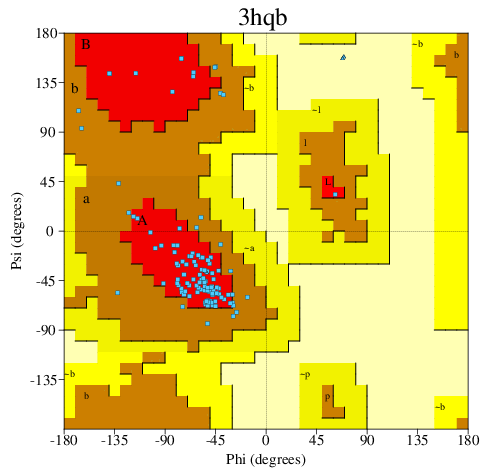
PROCHECK
Go to PROCHECK summary
 Headers
 References

Protein chains
Pfam   ArchSchema ?
P01031  (CO5_HUMAN) -  Complement C5 from Homo sapiens
Seq:
Struc:
 
Seq:
Struc:
 
Seq:
Struc:
 
Seq:
Struc:
1676 a.a.
63 a.a.*
Key:    PfamA domain  Secondary structure  CATH domain
* PDB and UniProt seqs differ at 1 residue position (black cross)


Acta Crystallogr D Biol Crystallogr 66:190-197 (2010)
PubMed id: 20124699  
 
 
Structure of human desArg-C5a.
W.J.Cook, N.Galakatos, W.C.Boyar, R.L.Walter, S.E.Ealick.
 
  ABSTRACT  
 
The anaphylatoxin C5a is derived from the complement component C5 during activation of the complement cascade. It is an important component in the pathogenesis of a number of inflammatory diseases. NMR structures of human and porcine C5a have been reported; these revealed a four-helix bundle stabilized by three disulfide bonds. The crystal structure of human desArg-C5a has now been determined in two crystal forms. Surprisingly, the protein crystallizes as a dimer and each monomer in the dimer has a three-helix core instead of the four-helix bundle noted in the NMR structure determinations. Furthermore, the N-terminal helices of the two monomers occupy different positions relative to the three-helix core and are completely different from the NMR structures. The physiological significance of these structural differences is unknown.


spacer

spacer