 |
PDBsum entry 3hpr

|
|
|
|
|
 |
Contents |
 |
|
|
|
|
|
|
|
|
|
|
|
|
* Residue conservation analysis
|
|
|
|
|
|
PDB id:
|
|
|
|
| Name: |
|
Transferase
|
|
|
Title:
|
|
Crystal structure of v148g adenylate kinase from e. Coli, in complex with ap5a
|
|
Structure:
|
|
Adenylate kinase. Chain: a, b. Synonym: ak, atp-amp transphosphorylase. Engineered: yes. Mutation: yes
|
|
Source:
|
|
Escherichia coli. Organism_taxid: 83333. Strain: k-12. Gene: adk, b0474, dnaw, jw0463, plsa. Expressed in: escherichia coli. Expression_system_taxid: 562.
|
|
Resolution:
|
|
|
2.00Å
|
R-factor:
|
0.210
|
R-free:
|
0.243
|
|
|
Authors:
|
|
V.J.Hilser,T.P.Travis,D.W.Bolen
|
Key ref:

|
|
T.P.Schrank
et al.
(2009).
Rational modulation of conformational fluctuations in adenylate kinase reveals a local unfolding mechanism for allostery and functional adaptation in proteins.
Proc Natl Acad Sci U S A,
106,
16984-16989.
PubMed id:
DOI:

|
|
|
Date:
|
|
|
04-Jun-09
|
Release date:
|
03-Nov-09
|
|
|
|
|
|
|
PROCHECK
|

|
|
|
|
|
Headers
|
|
|
|
References
|
|
|
|
|
|

|
|
P69441
(KAD_ECOLI) -
Adenylate kinase from Escherichia coli (strain K12)
|
|
|
|
Seq:
Struc:
|
|
|
|
214 a.a.
214 a.a.*
|
|

|

|
|
|
|
|
|
|
|
|
|
|
|
Key: |
|
 |
Secondary structure |
|
 |
CATH domain |
|
|
*
PDB and UniProt seqs differ
at 1 residue position (black
cross)
|
|
|
|
|
|
|
|
|
|
|
|
|
Enzyme class:
|
|
E.C.2.7.4.3
- adenylate kinase.
|
|
|
|
|
|
|
Reaction:
|
|
AMP + ATP = 2 ADP
|
|
|
|
|
|
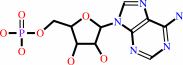 AMP
AMP
|
+
|
ATP
Bound ligand (Het Group name = )
matches with 54.39% similarity
|
=
|
 2
×
ADP
2
×
ADP
|
|
|
|
|
|
|
|
|
|
|
|
|
Molecule diagrams generated from .mol files obtained from the
KEGG ftp site
|
|
|
|
|
|
|
|
|
|
|
|
|
|
 |
|
|
|
|
|
|
| |
|
|
| |
|
DOI no:
|
Proc Natl Acad Sci U S A
106:16984-16989
(2009)
|
|
PubMed id:
|
|
|
|
|
|
| |
|
Rational modulation of conformational fluctuations in adenylate kinase reveals a local unfolding mechanism for allostery and functional adaptation in proteins.
|
|
T.P.Schrank,
D.W.Bolen,
V.J.Hilser.
|
|
|
|
|
| |
ABSTRACT
|
|
|
|
| |
|
|
Elucidating the complex interplay between protein structure and dynamics is a
prerequisite to an understanding of both function and adaptation in proteins.
Unfortunately, it has been difficult to experimentally decouple these effects
because it is challenging to rationally design mutations that will either affect
the structure but not the dynamics, or that will affect the dynamics but not the
structure. Here we adopt a mutation approach that is based on a thermal
adaptation strategy observed in nature, and we use it to study the binding
interaction of Escherichia coli adenylate kinase (AK). We rationally design
several single-site, surface-exposed glycine mutations to selectively perturb
the excited state conformational repertoire, leaving the ground-state X-ray
crystallographic structure unaffected. The results not only demonstrate that the
conformational ensemble of AK is significantly populated by a locally unfolded
state that is depopulated upon binding, but also that the excited-state
conformational ensemble can be manipulated through mutation, independent of
perturbations of the ground-state structures. The implications of these results
are twofold. First, they indicate that it is possible to rationally design
dynamic allosteric mutations, which do not propagate through a pathway of
structural distortions connecting the mutated and the functional sites. Secondly
and equally as important, the results reveal a general strategy for thermal
adaptation that allows enzymes to modulate binding affinity by controlling the
amount of local unfolding in the native-state ensemble. These findings open new
avenues for rational protein design and fundamentally illuminate the role of
local unfolding in function and adaptation.
|
|
|
|
|
|
| |
Selected figure(s)
|
|
|
|
| |
|
|

|
|

|
|
Figure 1.
Mutation strategy applied to adenylate kinase. Structure of
“Open” [i.e., Apo-AK; (PDB ID 4AKE) (11)] and “Closed”
[i.e., complex of AK and the nonhydrolysable bisubstrate
analogue inhibitor P^1,P^5-Di(adenosine) pentaphosphate (Ap5A);
PDB ID 1AKE (10)] states of AK. LID is shown in gray. The “LID
domain,” as defined by Shapiro et al. (7). AMPbd is shown in
green. The “AMP binding domain” (7). Red spheres, selected
mutation sites.
|
|
Figure 4.
Surface Gly mutations in LID conserve ground-state structure.
(A) Alignment of the reported crystal structures of WT and v148g
AK. Shown in red are chains (WT and v148g) from position A
within the asymmetric unit. Shown in black are chains from
position B within the asymmetric unit. (B) ^1H-^15N HSQC spectra
of WT (black) and v142g (red) AK at 21° C, which suppress
local unfolding within the LID region. Enhanced contrast is used
for v142g to allow visualization of peaks with decreased
intensity, most likely because of exchange broadening. Available
assignments are provided for resonances with differences at this
temperature. (C) Analysis of structural perturbations effected
by mutation. The gray spheres represent all atoms that move >0.3
Å from the WT to mutant structure in both copies within
the ASU. The dark red spheres show the mutation site (position
148). The light red spheres show all perturbed atoms (gray) that
can be connected to the mutation site by a continuous chain (< 6
Å per step) of other perturbed atoms. Blue spheres, Ap5A.
|
|
|
|
| |
Figures were
selected
by an automated process.
|
|
|
|
|
|
|
|
|
|
|
|
|
|
|
|
 |
 |
 |
|
Literature references that cite this PDB file's key reference
|
|
|
| |
PubMed id
|
|
Reference
|
|
|
|
|
|
C.G.Kalodimos
(2011).
NMR reveals novel mechanisms of protein activity regulation.
|
| |
Protein Sci,
20,
773-782.
|
|
|
|
|
|
|
D.Armenta-Medina,
E.Pérez-Rueda,
and
L.Segovia
(2011).
Identification of functional motions in the adenylate kinase (ADK) protein family by computational hybrid approaches.
|
| |
Proteins,
79,
1662-1671.
|
|
|
|
|
|
|
R.J.Falconer,
and
B.M.Collins
(2011).
Survey of the year 2009: applications of isothermal titration calorimetry.
|
| |
J Mol Recognit,
24,
1.
|
|
|
|
|
|
|
W.Li,
P.G.Wolynes,
and
S.Takada
(2011).
Frustration, specific sequence dependence, and nonlinearity in large-amplitude fluctuations of allosteric proteins.
|
| |
Proc Natl Acad Sci U S A,
108,
3504-3509.
|
|
|
|
|
|
|
J.B.Brokaw,
and
J.W.Chu
(2010).
On the roles of substrate binding and hinge unfolding in conformational changes of adenylate kinase.
|
| |
Biophys J,
99,
3420-3429.
|
|
|
|
|
|
|
J.O.Wrabl,
and
V.J.Hilser
(2010).
Investigating homology between proteins using energetic profiles.
|
| |
PLoS Comput Biol,
6,
e1000722.
|
|
|
|
|
|
|
P.Csermely,
R.Palotai,
and
R.Nussinov
(2010).
Induced fit, conformational selection and independent dynamic segments: an extended view of binding events.
|
| |
Trends Biochem Sci,
35,
539-546.
|
|
|
|
|
|
|
U.Olsson,
and
M.Wolf-Watz
(2010).
Overlap between folding and functional energy landscapes for adenylate kinase conformational change.
|
| |
Nat Commun,
1,
111.
|
|
|
|
|
|
The most recent references are shown first.
Citation data come partly from CiteXplore and partly
from an automated harvesting procedure. Note that this is likely to be
only a partial list as not all journals are covered by
either method. However, we are continually building up the citation data
so more and more references will be included with time.
|
|


 Links
Links


