 |
PDBsum entry 3hg0

|
|
|
|
|
|

|

|

|

|
|

|
|

|
|

|
|

|
|

|
|
|
 |

|

|
|
|
|
|
|
|
|
|
|
|
|
|
|
|
|
|
|
|
|
|
|
|
|
|
|
|
|
|
|
|
|
|
|
Protein binding
|
PDB id
|
|
|
|
3hg0
|
|
|
|
|
|
|
|
|
|
|
|
|
|
|

|

|

|
|
|
|
|
|
|
|
 |
Contents |
 |
|
|
|
|
|
|
|
|
|
|
|
 137 a.a.
|
|
|
|
|
|
|
|
|
|
|

 130 a.a.
|
|
|
|
|
|
|
|
|
|
|
 124 a.a.
|
|
|
|
|
|
|
|
|
* Residue conservation analysis
|
|
|
|
|
|
PDB id:
|
|
|
|
| Name: |
|
Protein binding
|
|
|
Title:
|
|
Crystal structure of a darpin in complex with orf49 from lactococcal phage tp901-1
|
|
Structure:
|
|
Baseplate protein. Chain: a, b, c. Synonym: bpp. Engineered: yes. Designed ankyrin repeat protein (darpin) 20. Chain: d. Engineered: yes
|
|
Source:
|
|
Lactococcus phage tp901-1. Organism_taxid: 35345. Gene: bpp, bppl. Expressed in: escherichia coli. Expression_system_taxid: 562. Artificial gene. Organism_taxid: 32630.
|
|
Resolution:
|
|
|
2.10Å
|
R-factor:
|
0.209
|
R-free:
|
0.243
|
|
|
Authors:
|
|
D.Veesler,B.Dreier,S.Blangy,J.Lichiere,D.Tremblay,S.Moineau, S.Spinelli,M.Tegoni,A.Pluckthun,V.Campanacci,C.Cambillau
|
|
Key ref:
|
|
D.Veesler
et al.
(2009).
Crystal structure and function of a DARPin neutralizing inhibitor of lactococcal phage TP901-1: comparison of DARPin and camelid VHH binding mode.
J Biol Chem,
284,
30718-30726.
PubMed id:
|
|
|
Date:
|
|
|
13-May-09
|
Release date:
|
08-Sep-09
|
|
|
|
|
|
|
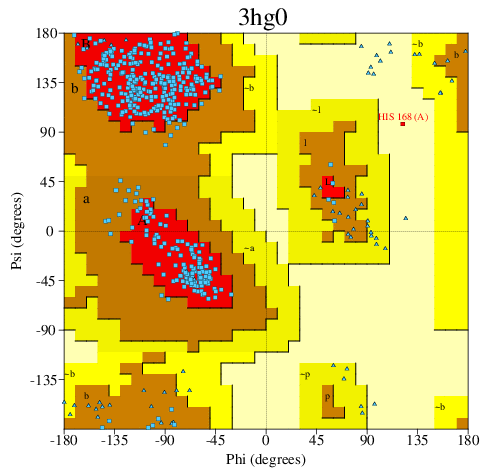
PROCHECK
|
|
|
|
|
|
Headers
|
|
|
|
References
|
|
|
|
|
|

|
|
Q9G096
(Q9G096_9CAUD) -
BPP from Lactococcus phage TP901-1
|
|
|
|
Seq:
Struc:
|
|
|
|
163 a.a.
137 a.a.
|
|

|

|
|
|
|
|
|
|
|
|
|
|
|
|
|
|
|
|
|
Enzyme class:
|
|
Chains A, B, C:
E.C.?
|
|
|
|
|
|
|
|
|
|
|
|
|
|
|
|
|
|
|
 |
|
|
|
|
|
|
| |
|
|
J Biol Chem
284:30718-30726
(2009)
|
|
PubMed id:
|
|
|
|
|
|
| |
|
Crystal structure and function of a DARPin neutralizing inhibitor of lactococcal phage TP901-1: comparison of DARPin and camelid VHH binding mode.
|
|
D.Veesler,
B.Dreier,
S.Blangy,
J.Lichière,
D.Tremblay,
S.Moineau,
S.Spinelli,
M.Tegoni,
A.Plückthun,
V.Campanacci,
C.Cambillau.
|
|
|
|
|
| |
ABSTRACT
|
|
|
|
| |
|
|
Combinatorial libraries of designed ankyrin repeat proteins (DARPins) have been
proven to be a valuable source of specific binding proteins, as they can be
expressed at very high levels and are very stable. We report here the selection
of DARPins directed against a macromolecular multiprotein complex, the baseplate
BppUxBppL complex of the lactococcal phage TP901-1. Using ribosome display, we
selected several DARPins that bound specifically to the tip of the
receptor-binding protein (RBP, the BppL trimer). The three selected DARPins
display high specificity and affinity in the low nanomolar range and bind with a
stoichiometry of one DARPin per BppL trimer. The crystal structure of a DARPin
complexed with the RBP was solved at 2.1 A resolution. The DARPinxRBP interface
is of the concave (DARPin)-convex (RBP) type, typical of other DARPin protein
complexes and different from what is observed with a camelid VHH domain, which
penetrates the phage p2 RBP inter-monomer interface. Finally, phage infection
assays demonstrated that TP901-1 infection of Lactococcus lactis cells was
inhibited by each of the three selected DARPins. This study provides proof of
concept for the possible use of DARPins to circumvent viral infection. It also
provides support for the use of DARPins in co-crystallization, due to their
rigidity and their ability to provide multiple crystal contacts.
|
|
|
|
|
|
|
|
|
|
|
|
|
|
|
|
|
|
 |
 |
 |
|
Literature references that cite this PDB file's key reference
|
|
|
| |
PubMed id
|
|
Reference
|
|
|
|
|
|
J.C.Pai,
J.A.Culver,
J.E.Drury,
R.S.Motani,
R.L.Lieberman,
and
J.A.Maynard
(2011).
Conversion of scFv peptide-binding specificity for crystal chaperone development.
|
| |
Protein Eng Des Sel,
24,
419-428.
|
|
|
|
|
|
|
N.Monroe,
G.Sennhauser,
M.A.Seeger,
C.Briand,
and
M.G.Grütter
(2011).
Designed ankyrin repeat protein binders for the crystallization of AcrB: plasticity of the dominant interface.
|
| |
J Struct Biol,
174,
269-281.
|
|
|
PDB codes:
|
|
|
|
|
|
|
|
D.Veesler,
S.Blangy,
J.Lichière,
M.Ortiz-Lombarda,
P.Tavares,
V.Campanacci,
and
C.Cambillau
(2010).
Crystal structure of Bacillus subtilis SPP1 phage gp23.1, a putative chaperone.
|
| |
Protein Sci,
19,
1812-1816.
|
|
|
PDB codes:
|
|
|
|
|
|
|
|
D.Veesler,
S.Blangy,
S.Spinelli,
P.Tavares,
V.Campanacci,
and
C.Cambillau
(2010).
Crystal structure of Bacillus subtilis SPP1 phage gp22 shares fold similarity with a domain of lactococcal phage p2 RBP.
|
| |
Protein Sci,
19,
1439-1443.
|
|
|
PDB code:
|
|
|
|
|
|
|
|
F.Vincent,
A.Round,
A.Reynaud,
C.Bordi,
A.Filloux,
and
Y.Bourne
(2010).
Distinct oligomeric forms of the Pseudomonas aeruginosa RetS sensor domain modulate accessibility to the ligand binding site.
|
| |
Environ Microbiol,
12,
1775-1786.
|
|
|
PDB code:
|
|
|
|
|
|
|
|
P.Pugach,
A.Krarup,
A.Gettie,
M.Kuroda,
J.Blanchard,
M.Piatak,
J.D.Lifson,
A.Trkola,
and
M.Robbiani
(2010).
In vivo binding and retention of CD4-specific DARPin 57.2 in macaques.
|
| |
PLoS One,
5,
e12455.
|
|
|
|
|
|
|
Z.S.Derewenda
(2010).
Application of protein engineering to enhance crystallizability and improve crystal properties.
|
| |
Acta Crystallogr D Biol Crystallogr,
66,
604-615.
|
|
|
|
|
|
The most recent references are shown first.
Citation data come partly from CiteXplore and partly
from an automated harvesting procedure. Note that this is likely to be
only a partial list as not all journals are covered by
either method. However, we are continually building up the citation data
so more and more references will be included with time.
Where a reference describes a PDB structure, the PDB
codes are
shown on the right.
|
|
| |


 Links
Links


