
|
|
|
|
|
 |
Contents |
 |
|
|
|
|
|
|
|
|
|
|
* Residue conservation analysis
|
|
|
|
|
|
|
|
|
|
Enzyme class:
|
|
Chain B:
E.C.3.6.4.13
- Rna helicase.
|
|
|
|
|
|
|
Reaction:
|
|
ATP + H2O = ADP + phosphate + H+
|
|
|
|
|
|
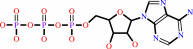 ATP
ATP
|
+
|
H2O
|
=
|
 ADP
ADP
|
+
|
 phosphate
|
+
|
H(+)
|
|
|
|
|
|
|
|
|
|
|
|
|
Molecule diagrams generated from .mol files obtained from the
KEGG ftp site
|
|
|
|
|
|
|
|
|
|
|
|
|
|
 |
|
|
|
|
|
|
| |
|
|
| |
|
DOI no:
|
Nat Struct Biol
16:247-254
(2009)
|
|
PubMed id:
|
|
|
|
|
|
| |
|
The mRNA export protein DBP5 binds RNA and the cytoplasmic nucleoporin NUP214 in a mutually exclusive manner.
|
|
H.von Moeller,
C.Basquin,
E.Conti.
|
|
|
|
|
| |
ABSTRACT
|
|
|
|
| |
|
|
The DEAD-box protein DBP5 is essential for mRNA export in both yeast and humans.
It binds RNA and is concentrated and locally activated at the cytoplasmic side
of the nuclear pore complex. We have determined the crystal structures of human
DBP5 bound to RNA and AMPPNP, and bound to the cytoplasmic nucleoporin NUP214.
The structures reveal that binding of DBP5 to nucleic acid and to NUP214 is
mutually exclusive. Using in vitro assays, we demonstrate that NUP214 decreases
both the RNA binding and ATPase activities of DBP5. The interactions are
mediated by conserved residues, implying a conserved recognition mechanism.
These results suggest a framework for the consecutive steps leading to the
release of mRNA at the final stages of nuclear export. More generally, they
provide a paradigm for how binding of regulators can specifically inhibit
DEAD-box proteins.
|
|
|
|
|
|
| |
Selected figure(s)
|
|
|
|
| |
|
|

|
|

|
|
Figure 1.
(a) Schematic representation of the domain organization of
DBP5 with the domain boundaries of the protein constructs used
in this study. The RecA-like domains are colored blue and the
N-terminal region is shown in orange. (b) Protein precipitations
with biotinylated single-stranded RNA identify the RNA binding
region of human DBP5 for structural studies. Purified proteins
were mixed with 5' end–biotinylated 20-mer single-stranded RNA
and incubated with or without AMPPNP or ADP, as indicated.
Proteins mixtures before (input, 17% of the total) and after
coprecipitation (precipitate) were separated on a 15% (w/v)
acrylamide SDS-PAGE and visualized using Coomassie stain. The
molecular weight standards are shown in lane 1. DBP5 constructs
are described in a. NUP214   C
corresponds to residues 1–405 (human sequence). (c) Structure
of DBP5 N
(light blue) bound to AMPPNP (yellow) and single-stranded RNA
(black). The magnesium ion at the ATP binding site is shown in
magenta. Six ordered nucleotides of a single-stranded poly-U RNA
are present in the 2.2-Å resolution structure. The N- and
C-terminal residues of DBP5 visible in the electron density are
indicated. The N-terminal region of DBP5 (residues 75–92,
orange) folds into a short C
corresponds to residues 1–405 (human sequence). (c) Structure
of DBP5 N
(light blue) bound to AMPPNP (yellow) and single-stranded RNA
(black). The magnesium ion at the ATP binding site is shown in
magenta. Six ordered nucleotides of a single-stranded poly-U RNA
are present in the 2.2-Å resolution structure. The N- and
C-terminal residues of DBP5 visible in the electron density are
indicated. The N-terminal region of DBP5 (residues 75–92,
orange) folds into a short  -helix.
This and all other ribbon diagrams in the manuscript were
generated using PyMol (http://www.pymol.org). -helix.
This and all other ribbon diagrams in the manuscript were
generated using PyMol (http://www.pymol.org).
|
|
Figure 3.
(a) Close-up of the region of interaction between the
N-terminal RecA-like domain of DBP5 (in blue) and NUP214 (in
green) in the DBP5 N
C–NUP214
C
structure. The residues involved in hydrophobic and
electrostatic interactions are highlighted. (b) Protein
precipitations by GST pull-downs with DBP5 and NUP214 mutant
proteins. The pull-down assays were carried out as described in
Figure 2a. The DBP5 D223R, I258A, R259D or R262A mutations of
DBP5 impair its interaction with NUP214. NUP214 V353A shows
reduced binding to DBP5, whereas NUP214 D359R impairs the
interaction.
|
|
|
|
|
|
| |
The above figures are
reprinted
by permission from Macmillan Publishers Ltd:
Nat Struct Biol
(2009,
16,
247-254)
copyright 2009.
|
|
| |
Figures were
selected
by an automated process.
|
|
|
|
|
|
|
|
|
|
|
|
|
|
|
|
 |
 |
 |
|
Literature references that cite this PDB file's key reference
|
|
|
| |
PubMed id
|
|
Reference
|
|
|
|
|
|
B.Montpetit,
N.D.Thomsen,
K.J.Helmke,
M.A.Seeliger,
J.M.Berger,
and
K.Weis
(2011).
A conserved mechanism of DEAD-box ATPase activation by nucleoporins and InsP6 in mRNA export.
|
| |
Nature,
472,
238-242.
|
|
|
PDB codes:
|
|
|
|
|
|
|
|
D.Klostermeier
(2011).
Single-molecule FRET reveals nucleotide-driven conformational changes in molecular machines and their link to RNA unwinding and DNA supercoiling.
|
| |
Biochem Soc Trans,
39,
611-616.
|
|
|
|
|
|
|
E.Jankowsky
(2011).
RNA helicases at work: binding and rearranging.
|
| |
Trends Biochem Sci,
36,
19-29.
|
|
|
|
|
|
|
J.Strohmeier,
I.Hertel,
U.Diederichsen,
M.G.Rudolph,
and
D.Klostermeier
(2011).
Changing nucleotide specificity of the DEAD-box helicase Hera abrogates communication between the Q-motif and the P-loop.
|
| |
Biol Chem,
392,
357-369.
|
|
|
PDB codes:
|
|
|
|
|
|
|
|
M.Hilbert,
F.Kebbel,
A.Gubaev,
and
D.Klostermeier
(2011).
eIF4G stimulates the activity of the DEAD box protein eIF4A by a conformational guidance mechanism.
|
| |
Nucleic Acids Res,
39,
2260-2270.
|
|
|
|
|
|
|
P.Björk,
and
L.Wieslander
(2011).
Nucleocytoplasmic mRNP export is an integral part of mRNP biogenesis.
|
| |
Chromosoma,
120,
23-38.
|
|
|
|
|
|
|
T.Funasaka,
and
R.W.Wong
(2011).
The role of nuclear pore complex in tumor microenvironment and metastasis.
|
| |
Cancer Metastasis Rev,
30,
239-251.
|
|
|
|
|
|
|
A.L.Bifano,
E.M.Turk,
and
M.G.Caprara
(2010).
Structure-guided mutational analysis of a yeast DEAD-box protein involved in mitochondrial RNA splicing.
|
| |
J Mol Biol,
398,
429-443.
|
|
|
|
|
|
|
J.R.Weir,
F.Bonneau,
J.Hentschel,
and
E.Conti
(2010).
Structural analysis reveals the characteristic features of Mtr4, a DExH helicase involved in nuclear RNA processing and surveillance.
|
| |
Proc Natl Acad Sci U S A,
107,
12139-12144.
|
|
|
PDB code:
|
|
|
|
|
|
|
|
M.Stewart
(2010).
Nuclear export of mRNA.
|
| |
Trends Biochem Sci,
35,
609-617.
|
|
|
|
|
|
|
S.Lattmann,
B.Giri,
J.P.Vaughn,
S.A.Akman,
and
Y.Nagamine
(2010).
Role of the amino terminal RHAU-specific motif in the recognition and resolution of guanine quadruplex-RNA by the DEAH-box RNA helicase RHAU.
|
| |
Nucleic Acids Res,
38,
6219-6233.
|
|
|
|
|
|
|
Y.Ren,
H.S.Seo,
G.Blobel,
and
A.Hoelz
(2010).
Structural and functional analysis of the interaction between the nucleoporin Nup98 and the mRNA export factor Rae1.
|
| |
Proc Natl Acad Sci U S A,
107,
10406-10411.
|
|
|
PDB code:
|
|
|
|
|
|
|
|
A.R.Karow,
and
D.Klostermeier
(2009).
A conformational change in the helicase core is necessary but not sufficient for RNA unwinding by the DEAD box helicase YxiN.
|
| |
Nucleic Acids Res,
37,
4464-4471.
|
|
|
|
|
|
|
M.Del Campo,
and
A.M.Lambowitz
(2009).
Crystallization and preliminary X-ray diffraction of the DEAD-box protein Mss116p complexed with an RNA oligonucleotide and AMP-PNP.
|
| |
Acta Crystallogr Sect F Struct Biol Cryst Commun,
65,
832-835.
|
|
|
|
|
|
|
M.Del Campo,
and
A.M.Lambowitz
(2009).
Structure of the Yeast DEAD box protein Mss116p reveals two wedges that crimp RNA.
|
| |
Mol Cell,
35,
598-609.
|
|
|
PDB codes:
|
|
|
|
|
|
|
|
M.G.Rudolph,
and
D.Klostermeier
(2009).
The Thermus thermophilus DEAD box helicase Hera contains a modified RNA recognition motif domain loosely connected to the helicase core.
|
| |
RNA,
15,
1993-2001.
|
|
|
PDB codes:
|
|
|
|
|
|
|
|
M.Hilbert,
A.R.Karow,
and
D.Klostermeier
(2009).
The mechanism of ATP-dependent RNA unwinding by DEAD box proteins.
|
| |
Biol Chem,
390,
1237-1250.
|
|
|
|
|
|
|
S.G.Brohawn,
J.R.Partridge,
J.R.Whittle,
and
T.U.Schwartz
(2009).
The nuclear pore complex has entered the atomic age.
|
| |
Structure,
17,
1156-1168.
|
|
|
|
|
|
|
S.R.Carmody,
and
S.R.Wente
(2009).
mRNA nuclear export at a glance.
|
| |
J Cell Sci,
122,
1933-1937.
|
|
|
|
|
|
|
Z.Y.Dossani,
C.S.Weirich,
J.P.Erzberger,
J.M.Berger,
and
K.Weis
(2009).
Structure of the C-terminus of the mRNA export factor Dbp5 reveals the interaction surface for the ATPase activator Gle1.
|
| |
Proc Natl Acad Sci U S A,
106,
16251-16256.
|
|
|
PDB code:
|
|
|
|
|
|
|
The most recent references are shown first.
Citation data come partly from CiteXplore and partly
from an automated harvesting procedure. Note that this is likely to be
only a partial list as not all journals are covered by
either method. However, we are continually building up the citation data
so more and more references will be included with time.
Where a reference describes a PDB structure, the PDB
codes are
shown on the right.
|
 |


 Links
Links


