 |
PDBsum entry 3ewh

|
|
|
|
|
 |
Contents |
 |
|
|
|
|
|
|
|
|
|
|
|
|
* Residue conservation analysis
|
|
|
|
|
|
PDB id:
|
|
|
|
| Name: |
|
Transferase
|
|
|
Title:
|
|
Crystal structure of the vegfr2 kinase domain in complex with a pyridyl-pyrimidine benzimidazole inhibitor
|
|
Structure:
|
|
Vascular endothelial growth factor receptor 2. Chain: a. Fragment: unp residues 815-939, 990-1171. Synonym: vegfr-2, kinase insert domain receptor, protein-tyrosine kinase receptor flk-1, cd309 antigen. Engineered: yes. Mutation: yes
|
|
Source:
|
|
Homo sapiens. Organism_taxid: 9606. Gene: kdr, flk1. Expressed in: trichoplusia ni. Expression_system_taxid: 7111.
|
|
Resolution:
|
|
|
1.60Å
|
R-factor:
|
0.206
|
R-free:
|
0.234
|
|
|
Authors:
|
|
D.A.Whittington,A.M.Long,P.Rose,Y.Gu,H.Zhao
|
|
Key ref:
|
|
V.J.Cee
et al.
(2009).
Pyridyl-pyrimidine benzimidazole derivatives as potent, selective, and orally bioavailable inhibitors of Tie-2 kinase.
Bioorg Med Chem Lett,
19,
424-427.
PubMed id:
|
|
|
Date:
|
|
|
15-Oct-08
|
Release date:
|
25-Aug-09
|
|
|
|
|
|
|
PROCHECK
|

|
|
|
|
|
Headers
|
|
|
|
References
|
|
|
|
|
|

|
|
P35968
(VGFR2_HUMAN) -
Vascular endothelial growth factor receptor 2 from Homo sapiens
|
|
|
|
Seq:
Struc:
|
|
|
|
1356 a.a.
300 a.a.*
|
|

|

|

|
|
|
|
|
|
|
|
|
|
|
Key: |
 |
PfamA domain |
|
|
 |
Secondary structure |
|
 |
CATH domain |
|
|
*
PDB and UniProt seqs differ
at 8 residue positions (black
crosses)
|
|
|
|
|
|
|
|
|
|
|
|
|
Enzyme class:
|
|
E.C.2.7.10.1
- receptor protein-tyrosine kinase.
|
|
|
|
|
|
|
Reaction:
|
|
L-tyrosyl-[protein] + ATP = O-phospho-L-tyrosyl-[protein] + ADP + H+
|
|
|
|
|
|
L-tyrosyl-[protein]
|
+
|
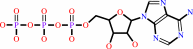 ATP
ATP
|
=
|
O-phospho-L-tyrosyl-[protein]
|
+
|
 ADP
ADP
|
+
|
H(+)
|
|
|
|
|
|
|
|
|
|
|
|
|
Molecule diagrams generated from .mol files obtained from the
KEGG ftp site
|
|
|
|
|
|
|
|
|
|
|
|
|
|
 |
|
|
|
|
|
|
| |
|
|
| |
|
|
Bioorg Med Chem Lett
19:424-427
(2009)
|
|
PubMed id:
|
|
|
|
|
|
| |
|
Pyridyl-pyrimidine benzimidazole derivatives as potent, selective, and orally bioavailable inhibitors of Tie-2 kinase.
|
|
V.J.Cee,
A.C.Cheng,
K.Romero,
S.Bellon,
C.Mohr,
D.A.Whittington,
A.Bak,
J.Bready,
S.Caenepeel,
A.Coxon,
H.L.Deak,
J.Fretland,
Y.Gu,
B.L.Hodous,
X.Huang,
J.L.Kim,
J.Lin,
A.M.Long,
H.Nguyen,
P.R.Olivieri,
V.F.Patel,
L.Wang,
Y.Zhou,
P.Hughes,
S.Geuns-Meyer.
|
|
|
|
|
| |
ABSTRACT
|
|
|
|
| |
|
|
Selective small molecule inhibitors of Tie-2 kinase are important tools for the
validation of Tie-2 signaling in pathological angiogenesis. Reported herein is
the optimization of a nonselective scaffold into a potent and highly selective
inhibitor of Tie-2 kinase.
|
|
|
|
|
|
|
|
|
|
|
|
|
|
|
|
|
|
 |
 |
 |
|


 Links
Links


