 |
PDBsum entry 3eqc

|
|
|
|
|
 |
Contents |
 |
|
|
|
|
|
|
|
|
|
|
|
|
|
|
* Residue conservation analysis
|
|
|
|
|
|
PDB id:
|
|
|
|
| Name: |
|
Transferase
|
|
|
Title:
|
|
X-ray structure of the human mitogen-activated protein kinase kinase 1 (mek1) in a ternary complex with compound 1, atp-gs and mg2p
|
|
Structure:
|
|
Dual specificity mitogen-activated protein kinase kinase 1. Chain: a. Fragment: protein kinase domain, unp residues 35-393. Synonym: map kinase kinase 1, mapkk 1, erk activator kinase 1, mapk/erk kinase 1, mek1. Engineered: yes. Mutation: yes
|
|
Source:
|
|
Homo sapiens. Human. Organism_taxid: 9606. Gene: map2k1, mek1, prkmk1
|
|
Resolution:
|
|
|
1.80Å
|
R-factor:
|
0.201
|
R-free:
|
0.235
|
|
|
Authors:
|
|
T.O.Fischmann
|
|
Key ref:
|
|
T.O.Fischmann
et al.
(2009).
Crystal structures of MEK1 binary and ternary complexes with nucleotides and inhibitors.
Biochemistry,
48,
2661-2674.
PubMed id:
|
|
|
Date:
|
|
|
30-Sep-08
|
Release date:
|
24-Feb-09
|
|
|
|
|
|
|
PROCHECK
|

|
|
|
|
|
Headers
|
|
|
|
References
|
|
|
|
|
|

|
|
Q02750
(MP2K1_HUMAN) -
Dual specificity mitogen-activated protein kinase kinase 1 from Homo sapiens
|
|
|
|
Seq:
Struc:
|
|
|
|
393 a.a.
312 a.a.
|
|

|

|

|
|
|
|
|
|
|
|
|
|
|
Key: |
 |
PfamA domain |
|
|
 |
Secondary structure |
|
 |
CATH domain |
|
|
|
|
|
|
|
|
|
|
|
|
|
Enzyme class:
|
|
E.C.2.7.12.2
- mitogen-activated protein kinase kinase.
|
|
|
|
|
|
|
Reaction:
|
|
|
1.
|
L-seryl-[protein] + ATP = O-phospho-L-seryl-[protein] + ADP + H+
|
|
2.
|
L-threonyl-[protein] + ATP = O-phospho-L-threonyl-[protein] + ADP + H+
|
|
3.
|
L-tyrosyl-[protein] + ATP = O-phospho-L-tyrosyl-[protein] + ADP + H+
|
|
|
|
|
|
|
L-seryl-[protein]
Bound ligand (Het Group name = )
matches with 93.75% similarity
|
+
|
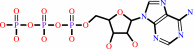 ATP
ATP
|
=
|
O-phospho-L-seryl-[protein]
|
+
|
 ADP
ADP
|
+
|
H(+)
|
|
|
|
|
|
|
L-threonyl-[protein]
Bound ligand (Het Group name = )
matches with 93.75% similarity
|
+
|
ATP
|
=
|
O-phospho-L-threonyl-[protein]
|
+
|
ADP
|
+
|
H(+)
|
|
|
|
|
|
|
L-tyrosyl-[protein]
Bound ligand (Het Group name = )
matches with 93.75% similarity
|
+
|
ATP
|
=
|
O-phospho-L-tyrosyl-[protein]
|
+
|
ADP
|
+
|
H(+)
|
|
|
|
|
|
|
|
|
|
|
|
|
Molecule diagrams generated from .mol files obtained from the
KEGG ftp site
|
|
|
|
|
|
|
|
|
|
|
|
|
|
 |
|
|
|
|
|
|
| |
|
|
| |
|
|
Biochemistry
48:2661-2674
(2009)
|
|
PubMed id:
|
|
|
|
|
|
| |
|
Crystal structures of MEK1 binary and ternary complexes with nucleotides and inhibitors.
|
|
T.O.Fischmann,
C.K.Smith,
T.W.Mayhood,
J.E.Myers,
P.Reichert,
A.Mannarino,
D.Carr,
H.Zhu,
J.Wong,
R.S.Yang,
H.V.Le,
V.S.Madison.
|
|
|
|
|
| |
ABSTRACT
|
|
|
|
| |
|
|
MEK1 is a member of the MAPK signal transduction pathway that responds to growth
factors and cytokines. We have determined that the kinase domain spans residues
35-382 by proteolytic cleavage. The complete kinase domain has been crystallized
and its X-ray crystal structure as a complex with magnesium and ATP-gammaS
determined at 2.1 A. Unlike crystals of a truncated kinase domain previously
published, the crystals of the intact domain can be grown either as a binary
complex with a nucleotide or as a ternary complex with a nucleotide and one of a
multitude of allosteric inhibitors. Further, the crystals allow for the
determination of costructures with ATP competitive inhibitors. We describe the
structures of nonphosphorylated MEK1 (npMEK1) binary complexes with ADP and
K252a, an ATP-competitive inhibitor (see Table 1), at 1.9 and 2.7 A resolution,
respectively. Ternary complexes have also been solved between npMEK1, a
nucleotide, and an allosteric non-ATP competitive inhibitor: ATP-gammaS with
compound 1 and ADP with either U0126 or the MEK1 clinical candidate PD325089 at
1.8, 2.0, and 2.5 A, respectively. Compound 1 is structurally similar to
PD325901. These structures illustrate fundamental differences among various
mechanisms of inhibition at the molecular level. Residues 44-51 have previously
been shown to play a negative regulatory role in MEK1 activity. The crystal
structure of the integral kinase domain provides a structural rationale for the
role of these residues. They form helix A and repress enzymatic activity by
stabilizing an inactive conformation in which helix C is displaced from its
active state position. Finally, the structure provides for the first time a
molecular rationale that explains how mutations in MEK may lead to the
cardio-facio-cutaneous syndrome.
|
|
|
|
|
|
|
|
|
|
|
|
|
|
|
|
|
|
 |
 |
 |
|
Literature references that cite this PDB file's key reference
|
|
|
| |
PubMed id
|
|
Reference
|
|
|
|
|
|
S.I.Nikolaev,
D.Rimoldi,
C.Iseli,
A.Valsesia,
D.Robyr,
C.Gehrig,
K.Harshman,
M.Guipponi,
O.Bukach,
V.Zoete,
O.Michielin,
K.Muehlethaler,
D.Speiser,
J.S.Beckmann,
I.Xenarios,
T.D.Halazonetis,
C.V.Jongeneel,
B.J.Stevenson,
and
S.E.Antonarakis
(2012).
Exome sequencing identifies recurrent somatic MAP2K1 and MAP2K2 mutations in melanoma.
|
| |
Nat Genet,
44,
133-139.
|
|
|
|
|
|
|
D.F.Brennan,
A.C.Dar,
N.T.Hertz,
W.C.Chao,
A.L.Burlingame,
K.M.Shokat,
and
D.Barford
(2011).
A Raf-induced allosteric transition of KSR stimulates phosphorylation of MEK.
|
| |
Nature,
472,
366-369.
|
|
|
PDB code:
|
|
|
|
|
|
|
|
K.W.Lee,
A.M.Bode,
and
Z.Dong
(2011).
Molecular targets of phytochemicals for cancer prevention.
|
| |
Nat Rev Cancer,
11,
211-218.
|
|
|
|
|
|
|
O.Fedorov,
K.Huber,
A.Eisenreich,
P.Filippakopoulos,
O.King,
A.N.Bullock,
D.Szklarczyk,
L.J.Jensen,
D.Fabbro,
J.Trappe,
U.Rauch,
F.Bracher,
and
S.Knapp
(2011).
Specific CLK inhibitors from a novel chemotype for regulation of alternative splicing.
|
| |
Chem Biol,
18,
67-76.
|
|
|
PDB codes:
|
|
|
|
|
|
|
|
D.X.Hou,
and
T.Kumamoto
(2010).
Flavonoids as protein kinase inhibitors for cancer chemoprevention: direct binding and molecular modeling.
|
| |
Antioxid Redox Signal,
13,
691-719.
|
|
|
|
|
|
|
C.M.Emery,
K.G.Vijayendran,
M.C.Zipser,
A.M.Sawyer,
L.Niu,
J.J.Kim,
C.Hatton,
R.Chopra,
P.A.Oberholzer,
M.B.Karpova,
L.E.MacConaill,
J.Zhang,
N.S.Gray,
W.R.Sellers,
R.Dummer,
and
L.A.Garraway
(2009).
MEK1 mutations confer resistance to MEK and B-RAF inhibition.
|
| |
Proc Natl Acad Sci U S A,
106,
20411-20416.
|
|
|
|
|
|
|
K.Fukuda,
S.Gupta,
K.Chen,
C.Wu,
and
J.Qin
(2009).
The pseudoactive site of ILK is essential for its binding to alpha-Parvin and localization to focal adhesions.
|
| |
Mol Cell,
36,
819-830.
|
|
|
PDB codes:
|
|
|
|
|
|
|
The most recent references are shown first.
Citation data come partly from CiteXplore and partly
from an automated harvesting procedure. Note that this is likely to be
only a partial list as not all journals are covered by
either method. However, we are continually building up the citation data
so more and more references will be included with time.
Where a reference describes a PDB structure, the PDB
code is
shown on the right.
|
|


 Links
Links


