 |
PDBsum entry 3d0e

|
|
|
|
|
|

|

|

|

|
|

|
|

|
|

|
|

|
|

|
|
|
 |

|

|
|
|
|
|
|
|
|
|
|
|
|
|
|
|
|
|
|
|
|
|
|
|
|
|
|
|
|
|
|
|
|
|
|
Transferase inhibitor
|
PDB id
|
|
|
|
3d0e
|
|
|
|
|
|
|
|
|
|
|
|
|
|
|

|

|

|
|
|
|
|
|
|
|
 |
Contents |
 |
|
|
|
|
|
|
|
|
|
|
|
|
* Residue conservation analysis
|
|
|
|
|
|
PDB id:
|
|
|
|
| Name: |
|
Transferase inhibitor
|
|
|
Title:
|
|
Crystal structure of human akt2 in complex with gsk690693
|
|
Structure:
|
|
Rac-beta serine/threonine-protein kinase. Chain: a, b. Fragment: kinase domain. Synonym: rac-pk-beta, protein kinase akt-2, protein kinase b, beta, pkb beta. Engineered: yes. Mutation: yes
|
|
Source:
|
|
Homo sapiens. Organism_taxid: 9606. Gene: akt2. Expressed in: spodoptera frugiperda. Expression_system_taxid: 7108. Expression_system_cell_line: sf9.
|
|
Resolution:
|
|
|
2.00Å
|
R-factor:
|
0.208
|
R-free:
|
0.246
|
|
|
Authors:
|
|
N.O.Concha,A.Smallwood
|
|
Key ref:
|
|
D.A.Heerding
et al.
(2008).
Identification of 4-(2-(4-amino-1,2,5-oxadiazol-3-yl)-1-ethyl-7-{[(3S)-3-piperidinylmethyl]oxy}-1H-imidazo[4,5-c]pyridin-4-yl)-2-methyl-3-butyn-2-ol (GSK690693), a novel inhibitor of AKT kinase.
J Med Chem,
51,
5663-5679.
PubMed id:
|
|
|
Date:
|
|
|
01-May-08
|
Release date:
|
21-Oct-08
|
|
|
|
|
|
|
PROCHECK
|

|
|
|
|
|
Headers
|
|
|
|
References
|
|
|
|
|
|

|
|
P31751
(AKT2_HUMAN) -
RAC-beta serine/threonine-protein kinase from Homo sapiens
|
|
|
|
Seq:
Struc:
|
|
|
|
481 a.a.
324 a.a.*
|
|

|

|

|
|
|
|
|
|
|
|
|
|
|
Key: |
 |
PfamA domain |
|
|
 |
Secondary structure |
|
 |
CATH domain |
|
|
*
PDB and UniProt seqs differ
at 3 residue positions (black
crosses)
|
|
|
|
|
|
|
|
|
|
|
|
|
Enzyme class:
|
|
E.C.2.7.11.1
- non-specific serine/threonine protein kinase.
|
|
|
|
|
|
|
Reaction:
|
|
|
1.
|
L-seryl-[protein] + ATP = O-phospho-L-seryl-[protein] + ADP + H+
|
|
2.
|
L-threonyl-[protein] + ATP = O-phospho-L-threonyl-[protein] + ADP + H+
|
|
|
|
|
|
|
L-seryl-[protein]
|
+
|
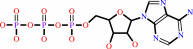 ATP
ATP
|
=
|
O-phospho-L-seryl-[protein]
|
+
|
 ADP
ADP
|
+
|
H(+)
|
|
|
|
|
|
|
L-threonyl-[protein]
|
+
|
ATP
|
=
|
O-phospho-L-threonyl-[protein]
|
+
|
ADP
|
+
|
H(+)
|
|
|
|
|
|
|
|
|
|
|
|
|
Molecule diagrams generated from .mol files obtained from the
KEGG ftp site
|
|
|
|
|
|
|
|
|
|
|
|
|
|
 |
|
|
|
|
|
|
| |
|
|
| |
|
|
J Med Chem
51:5663-5679
(2008)
|
|
PubMed id:
|
|
|
|
|
|
| |
|
Identification of 4-(2-(4-amino-1,2,5-oxadiazol-3-yl)-1-ethyl-7-{[(3S)-3-piperidinylmethyl]oxy}-1H-imidazo[4,5-c]pyridin-4-yl)-2-methyl-3-butyn-2-ol (GSK690693), a novel inhibitor of AKT kinase.
|
|
D.A.Heerding,
N.Rhodes,
J.D.Leber,
T.J.Clark,
R.M.Keenan,
L.V.Lafrance,
M.Li,
I.G.Safonov,
D.T.Takata,
J.W.Venslavsky,
D.S.Yamashita,
A.E.Choudhry,
R.A.Copeland,
Z.Lai,
M.D.Schaber,
P.J.Tummino,
S.L.Strum,
E.R.Wood,
D.R.Duckett,
D.Eberwein,
V.B.Knick,
T.J.Lansing,
R.T.McConnell,
S.Zhang,
E.A.Minthorn,
N.O.Concha,
G.L.Warren,
R.Kumar.
|
|
|
|
|
| |
ABSTRACT
|
|
|
|
| |
|
|
Overexpression of AKT has an antiapoptotic effect in many cell types, and
expression of dominant negative AKT blocks the ability of a variety of growth
factors to promote survival. Therefore, inhibitors of AKT kinase activity might
be useful as monotherapy for the treatment of tumors with activated AKT. Herein,
we describe our lead optimization studies culminating in the discovery of
compound 3g (GSK690693). Compound 3g is a novel ATP competitive, pan-AKT kinase
inhibitor with IC 50 values of 2, 13, and 9 nM against AKT1, 2, and 3,
respectively. An X-ray cocrystal structure was solved with 3g and the kinase
domain of AKT2, confirming that 3g bound in the ATP binding pocket. Compound 3g
potently inhibits intracellular AKT activity as measured by the inhibition of
the phosphorylation levels of GSK3beta. Intraperitoneal administration of 3g in
immunocompromised mice results in the inhibition of GSK3beta phosphorylation and
tumor growth in human breast carcinoma (BT474) xenografts.
|
|
|
|
|
|
|
|
|
|
|
|
|
|
|
|
|
|
 |
 |
 |
|
Literature references that cite this PDB file's key reference
|
|
|
| |
PubMed id
|
|
Reference
|
|
|
|
|
|
M.Roy,
B.V.Chakravarthi,
C.Jayabaskaran,
A.A.Karande,
and
A.R.Chakravarty
(2011).
Impact of metal binding on the antitumor activity and cellular imaging of a metal chelator cationic imidazopyridine derivative.
|
| |
Dalton Trans,
40,
4855-4864.
|
|
|
|
|
|
|
A.Ocaña,
and
A.Pandiella
(2010).
Personalized therapies in the cancer "omics" era.
|
| |
Mol Cancer,
9,
202.
|
|
|
|
|
|
|
D.A.Altomare,
L.Zhang,
J.Deng,
A.Di Cristofano,
A.J.Klein-Szanto,
R.Kumar,
and
J.R.Testa
(2010).
GSK690693 delays tumor onset and progression in genetically defined mouse models expressing activated Akt.
|
| |
Clin Cancer Res,
16,
486-496.
|
|
|
|
|
|
|
T.McHardy,
J.J.Caldwell,
K.M.Cheung,
L.J.Hunter,
K.Taylor,
M.Rowlands,
R.Ruddle,
A.Henley,
A.de Haven Brandon,
M.Valenti,
T.G.Davies,
L.Fazal,
L.Seavers,
F.I.Raynaud,
S.A.Eccles,
G.W.Aherne,
M.D.Garrett,
and
I.Collins
(2010).
Discovery of 4-amino-1-(7H-pyrrolo[2,3-d]pyrimidin-4-yl)piperidine-4-carboxamides as selective, orally active inhibitors of protein kinase B (Akt).
|
| |
J Med Chem,
53,
2239-2249.
|
|
|
PDB codes:
|
|
|
|
|
|
|
|
T.Okuzumi,
G.S.Ducker,
C.Zhang,
B.Aizenstein,
R.Hoffman,
and
K.M.Shokat
(2010).
Synthesis and evaluation of indazole based analog sensitive Akt inhibitors.
|
| |
Mol Biosyst,
6,
1389-1402.
|
|
|
|
|
|
|
J.A.Engelman
(2009).
Targeting PI3K signalling in cancer: opportunities, challenges and limitations.
|
| |
Nat Rev Cancer,
9,
550-562.
|
|
|
|
|
|
|
T.Okuzumi,
D.Fiedler,
C.Zhang,
D.C.Gray,
B.Aizenstein,
R.Hoffman,
and
K.M.Shokat
(2009).
Inhibitor hijacking of Akt activation.
|
| |
Nat Chem Biol,
5,
484-493.
|
|
|
|
|
|
The most recent references are shown first.
Citation data come partly from CiteXplore and partly
from an automated harvesting procedure. Note that this is likely to be
only a partial list as not all journals are covered by
either method. However, we are continually building up the citation data
so more and more references will be included with time.
Where a reference describes a PDB structure, the PDB
codes are
shown on the right.
|
|


 Links
Links


