 |
PDBsum entry 3csf

|
|
|
|
|
 |
Contents |
 |
|
|
|
|
|
|
|
|
|
|
|
|
* Residue conservation analysis
|
|
|
|
|
|
|
|
|
|
|
Enzyme class 2:
|
|
E.C.2.7.11.1
- non-specific serine/threonine protein kinase.
|
|
|
|
|
|
|
Reaction:
|
|
|
1.
|
L-seryl-[protein] + ATP = O-phospho-L-seryl-[protein] + ADP + H+
|
|
2.
|
L-threonyl-[protein] + ATP = O-phospho-L-threonyl-[protein] + ADP + H+
|
|
|
|
|
|
|
L-seryl-[protein]
|
+
|
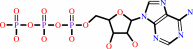 ATP
ATP
|
=
|
O-phospho-L-seryl-[protein]
|
+
|
 ADP
ADP
|
+
|
H(+)
|
|
|
|
|
|
|
L-threonyl-[protein]
|
+
|
ATP
|
=
|
O-phospho-L-threonyl-[protein]
|
+
|
ADP
|
+
|
H(+)
|
|
|
|
|
|
|
|
|
|
Enzyme class 3:
|
|
E.C.2.7.1.137
- phosphatidylinositol 3-kinase.
|
|
|
|
|
|
|
Pathway:
|
|
|
|
|
|
|
|
Reaction:
|
|
a 1,2-diacyl-sn-glycero-3-phospho-(1D-myo-inositol) + ATP = a 1,2-diacyl- sn-glycero-3-phospho-(1D-myo-inositol-3-phosphate) + ADP + H+
|
|
|
|
|
|
1,2-diacyl-sn-glycero-3-phospho-(1D-myo-inositol)
|
+
|
ATP
|
=
|
1,2-diacyl- sn-glycero-3-phospho-(1D-myo-inositol-3-phosphate)
|
+
|
ADP
|
+
|
H(+)
|
|
|
|
|
|
|
|
|
|
Enzyme class 4:
|
|
E.C.2.7.1.153
- phosphatidylinositol-4,5-bisphosphate 3-kinase.
|
|
|
|
|
|
|
Pathway:
|
|
|
|
|
|
|
|
Reaction:
|
|
a 1,2-diacyl-sn-glycero-3-phospho-(1D-myo-inositol-4,5-bisphosphate) + ATP = a 1,2-diacyl-sn-glycero-3-phospho-(1D-myo-inositol-3,4,5- trisphosphate) + ADP + H+
|
|
|
|
|
|
1,2-diacyl-sn-glycero-3-phospho-(1D-myo-inositol-4,5-bisphosphate)
|
+
|
ATP
|
=
|
1,2-diacyl-sn-glycero-3-phospho-(1D-myo-inositol-3,4,5- trisphosphate)
|
+
|
ADP
|
+
|
H(+)
|
|
|
|
|
|
|
|
|
|
Enzyme class 5:
|
|
E.C.2.7.1.154
- phosphatidylinositol-4-phosphate 3-kinase.
|
|
|
|
|
|
|
Pathway:
|
|
|
|
|
|
|
|
Reaction:
|
|
a 1,2-diacyl-sn-glycero-3-phospho-(1D-myo-inositol 4-phosphate) + ATP = a 1,2-diacyl-sn-glycero-3-phospho-(1D-myo-inositol-3,4-bisphosphate) + ADP + H+
|
|
|
|
|
|
1,2-diacyl-sn-glycero-3-phospho-(1D-myo-inositol 4-phosphate)
|
+
|
ATP
|
=
|
1,2-diacyl-sn-glycero-3-phospho-(1D-myo-inositol-3,4-bisphosphate)
|
+
|
ADP
|
+
|
H(+)
|
|
|
|
|
|
|
|
|
|
|
|
|
Note, where more than one E.C. class is given (as above), each may
correspond to a different protein domain or, in the case of polyprotein
precursors, to a different mature protein.
|
|
|
|
Molecule diagrams generated from .mol files obtained from the
KEGG ftp site
|
|
|
|
|
|
|
|
|
|
|
|
|
|
 |
|
|
|
|
|
|
| |
|
|
| |
|
DOI no:
|
Acs Chem Biol
3:305-316
(2008)
|
|
PubMed id:
|
|
|
|
|
|
| |
|
Structure-based design of an organoruthenium phosphatidyl-inositol-3-kinase inhibitor reveals a switch governing lipid kinase potency and selectivity.
|
|
P.Xie,
D.S.Williams,
G.E.Atilla-Gokcumen,
L.Milk,
M.Xiao,
K.S.Smalley,
M.Herlyn,
E.Meggers,
R.Marmorstein.
|
|
|
|
|
| |
ABSTRACT
|
|
|
|
| |
|
|
Mutations that constitutively activate the phosphatidyl-inositol-3-kinase (PI3K)
signaling pathway, including alterations in PI3K, PTEN, and AKT, are found in a
variety of human cancers, implicating the PI3K lipid kinase as an attractive
target for the development of therapeutic agents to treat cancer and other
related diseases. In this study, we report on the combination of a novel
organometallic kinase inhibitor scaffold with structure-based design to develop
a PI3K inhibitor, called E5E2, with an IC 50 potency in the mid-low-nanomolar
range and selectivity against a panel of protein kinases. We also show that E5E2
inhibits phospho-AKT in human melanoma cells and leads to growth inhibition.
Consistent with a role for the PI3K pathway in tumor cell invasion, E5E2
treatment also inhibits the migration of melanoma cells in a 3D spheroid assay.
The structure of the PI3Kgamma/E5E2 complex reveals the molecular features that
give rise to this potency and selectivity toward lipid kinases with implications
for the design of a subsequent generation of PI3K-isoform-specific
organometallic inhibitors.
|
|
|
|
|
|
|
|
|
|
|
|
|
|
|
|
|
|
 |
 |
 |
|
Literature references that cite this PDB file's key reference
|
|
|
| |
PubMed id
|
|
Reference
|
|
|
|
|
|
G.E.Atilla-Gokcumen,
L.Di Costanzo,
and
E.Meggers
(2011).
Structure of anticancer ruthenium half-sandwich complex bound to glycogen synthase kinase 3β.
|
| |
J Biol Inorg Chem,
16,
45-50.
|
|
|
PDB code:
|
|
|
|
|
|
|
|
C.Y.Liew,
X.H.Ma,
and
C.W.Yap
(2010).
Consensus model for identification of novel PI3K inhibitors in large chemical library.
|
| |
J Comput Aided Mol Des,
24,
131-141.
|
|
|
|
|
|
|
P.Heffeter,
K.Böck,
B.Atil,
M.A.Reza Hoda,
W.Körner,
C.Bartel,
U.Jungwirth,
B.K.Keppler,
M.Micksche,
W.Berger,
and
G.Koellensperger
(2010).
Intracellular protein binding patterns of the anticancer ruthenium drugs KP1019 and KP1339.
|
| |
J Biol Inorg Chem,
15,
737-748.
|
|
|
|
|
|
|
S.B.Gabelli,
D.Mandelker,
O.Schmidt-Kittler,
B.Vogelstein,
and
L.M.Amzel
(2010).
Somatic mutations in PI3Kalpha: structural basis for enzyme activation and drug design.
|
| |
Biochim Biophys Acta,
1804,
533-540.
|
|
|
|
|
|
|
E.Meggers
(2009).
Targeting proteins with metal complexes.
|
| |
Chem Commun (Camb),
(),
1001-1010.
|
|
|
|
|
|
|
K.L.Haas,
and
K.J.Franz
(2009).
Application of metal coordination chemistry to explore and manipulate cell biology.
|
| |
Chem Rev,
109,
4921-4960.
|
|
|
|
|
|
|
N.Pagano,
E.Y.Wong,
T.Breiding,
H.Liu,
A.Wilbuer,
H.Bregman,
Q.Shen,
S.L.Diamond,
and
E.Meggers
(2009).
From imide to lactam metallo-pyridocarbazoles: distinct scaffolds for the design of selective protein kinase inhibitors.
|
| |
J Org Chem,
74,
8997-9009.
|
|
|
|
|
|
|
P.Xie,
C.Streu,
J.Qin,
H.Bregman,
N.Pagano,
E.Meggers,
and
R.Marmorstein
(2009).
The crystal structure of BRAF in complex with an organoruthenium inhibitor reveals a mechanism for inhibition of an active form of BRAF kinase.
|
| |
Biochemistry,
48,
5187-5198.
|
|
|
PDB code:
|
|
|
|
|
|
|
|
R.Anand,
J.Maksimoska,
N.Pagano,
E.Y.Wong,
P.A.Gimotty,
S.L.Diamond,
E.Meggers,
and
R.Marmorstein
(2009).
Toward the development of a potent and selective organoruthenium mammalian sterile 20 kinase inhibitor.
|
| |
J Med Chem,
52,
1602-1611.
|
|
|
|
|
|
|
T.J.Sundstrom,
A.C.Anderson,
and
D.L.Wright
(2009).
Inhibitors of phosphoinositide-3-kinase: a structure-based approach to understanding potency and selectivity.
|
| |
Org Biomol Chem,
7,
840-850.
|
|
|
|
|
|
|
G.E.Atilla-Gokcumen,
N.Pagano,
C.Streu,
J.Maksimoska,
P.Filippakopoulos,
S.Knapp,
and
E.Meggers
(2008).
Extremely tight binding of a ruthenium complex to glycogen synthase kinase 3.
|
| |
Chembiochem,
9,
2933-2936.
|
|
|
PDB code:
|
|
|
|
|
|
|
The most recent references are shown first.
Citation data come partly from CiteXplore and partly
from an automated harvesting procedure. Note that this is likely to be
only a partial list as not all journals are covered by
either method. However, we are continually building up the citation data
so more and more references will be included with time.
Where a reference describes a PDB structure, the PDB
code is
shown on the right.
|
|


 Links
Links


