
|
|
|
|
|
 |
Contents |
 |
|
|
|
|
|
|
|
|
|
|
|
|
* Residue conservation analysis
|
|
|
|
|
|
PDB id:
|
|
|
|
| Name: |
|
Membrane protein, protein transport
|
|
|
Title:
|
|
Crystal structural of native escu c-terminal domain
|
|
Structure:
|
|
Escu. Chain: a. Fragment: unp residues 215-262. Engineered: yes. Escu. Chain: b. Fragment: unp residues 263-345. Engineered: yes
|
|
Source:
|
|
Escherichia coli. Organism_taxid: 562. Strain: epec e2348/69. Gene: escu. Expressed in: escherichia coli bl21(de3). Expression_system_taxid: 469008.
|
|
Resolution:
|
|
|
1.50Å
|
R-factor:
|
0.203
|
R-free:
|
0.225
|
|
|
Authors:
|
|
R.Zarivach,W.Deng,M.Vuckovic,H.B.Felise,H.V.Nguyen,S.I.Miller, B.B.Finlay,N.C.J.Strynadka
|
Key ref:

|
|
R.Zarivach
et al.
(2008).
Structural analysis of the essential self-cleaving type III secretion proteins EscU and SpaS.
Nature,
453,
124-127.
PubMed id:
DOI:

|
|
|
Date:
|
|
|
18-Jan-08
|
Release date:
|
22-Apr-08
|
|
|
|
|
|
|
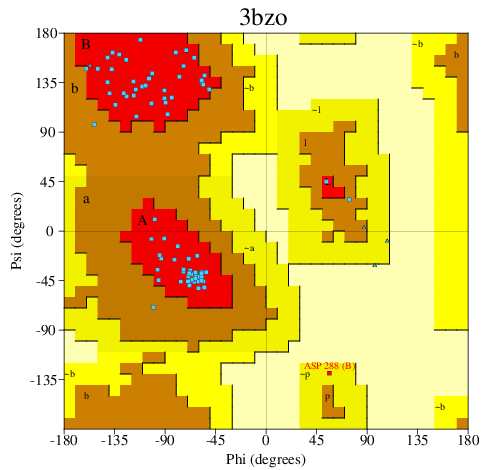
PROCHECK
|
|
|
|
|
|
Headers
|
|
|
|
References
|
|
|
|
|
|
|
|
|
|
|
|
|
|
|
|
 |
|
|
|
|
|
|
| |
|
DOI no:
|
Nature
453:124-127
(2008)
|
|
PubMed id:
|
|
|
|
|
|
| |
|
Structural analysis of the essential self-cleaving type III secretion proteins EscU and SpaS.
|
|
R.Zarivach,
W.Deng,
M.Vuckovic,
H.B.Felise,
H.V.Nguyen,
S.I.Miller,
B.B.Finlay,
N.C.Strynadka.
|
|
|
|
|
| |
ABSTRACT
|
|
|
|
| |
|
|
During infection by Gram-negative pathogenic bacteria, the type III secretion
system (T3SS) is assembled to allow for the direct transmission of bacterial
virulence effectors into the host cell. The T3SS system is characterized by a
series of prominent multi-component rings in the inner and outer bacterial
membranes, as well as a translocation pore in the host cell membrane. These are
all connected by a series of polymerized tubes that act as the direct conduit
for the T3SS proteins to pass through to the host cell. During assembly of the
T3SS, as well as the evolutionarily related flagellar apparatus, a
post-translational cleavage event within the inner membrane proteins EscU/FlhB
is required to promote a secretion-competent state. These proteins have long
been proposed to act as a part of a molecular switch, which would regulate the
appropriate chronological secretion of the various T3SS apparatus components
during assembly and subsequently the transported virulence effectors. Here we
show that a surface type II beta-turn in the Escherichia coli protein EscU
undergoes auto-cleavage by a mechanism involving cyclization of a strictly
conserved asparagine residue. Structural and in vivo analysis of point and
deletion mutations illustrates the subtle conformational effects of
auto-cleavage in modulating the molecular features of a highly conserved surface
region of EscU, a potential point of interaction with other T3SS components at
the inner membrane. In addition, this work provides new structural insight into
the distinct conformational requirements for a large class of self-cleaving
reactions involving asparagine cyclization.
|
|
|
|
|
|
| |
Selected figure(s)
|
|
|
|
| |
|
|

|
|

|
|
Figure 1.
Figure 1: Structure of the C-terminal domains of EscU and SpaS.
a, The native cleaved CTD of EscU and SpaS with a blue arrow
pointing to the auto-cleavage site. CTD is a novel  / /
 -fold
with a mixed parallel and anti-parallel five-stranded twisted
-sheet
(topology 4,
1,
2,
3,
5)
flanked by two helices on each side ( 1,
2,
3
and 4).
b, Superposition of the CTD reveals a different fold for the
N-terminal linker between EscU, EscU mutants and SpaS, as well
as a longer C-terminal helix for SpaS. -fold
with a mixed parallel and anti-parallel five-stranded twisted
-sheet
(topology 4,
1,
2,
3,
5)
flanked by two helices on each side ( 1,
2,
3
and 4).
b, Superposition of the CTD reveals a different fold for the
N-terminal linker between EscU, EscU mutants and SpaS, as well
as a longer C-terminal helix for SpaS.
|
|
Figure 3.
Figure 3: Auto-cleaving mechanism of EscU. a, Non-cleaved
type I -bend
of P263A (left), the non-cleaved type II beta bend of N262A
(middle left), the non-cleaved type II beta bend of N262Di
(middle right) and the native cleaved loop with a flipped His
265 (right). Note the identical conformations of the N, C, C
and
C at
position 262 in all uncleaved forms. All maps are sigma-A
weighted 2F[o] - F[c] electron density (1.5  );
water molecules are represented by the red spheres. b, Detailed
mechanism for the asparagine cyclization in EscU. );
water molecules are represented by the red spheres. b, Detailed
mechanism for the asparagine cyclization in EscU.
|
|
|
|
|
|
| |
The above figures are
reprinted
by permission from Macmillan Publishers Ltd:
Nature
(2008,
453,
124-127)
copyright 2008.
|
|
| |
Figures were
selected
by an automated process.
|
|
|
|
|
|
|
|
|
|
|
|
|
|
|
|
 |
 |
 |
|
Literature references that cite this PDB file's key reference
|
|
|
| |
PubMed id
|
|
Reference
|
|
|
|
|
|
C.Lorenz,
and
D.Büttner
(2011).
Secretion of early and late substrates of the type III secretion system from Xanthomonas is controlled by HpaC and the C-terminal domain of HrcU.
|
| |
Mol Microbiol,
79,
447-467.
|
|
|
|
|
|
|
L.J.Worrall,
E.Lameignere,
and
N.C.Strynadka
(2011).
Structural overview of the bacterial injectisome.
|
| |
Curr Opin Microbiol,
14,
3-8.
|
|
|
|
|
|
|
S.E.Osborne,
and
B.K.Coombes
(2011).
Expression and secretion hierarchy in the nonflagellar type III secretion system.
|
| |
Future Microbiol,
6,
193-202.
|
|
|
|
|
|
|
A.Botteaux,
C.A.Kayath,
A.L.Page,
N.Jouihri,
M.Sani,
E.Boekema,
L.Biskri,
C.Parsot,
and
A.Allaoui
(2010).
The 33 carboxyl-terminal residues of Spa40 orchestrate the multi-step assembly process of the type III secretion needle complex in Shigella flexneri.
|
| |
Microbiology,
156,
2807-2817.
|
|
|
|
|
|
|
C.Berger,
G.P.Robin,
U.Bonas,
and
R.Koebnik
(2010).
Membrane topology of conserved components of the type III secretion system from the plant pathogen Xanthomonas campestris pv. vesicatoria.
|
| |
Microbiology,
156,
1963-1974.
|
|
|
|
|
|
|
C.S.Barker,
I.V.Meshcheryakova,
A.S.Kostyukova,
and
F.A.Samatey
(2010).
FliO regulation of FliP in the formation of the Salmonella enterica flagellum.
|
| |
PLoS Genet,
6,
0.
|
|
|
|
|
|
|
G.R.Cornelis
(2010).
The type III secretion injectisome, a complex nanomachine for intracellular 'toxin' delivery.
|
| |
Biol Chem,
391,
745-751.
|
|
|
|
|
|
|
J.E.Deane,
P.Abrusci,
S.Johnson,
and
S.M.Lea
(2010).
Timing is everything: the regulation of type III secretion.
|
| |
Cell Mol Life Sci,
67,
1065-1075.
|
|
|
|
|
|
|
J.K.Anderson,
T.G.Smith,
and
T.R.Hoover
(2010).
Sense and sensibility: flagellum-mediated gene regulation.
|
| |
Trends Microbiol,
18,
30-37.
|
|
|
|
|
|
|
L.J.Worrall,
M.Vuckovic,
and
N.C.Strynadka
(2010).
Crystal structure of the C-terminal domain of the Salmonella type III secretion system export apparatus protein InvA.
|
| |
Protein Sci,
19,
1091-1096.
|
|
|
PDB codes:
|
|
|
|
|
|
|
|
T.C.Marlovits,
and
C.E.Stebbins
(2010).
Type III secretion systems shape up as they ship out.
|
| |
Curr Opin Microbiol,
13,
47-52.
|
|
|
|
|
|
|
A.C.Björnfot,
M.Lavander,
A.Forsberg,
and
H.Wolf-Watz
(2009).
Autoproteolysis of YscU of Yersinia pseudotuberculosis is important for regulation of expression and secretion of Yop proteins.
|
| |
J Bacteriol,
191,
4259-4267.
|
|
|
|
|
|
|
A.Danchin
(2009).
Natural selection and immortality.
|
| |
Biogerontology,
10,
503-516.
|
|
|
|
|
|
|
G.T.Lountos,
B.P.Austin,
S.Nallamsetty,
and
D.S.Waugh
(2009).
Atomic resolution structure of the cytoplasmic domain of Yersinia pestis YscU, a regulatory switch involved in type III secretion.
|
| |
Protein Sci,
18,
467-474.
|
|
|
PDB codes:
|
|
|
|
|
|
|
|
J.J.Tree,
E.B.Wolfson,
D.Wang,
A.J.Roe,
and
D.L.Gally
(2009).
Controlling injection: regulation of type III secretion in enterohaemorrhagic Escherichia coli.
|
| |
Trends Microbiol,
17,
361-370.
|
|
|
|
|
|
|
M.E.Charbonneau,
J.Janvore,
and
M.Mourez
(2009).
Autoprocessing of the Escherichia coli AIDA-I Autotransporter: A NEW MECHANISM INVOLVING ACIDIC RESIDUES IN THE JUNCTION REGION.
|
| |
J Biol Chem,
284,
17340-17351.
|
|
|
|
|
|
|
T.G.Smith,
L.Pereira,
and
T.R.Hoover
(2009).
Helicobacter pylori FlhB processing-deficient variants affect flagellar assembly but not flagellar gene expression.
|
| |
Microbiology,
155,
1170-1180.
|
|
|
|
|
|
|
T.Minamino,
N.Moriya,
T.Hirano,
K.T.Hughes,
and
K.Namba
(2009).
Interaction of FliK with the bacterial flagellar hook is required for efficient export specificity switching.
|
| |
Mol Microbiol,
74,
239-251.
|
|
|
|
|
|
|
J.E.Deane,
S.C.Graham,
E.P.Mitchell,
D.Flot,
S.Johnson,
and
S.M.Lea
(2008).
Crystal structure of Spa40, the specificity switch for the Shigella flexneri type III secretion system.
|
| |
Mol Microbiol,
69,
267-276.
|
|
|
PDB code:
|
|
|
|
|
|
|
The most recent references are shown first.
Citation data come partly from CiteXplore and partly
from an automated harvesting procedure. Note that this is likely to be
only a partial list as not all journals are covered by
either method. However, we are continually building up the citation data
so more and more references will be included with time.
Where a reference describes a PDB structure, the PDB
codes are
shown on the right.
|
 |


 Links
Links


