 |
PDBsum entry 3a4l

|
|
|
|
|
 |
Contents |
 |
|
|
|
|
|
|
|
|
|
|
|
|
|
|
* Residue conservation analysis
|
|
|
|
|
|
|
|
|
|
|
Enzyme class:
|
|
E.C.2.7.1.164
- O-phosphoseryl-tRNA(Sec) kinase.
|
|
|
|
|
|
|
Reaction:
|
|
L-seryl-tRNA(Sec) + ATP = O-phospho-L-seryl-tRNA(Sec) + ADP
|
|
|
|
|
|
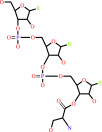 L-seryl-tRNA(Sec)
|
+
|
 ATP
ATP
|
=
|
O-phospho-L-seryl-tRNA(Sec)
Bound ligand (Het Group name = )
matches with 81.25% similarity
|
+
|
 ADP
ADP
|
|
|
|
|
|
|
|
|
|
|
|
|
Molecule diagrams generated from .mol files obtained from the
KEGG ftp site
|
|
|
|
|
|
|
|
|
|
|
|
|
|
 |
|
|
|
|
|
|
| |
|
|
| |
|
DOI no:
|
Proc Natl Acad Sci U S A
106:16215-16220
(2009)
|
|
PubMed id:
|
|
|
|
|
|
| |
|
Structure of a tRNA-dependent kinase essential for selenocysteine decoding.
|
|
Y.Araiso,
R.L.Sherrer,
R.Ishitani,
J.M.Ho,
D.Söll,
O.Nureki.
|
|
|
|
|
| |
ABSTRACT
|
|
|
|
| |
|
|
Compared to bacteria, archaea and eukaryotes employ an additional enzyme for the
biosynthesis of selenocysteine (Sec), the 21(st) natural amino acid (aa). An
essential RNA-dependent kinase, O-phosphoseryl-tRNA(Sec) kinase (PSTK), converts
seryl-tRNA(Sec) to O-phosphoseryl-tRNA(Sec), the immediate precursor of
selenocysteinyl-tRNA(Sec). The sequence of Methanocaldococcus jannaschii PSTK
(MjPSTK) suggests an N-terminal kinase domain (177 aa) followed by a presumed
tRNA binding region (75 aa). The structures of MjPSTK complexed with ADP and
AMPPNP revealed that this enzyme belongs to the P-loop kinase class, and that
the kinase domain is closely related to gluconate kinase and adenylate kinase.
ATP is bound by the P-loop domain (residues 11-18). Formed by antiparallel
dimerization of two PSTK monomers, the enzyme structure shows a deep groove with
positive electrostatic potential. Located in this groove is the enzyme's active
site, which biochemical and genetic data suggest is composed of Asp-41, Arg-44,
Glu-55, Tyr-82, Tyr-83, Met-86, and Met-132. Based on structural comparison with
Escherichia coli adenylate kinase a docking model was generated that assigns
these amino acids to the recognition of the terminal A76-Ser moieties of
Ser-tRNA(Sec). The geometry and electrostatic environment of the groove in
MjPSTK are perfectly complementary to the unusually long acceptor helix of
tRNA(Sec).
|
|
|
|
|
|
| |
Selected figure(s)
|
|
|
|
| |
|
|

|
|

|
|
Figure 1.
Overall structure of MjPSTK. (A) Ribbon representation of the
crystal structure of the MjPSTK dimer, consisting of the
N-terminal domain (residues 3–177, blue) and the C-terminal
domain (188–231 and 237–252, orange). The AMPPNP molecule is
shown as a ball-and-stick model. (B) Surface representations of
PSTK (left), rotated 90° (right), consisting of the core
region (residues 3–39, 52–117, and 126–177, blue), the
A76-binding region (40–51, green) the lid region (118–125,
yellow), and the C-terminal domain (188–231 and 237–252,
orange), with the active site colored pink. The
solvent-accessible surface was calculated with the program MSMS
(26). The AMPPNP molecule is shown as a ball-and-stick model.
The white and black arrows show the width and the depth,
respectively, of the tRNA binding groove.
|
|
Figure 2.
The detailed structure of the N-terminal and C-terminal
domains. (A) Ribbon representation of the crystal structure of
the N-terminal domain. Each region is defined according to Fig.
1. (B) Ribbon representation of the crystal structure of the
C-terminal domain, defined according to Fig. 1. The iodide ion
is colored yellow. (C) The N-terminal domain of E. coli AdK in
complex with ADP. (D) The N-terminal domain of E. coli GntK in
complex with AMPPCP. The coloring scheme is the same as in (A).
|
|
|
|
| |
Figures were
selected
by an automated process.
|
|
|
|
|
|
|
|
|
|
|
|
|
|
|
|
 |
 |
 |
|
Literature references that cite this PDB file's key reference
|
|
|
| |
PubMed id
|
|
Reference
|
|
|
|
|
|
R.L.Sherrer,
Y.Araiso,
C.Aldag,
R.Ishitani,
J.M.Ho,
D.Söll,
and
O.Nureki
(2011).
C-terminal domain of archaeal O-phosphoseryl-tRNA kinase displays large-scale motion to bind the 7-bp D-stem of archaeal tRNA(Sec).
|
| |
Nucleic Acids Res,
39,
1034-1041.
|
|
|
PDB code:
|
|
|
|
|
|
|
|
M.Rother,
and
J.A.Krzycki
(2010).
Selenocysteine, pyrrolysine, and the unique energy metabolism of methanogenic archaea.
|
| |
Archaea,
2010,
0.
|
|
|
|
|
|
|
S.Palioura,
J.Herkel,
M.Simonović,
A.W.Lohse,
and
D.Söll
(2010).
Human SepSecS or SLA/LP: selenocysteine formation and autoimmune hepatitis.
|
| |
Biol Chem,
391,
771-776.
|
|
|
|
|
|
The most recent references are shown first.
Citation data come partly from CiteXplore and partly
from an automated harvesting procedure. Note that this is likely to be
only a partial list as not all journals are covered by
either method. However, we are continually building up the citation data
so more and more references will be included with time.
Where a reference describes a PDB structure, the PDB
code is
shown on the right.
|
|


 Links
Links


