 |
PDBsum entry 2xac

|
|
|
|
|
|

|

|

|

|
|

|
|

|
|

|
|

|
|

|
|

|
|

|
|
|
 |

|

|
|
|
|
|
|
|
|
|
|
|
|
|
|
|
|
|
|
|
|
|
|
|
|
|
|
|
|
|
|
|
|
|
|
|
|
Transferase/signaling protein
|
PDB id
|
|
|
|
2xac
|
|
|
|
|
|
|
|
|
|
|
|
|
|
|

|

|

|
|
|
|
|
|
|
|
 |
Contents |
 |
|
|
|
|
|
|
|
|
|
|
|
|
* Residue conservation analysis
|
|
|
|
|
|
PDB id:
|
|
|
|
| Name: |
|
Transferase/signaling protein
|
|
|
Title:
|
|
Structural insights into the binding of vegf-b by vegfr-1d2: recognition and specificity
|
|
Structure:
|
|
Vascular endothelial growth factor b. Chain: a, b. Fragment: receptor-binding domain, residues 31-129. Synonym: vegf-b, vegf-related factor, vrf. Engineered: yes. Vascular endothelial growth factor receptor 1. Chain: c, x. Fragment: domain 2, residues 129-226. Synonym: vegfr-1, vascular permeability factor receptor, tyrosine-
|
|
Source:
|
|
Homo sapiens. Human. Organism_taxid: 9606. Expressed in: escherichia coli. Expression_system_taxid: 562. Expression_system_taxid: 469008.
|
|
Resolution:
|
|
|
2.71Å
|
R-factor:
|
0.286
|
R-free:
|
0.364
|
|
|
Authors:
|
|
S.Iyer,P.Darley,K.R.Acharya
|
|
Key ref:
|
|
S.Iyer
et al.
(2010).
Structural insights into the binding of vascular endothelial growth factor-B by VEGFR-1(D2): recognition and specificity.
J Biol Chem,
285,
23779-23789.
PubMed id:
|
|
|
Date:
|
|
|
30-Mar-10
|
Release date:
|
19-May-10
|
|
|
|
|
|
|
PROCHECK
|

|
|
|
|
|
Headers
|
|
|
|
References
|
|
|
|
|
|
|
|
|
|
|
|
Enzyme class:
|
|
Chains C, X:
E.C.2.7.10.1
- receptor protein-tyrosine kinase.
|
|
|
|
|
|
|
Reaction:
|
|
L-tyrosyl-[protein] + ATP = O-phospho-L-tyrosyl-[protein] + ADP + H+
|
|
|
|
|
|
L-tyrosyl-[protein]
|
+
|
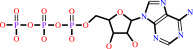 ATP
ATP
|
=
|
O-phospho-L-tyrosyl-[protein]
|
+
|
 ADP
ADP
|
+
|
H(+)
|
|
|
|
|
|
|
|
|
|
|
|
|
Molecule diagrams generated from .mol files obtained from the
KEGG ftp site
|
|
|
|
|
|
|
|
|
|
|
|
|
|
 |
|
|
|
|
|
|
| |
|
|
| |
|
|
J Biol Chem
285:23779-23789
(2010)
|
|
PubMed id:
|
|
|
|
|
|
| |
|
Structural insights into the binding of vascular endothelial growth factor-B by VEGFR-1(D2): recognition and specificity.
|
|
S.Iyer,
P.I.Darley,
K.R.Acharya.
|
|
|
|
|
| |
ABSTRACT
|
|
|
|
| |
|
|
The formation of blood vessels (angiogenesis) is a highly orchestrated sequence
of events involving crucial receptor-ligand interactions. Angiogenesis is
critical for physiological processes such as development, wound healing,
reproduction, tissue regeneration and remodeling. It also plays a major role in
sustaining tumor progression and chronic inflammation. Vascular Endothelial
Growth Factor-B (VEGF-B), a member of the VEGF family of angiogenic growth
factors, effects blood vessel formation by binding to a tyrosine kinase
receptor, VEGFR-1. There is growing evidence of the important role played by
VEGF-B in physiological and pathological vasculogenesis. Development of VEGF-B
antagonists, which inhibit the interaction of this molecule with its cognate
receptor, would be important for the treatment of pathologies associated
specifically with this growth factor. In this study we present the crystal
structure of the complex of VEGF-B with domain 2 of VEGFR-1 at 2.7A resolution.
Our analysis reveals that each molecule of the ligand engages two receptor
molecules using two symmetrical binding sites. Based on these interactions we
identify the receptor-binding determinants on VEGF-B and shed light on the
differences in specificity towards VEGFR-1 among the different VEGF homologs.
|
|
|
|
|
|
|
|
|
|
|
|
|
|
|
|
|
|
 |
 |
 |
|
Literature references that cite this PDB file's key reference
|
|
|
| |
PubMed id
|
|
Reference
|
|
|
|
|
|
V.M.Leppänen,
M.Jeltsch,
A.Anisimov,
D.Tvorogov,
K.Aho,
N.Kalkkinen,
P.Toivanen,
S.Ylä-Herttuala,
K.Ballmer-Hofer,
and
K.Alitalo
(2011).
Structural determinants of vascular endothelial growth factor-D receptor binding and specificity.
|
| |
Blood,
117,
1507-1515.
|
|
|
PDB code:
|
|
|
|
|
|
|
The most recent references are shown first.
Citation data come partly from CiteXplore and partly
from an automated harvesting procedure. Note that this is likely to be
only a partial list as not all journals are covered by
either method. However, we are continually building up the citation data
so more and more references will be included with time.
Where a reference describes a PDB structure, the PDB
code is
shown on the right.
|
|
|


 Links
Links


