 |
PDBsum entry 2wxl

|
|
|
|
|
 |
Contents |
 |
|
|
|
|
|
|
|
|
|
|
|
|
* Residue conservation analysis
|
|
|
|
|
|
PDB id:
|
|
|
|
| Name: |
|
Transferase
|
|
|
Title:
|
|
The crystal structure of the murine class ia pi 3-kinase p110delta in complex with zstk474.
|
|
Structure:
|
|
Phosphatidylinositol-4,5-bisphosphate 3-kinase catalytic subunit delta isoform. Chain: a. Fragment: residues 106-1044. Synonym: pi3-kinase p110 subunit delta, ptdins-3-kinase p110, p110delta, pi3k. Engineered: yes
|
|
Source:
|
|
Mus musculus. House mouse. Organism_taxid: 10090. Expressed in: spodoptera frugiperda. Expression_system_taxid: 7108. Expression_system_cell_line: sf21.
|
|
Resolution:
|
|
|
1.99Å
|
R-factor:
|
0.215
|
R-free:
|
0.254
|
|
|
Authors:
|
|
A.Berndt,S.Miller,O.Williams,D.D.Lee,B.T.Houseman,J.I.Pacold, F.Gorrec,W.-C.Hon,Y.Liu,C.Rommel,P.Gaillard,T.Ruckle,M.K.Schwarz, K.M.Shokat,J.P.Shaw,R.L.Williams
|
Key ref:

|
|
A.Berndt
et al.
(2010).
The p110 delta structure: mechanisms for selectivity and potency of new PI(3)K inhibitors.
Nat Chem Biol,
6,
117-124.
PubMed id:
DOI:

|
|
|
Date:
|
|
|
09-Nov-09
|
Release date:
|
12-Jan-10
|
|
|
|
|
|
|
PROCHECK
|

|
|
|
|
|
Headers
|
|
|
|
References
|
|
|
|
|
|

|
|
O35904
(PK3CD_MOUSE) -
Phosphatidylinositol 4,5-bisphosphate 3-kinase catalytic subunit delta isoform from Mus musculus
|
|
|
|
Seq:
Struc:
|
|
|
|
1043 a.a.
823 a.a.
|
|

|

|
|
|
|
|
|
|
|
|
|
|
|
Key: |
 |
PfamA domain |
|
|
 |
Secondary structure |
|
 |
CATH domain |
|
|
|
|
|
|
|
|
|
|
|
|
|
Enzyme class 2:
|
|
E.C.2.7.1.137
- phosphatidylinositol 3-kinase.
|
|
|
|
|
|
|
Pathway:
|
|
1-Phosphatidyl-myo-inositol Metabolism
|
|
|
|
|
|
Reaction:
|
|
a 1,2-diacyl-sn-glycero-3-phospho-(1D-myo-inositol) + ATP = a 1,2-diacyl- sn-glycero-3-phospho-(1D-myo-inositol-3-phosphate) + ADP + H+
|
|
|
|
|
|
1,2-diacyl-sn-glycero-3-phospho-(1D-myo-inositol)
|
+
|
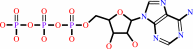 ATP
ATP
|
=
|
1,2-diacyl- sn-glycero-3-phospho-(1D-myo-inositol-3-phosphate)
|
+
|
 ADP
ADP
|
+
|
H(+)
|
|
|
|
|
|
|
|
|
|
Enzyme class 3:
|
|
E.C.2.7.1.153
- phosphatidylinositol-4,5-bisphosphate 3-kinase.
|
|
|
|
|
|
|
Pathway:
|
|
|
|
|
|
|
|
Reaction:
|
|
a 1,2-diacyl-sn-glycero-3-phospho-(1D-myo-inositol-4,5-bisphosphate) + ATP = a 1,2-diacyl-sn-glycero-3-phospho-(1D-myo-inositol-3,4,5- trisphosphate) + ADP + H+
|
|
|
|
|
|
1,2-diacyl-sn-glycero-3-phospho-(1D-myo-inositol-4,5-bisphosphate)
|
+
|
ATP
|
=
|
1,2-diacyl-sn-glycero-3-phospho-(1D-myo-inositol-3,4,5- trisphosphate)
|
+
|
ADP
|
+
|
H(+)
|
|
|
|
|
|
|
|
|
|
|
|
|
Note, where more than one E.C. class is given (as above), each may
correspond to a different protein domain or, in the case of polyprotein
precursors, to a different mature protein.
|
|
|
|
Molecule diagrams generated from .mol files obtained from the
KEGG ftp site
|
|
|
|
|
|
|
|
|
|
|
|
|
|
 |
|
|
|
|
|
|
| |
|
|
| |
|
DOI no:
|
Nat Chem Biol
6:117-124
(2010)
|
|
PubMed id:
|
|
|
|
|
|
| |
|
The p110 delta structure: mechanisms for selectivity and potency of new PI(3)K inhibitors.
|
|
A.Berndt,
S.Miller,
O.Williams,
D.D.Le,
B.T.Houseman,
J.I.Pacold,
F.Gorrec,
W.C.Hon,
Y.Liu,
C.Rommel,
P.Gaillard,
T.Rückle,
M.K.Schwarz,
K.M.Shokat,
J.P.Shaw,
R.L.Williams.
|
|
|
|
|
| |
ABSTRACT
|
|
|
|
| |
|
|
Deregulation of the phosphoinositide-3-OH kinase (PI(3)K) pathway has been
implicated in numerous pathologies including cancer, diabetes, thrombosis,
rheumatoid arthritis and asthma. Recently, small-molecule and ATP-competitive
PI(3)K inhibitors with a wide range of selectivities have entered clinical
development. In order to understand the mechanisms underlying the isoform
selectivity of these inhibitors, we developed a new expression strategy that
enabled us to determine to our knowledge the first crystal structure of the
catalytic subunit of the class IA PI(3)K p110 delta. Structures of this enzyme
in complex with a broad panel of isoform- and pan-selective class I PI(3)K
inhibitors reveal that selectivity toward p110 delta can be achieved by
exploiting its conformational flexibility and the sequence diversity of active
site residues that do not contact ATP. We have used these observations to
rationalize and synthesize highly selective inhibitors for p110 delta with
greatly improved potencies.
|
|
|
|
|
|
| |
Selected figure(s)
|
|
|
|
| |
|
|

|
|

|
|
Figure 3.
(a–e) Shown are the binding modes of DL06 (a), DL07 (b),
ZSTK474 (c), AS5 (d) and GDC-0941 (e) in the active site of
p110δ. Met752 is in its 'in' position for all these compounds.
|
|
Figure 4.
(a) The highly p110δ-selective compound AS15 does not open
the specificity pocket and makes extensive use of a hydrophobic
patch between Trp760, Thr750 and Met752 adjacent to the
adenine-binding pocket. The 2mF[o] – DF[c] contouring level is
1σ. (b) Chemical structures of AS15 and PIK-39. (c)
Superposition of AS15 and PIK-39 to demonstrate their different
modes of binding within the active site of p110δ.
|
|
|
|
|
|
| |
The above figures are
reprinted
by permission from Macmillan Publishers Ltd:
Nat Chem Biol
(2010,
6,
117-124)
copyright 2010.
|
|
| |
Figures were
selected
by an automated process.
|
|
|
|
|
|
|
|
|
|
|
|
|
|
|
|
 |
 |
 |
|
Literature references that cite this PDB file's key reference
|
|
|
| |
PubMed id
|
|
Reference
|
|
|
|
|
|
J.A.Pinson,
O.Schmidt-Kittler,
J.Zhu,
I.G.Jennings,
K.W.Kinzler,
B.Vogelstein,
D.K.Chalmers,
and
P.E.Thompson
(2011).
Thiazolidinedione-Based PI3Kα Inhibitors: An Analysis of Biochemical and Virtual Screening Methods.
|
| |
ChemMedChem,
6,
514-522.
|
|
|
|
|
|
|
L.Stephens,
and
P.Hawkins
(2011).
Signalling via class IA PI3Ks.
|
| |
Adv Enzyme Regul,
51,
27-36.
|
|
|
|
|
|
|
X.Zhang,
O.Vadas,
O.Perisic,
K.E.Anderson,
J.Clark,
P.T.Hawkins,
L.R.Stephens,
and
R.L.Williams
(2011).
Structure of lipid kinase p110β/p85β elucidates an unusual SH2-domain-mediated inhibitory mechanism.
|
| |
Mol Cell,
41,
567-578.
|
|
|
PDB code:
|
|
|
|
|
|
|
|
A.Berndt,
S.Miller,
O.Williams,
D.D.Le,
B.T.Houseman,
J.I.Pacold,
F.Gorrec,
W.C.Hon,
Y.Liu,
C.Rommel,
P.Gaillard,
T.Rückle,
M.K.Schwarz,
K.M.Shokat,
J.P.Shaw,
and
R.L.Williams
(2010).
The p110delta structure: mechanisms for selectivity and potency of new PI(3)K inhibitors.
|
| |
Nat Chem Biol,
6,
244.
|
|
|
|
|
|
|
H.A.Dbouk,
H.Pang,
A.Fiser,
and
J.M.Backer
(2010).
A biochemical mechanism for the oncogenic potential of the p110beta catalytic subunit of phosphoinositide 3-kinase.
|
| |
Proc Natl Acad Sci U S A,
107,
19897-19902.
|
|
|
|
|
|
|
O.Williams,
B.T.Houseman,
E.J.Kunkel,
B.Aizenstein,
R.Hoffman,
Z.A.Knight,
and
K.M.Shokat
(2010).
Discovery of dual inhibitors of the immune cell PI3Ks p110delta and p110gamma: a prototype for new anti-inflammatory drugs.
|
| |
Chem Biol,
17,
123-134.
|
|
|
|
|
|
|
P.E.Thompson,
I.G.Jennings,
and
J.A.Pinson
(2010).
Inflammatory twins from PI3K gang brought to justice?
|
| |
Chem Biol,
17,
101-102.
|
|
|
|
|
|
|
P.Workman,
and
I.Collins
(2010).
Probing the Probes: Fitness Factors For Small Molecule Tools.
|
| |
Chem Biol,
17,
561-577.
|
|
|
|
|
|
|
P.Workman,
and
R.L.van Montfort
(2010).
PI(3) kinases: revealing the delta lady.
|
| |
Nat Chem Biol,
6,
82-83.
|
|
|
|
|
|
|
S.Carvalho,
and
F.Schmitt
(2010).
Potential role of PI3K inhibitors in the treatment of breast cancer.
|
| |
Future Oncol,
6,
1251-1263.
|
|
|
|
|
|
|
S.Miller,
B.Tavshanjian,
A.Oleksy,
O.Perisic,
B.T.Houseman,
K.M.Shokat,
and
R.L.Williams
(2010).
Shaping development of autophagy inhibitors with the structure of the lipid kinase Vps34.
|
| |
Science,
327,
1638-1642.
|
|
|
PDB codes:
|
|
|
|
|
|
|
The most recent references are shown first.
Citation data come partly from CiteXplore and partly
from an automated harvesting procedure. Note that this is likely to be
only a partial list as not all journals are covered by
either method. However, we are continually building up the citation data
so more and more references will be included with time.
Where a reference describes a PDB structure, the PDB
code is
shown on the right.
|
|


 Links
Links


