 |
PDBsum entry 2v6c

|
|
|
|
|
|

|

|

|

|
|

|
|

|
|

|
|
|
 |

|

|
|
|
|
|
|
|
|
|
|
|
|
|
|
|
|
|
|
|
|
|
|
|
|
|
|
|
|
|
|
|
|
Transcription regulator
|
PDB id
|
|
|
|
2v6c
|
|
|
|
|
|
|
|
|
|
|
|
|
|
|

|

|

|
|
|
|
|
|
|
|
 |
Contents |
 |
|
|
|
|
|
|
|
|
|
|
* Residue conservation analysis
|
|
|
|
|
|
PDB id:
|
|
|
|
| Name: |
|
Transcription regulator
|
|
|
Title:
|
|
Crystal structure of erbb3 binding protein 1 (ebp1)
|
|
Structure:
|
|
Proliferation-associated protein 2g4. Chain: a. Fragment: residues 7-359. Synonym: erbb3 binding protein 1, proliferation-associated protein 1, protein p38-2g4, mpp1, ires-specific cellular trans-acting factor 45 kda, itaf45. Engineered: yes
|
|
Source:
|
|
Mus musculus. Mouse. Organism_taxid: 10090. Expressed in: escherichia coli. Expression_system_taxid: 469008. Expression_system_variant: rosetta (novagen).
|
|
Resolution:
|
|
|
2.50Å
|
R-factor:
|
0.182
|
R-free:
|
0.213
|
|
|
Authors:
|
|
T.P.Monie,A.J.Perrin,J.R.Birtley,S.Curry
|
Key ref:

|
|
T.P.Monie
et al.
(2007).
Structural insights into the transcriptional and translational roles of Ebp1.
EMBO J,
26,
3936-3944.
PubMed id:
DOI:

|
|
|
Date:
|
|
|
16-Jul-07
|
Release date:
|
21-Aug-07
|
|
|
|
|
|
|
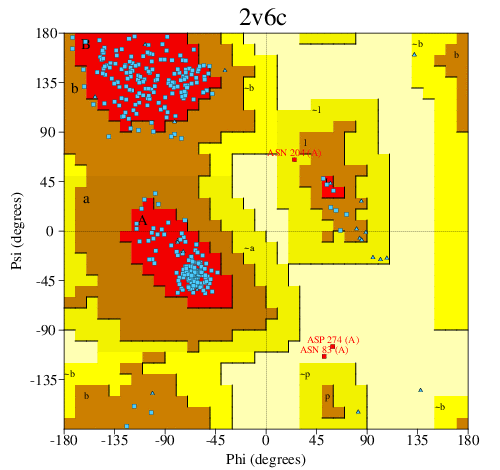
PROCHECK
|
|
|
|
|
|
Headers
|
|
|
|
References
|
|
|
|
|
|

|
|
P50580
(PA2G4_MOUSE) -
Proliferation-associated protein 2G4 from Mus musculus
|
|
|
|
Seq:
Struc:
|
|
|
|
394 a.a.
353 a.a.*
|
|

|

|

|
|
|
|
|
|
|
|
|
|
|
Key: |
 |
PfamA domain |
|
|
 |
Secondary structure |
|
 |
CATH domain |
|
|
*
PDB and UniProt seqs differ
at 3 residue positions (black
crosses)
|
|
|
|
|
|
|
|
|
|
|
|
|
|
|
|
|
 |
|
|
|
|
|
|
| |
|
DOI no:
|
EMBO J
26:3936-3944
(2007)
|
|
PubMed id:
|
|
|
|
|
|
| |
|
Structural insights into the transcriptional and translational roles of Ebp1.
|
|
T.P.Monie,
A.J.Perrin,
J.R.Birtley,
T.R.Sweeney,
I.Karakasiliotis,
Y.Chaudhry,
L.O.Roberts,
S.Matthews,
I.G.Goodfellow,
S.Curry.
|
|
|
|
|
| |
ABSTRACT
|
|
|
|
| |
|
|
The ErbB3-binding protein 1 (Ebp1) is an important regulator of transcription,
affecting eukaryotic cell growth, proliferation, differentiation and survival.
Ebp1 can also affect translation and cooperates with the polypyrimidine
tract-binding protein (PTB) to stimulate the activity of the internal ribosome
entry site (IRES) of foot-and-mouth disease virus (FMDV). We report here the
crystal structure of murine Ebp1 (p48 isoform), providing the first glimpse of
the architecture of this versatile regulator. The structure reveals a core
domain that is homologous to methionine aminopeptidases, coupled to a C-terminal
extension that contains important motifs for binding proteins and RNA. It sheds
new light on the conformational differences between the p42 and p48 isoforms of
Ebp1, the disposition of the key protein-interacting motif ((354)LKALL(358)) and
the RNA-binding activity of Ebp1. We show that the primary RNA-binding site is
formed by a Lys-rich motif in the C terminus and mediates the interaction with
the FMDV IRES. We also demonstrate a specific functional requirement for Ebp1 in
FMDV IRES-directed translation that is independent of a direct interaction with
PTB.
|
|
|
|
|
|
| |
Selected figure(s)
|
|
|
|
| |
|
|

|
|

|
|
Figure 1.
Figure 1 Molecular structure of Ebp1 and comparison with a type
II human MAP (hMAP2). (A) Ribbon diagram of the crystal
structure of Ebp1(8–360);  -helices
are coloured pink and -helices
are coloured pink and  -strands
blue. (B) Superposition of Ebp1 in orange and hMAP2 in cyan (PDB
1kq9 (Nonato et al, 2006)); insertions in Ebp1 are coloured dark
red and those in hMAP2 dark blue. (C–E) Comparison of the
active site of hMAP2 with the corresponding region in Ebp1. Side
chains of selected residues are shown as sticks for (C) hMAP2,
(D) a superposition of hMAP2 and Ebp1 and (E) Ebp1. The colour
coding is the same as for panel B. -strands
blue. (B) Superposition of Ebp1 in orange and hMAP2 in cyan (PDB
1kq9 (Nonato et al, 2006)); insertions in Ebp1 are coloured dark
red and those in hMAP2 dark blue. (C–E) Comparison of the
active site of hMAP2 with the corresponding region in Ebp1. Side
chains of selected residues are shown as sticks for (C) hMAP2,
(D) a superposition of hMAP2 and Ebp1 and (E) Ebp1. The colour
coding is the same as for panel B.
|
|
Figure 5.
Figure 5 Structural features at the N and C termini of Ebp1. (A)
The structure shows that the predicted p42 isoform (left) which
starts at Met 55 lacks one and a half helices at the N terminus
of the p48 isoform (indicated in grey in the structure on the
right). This helix makes extensive hydrophobic contacts with the
body of Ebp1 (coloured by atom type: carbon—orange;
nitrogen—blue oxygen—red; sulphur—yellow); its removal
exposes a large hydrophobic cleft on one face of the protein.
The structure of p48 Ebp1 also illustrates the proximity of K20
and K22 to the lys-rich loop 1; together these features may
constitute a bipartite nucleolar localisation signal (Squatrito
et al, 2004; Fujiwara et al, 2006). (B) Position of the
^354LKALL^358 protein-binding motif at the C terminus of Ebp1.
Colouring is the same as in Figure 1B except that residues from
the motifs are highlighted in green. The surface of Ebp1 up to
residue 337 is shown. Close-up views (in similar orientations)
of the LxxLL motif from (C) Ebp1 and (D) the AR ((Hur et al,
2004); PDB—1t7f). Residues from Ebp1 are colour coded as
described above. Carbon atoms of the LxxLL motif of the peptide
ligand of AR are cyan.
|
|
|
|
|
|
| |
The above figures are
reprinted
by permission from Macmillan Publishers Ltd:
EMBO J
(2007,
26,
3936-3944)
copyright 2007.
|
|
| |
Figures were
selected
by the author.
|
|
|
|
|
|
|
|
|
|
|
|
|
|
|
|
 |
 |
 |
|
Literature references that cite this PDB file's key reference
|
|
|
| |
PubMed id
|
|
Reference
|
|
|
|
|
|
B.Bradatsch,
C.Leidig,
S.Granneman,
M.Gnädig,
D.Tollervey,
B.Böttcher,
R.Beckmann,
and
E.Hurt
(2012).
Structure of the pre-60S ribosomal subunit with nuclear export factor Arx1 bound at the exit tunnel.
|
| |
Nat Struct Mol Biol,
19,
1234-1241.
|
|
|
PDB code:
|
|
|
|
|
|
|
|
Y.Lu,
H.Zhou,
W.Chen,
Y.Zhang,
and
A.W.Hamburger
(2011).
The ErbB3 binding protein EBP1 regulates ErbB2 protein levels and tamoxifen sensitivity in breast cancer cells.
|
| |
Breast Cancer Res Treat,
126,
27-36.
|
|
|
|
|
|
|
A.Pacheco,
and
E.Martinez-Salas
(2010).
Insights into the biology of IRES elements through riboproteomic approaches.
|
| |
J Biomed Biotechnol,
2010,
458927.
|
|
|
|
|
|
|
C.Perrot-Rechenmann
(2010).
Cellular responses to auxin: division versus expansion.
|
| |
Cold Spring Harb Perspect Biol,
2,
a001446.
|
|
|
|
|
|
|
D.Judah,
W.Y.Chang,
and
L.Dagnino
(2010).
EBP1 is a novel E2F target gene regulated by transforming growth factor-β.
|
| |
PLoS One,
5,
e13941.
|
|
|
|
|
|
|
H.Zhou,
K.Mazan-Mamczarz,
J.L.Martindale,
A.Barker,
Z.Liu,
M.Gorospe,
P.J.Leedman,
R.B.Gartenhaus,
A.W.Hamburger,
and
Y.Zhang
(2010).
Post-transcriptional regulation of androgen receptor mRNA by an ErbB3 binding protein 1 in prostate cancer.
|
| |
Nucleic Acids Res,
38,
3619-3631.
|
|
|
|
|
|
|
J.Merl,
S.Jakob,
K.Ridinger,
T.Hierlmeier,
R.Deutzmann,
P.Milkereit,
and
H.Tschochner
(2010).
Analysis of ribosome biogenesis factor-modules in yeast cells depleted from pre-ribosomes.
|
| |
Nucleic Acids Res,
38,
3068-3080.
|
|
|
|
|
|
|
M.Gopinath,
S.Raju,
A.Honda,
and
M.S.Shaila
(2010).
Host factor Ebp1 inhibits rinderpest virus transcription in vivo.
|
| |
Arch Virol,
155,
455-462.
|
|
|
|
|
|
|
M.J.Larriba,
J.Casado-Vela,
N.Pendás-Franco,
R.Peña,
A.García de Herreros,
M.T.Berciano,
M.Lafarga,
J.I.Casal,
and
A.Muñoz
(2010).
Novel snail1 target proteins in human colon cancer identified by proteomic analysis.
|
| |
PLoS One,
5,
e10221.
|
|
|
|
|
|
|
N.Fernández,
and
E.Martínez-Salas
(2010).
Tailoring the switch from IRES-dependent to 5'-end-dependent translation with the RNase P ribozyme.
|
| |
RNA,
16,
852-862.
|
|
|
|
|
|
|
A.Pacheco,
S.López de Quinto,
J.Ramajo,
N.Fernández,
and
E.Martínez-Salas
(2009).
A novel role for Gemin5 in mRNA translation.
|
| |
Nucleic Acids Res,
37,
582-590.
|
|
|
|
|
|
|
K.D.Fitzgerald,
and
B.L.Semler
(2009).
Bridging IRES elements in mRNAs to the eukaryotic translation apparatus.
|
| |
Biochim Biophys Acta,
1789,
518-528.
|
|
|
|
|
|
|
A.P.VanDemark,
H.Xin,
L.McCullough,
R.Rawlins,
S.Bentley,
A.Heroux,
D.J.Stillman,
C.P.Hill,
and
T.Formosa
(2008).
Structural and functional analysis of the Spt16p N-terminal domain reveals overlapping roles of yFACT subunits.
|
| |
J Biol Chem,
283,
5058-5068.
|
|
|
PDB codes:
|
|
|
|
|
|
|
|
A.Pacheco,
S.Reigadas,
and
E.Martínez-Salas
(2008).
Riboproteomic analysis of polypeptides interacting with the internal ribosome-entry site element of foot-and-mouth disease viral RNA.
|
| |
Proteomics,
8,
4782-4790.
|
|
|
|
|
|
|
A.W.Hamburger
(2008).
The role of ErbB3 and its binding partners in breast cancer progression and resistance to hormone and tyrosine kinase directed therapies.
|
| |
J Mammary Gland Biol Neoplasia,
13,
225-233.
|
|
|
|
|
|
|
D.Akinmade,
A.H.Talukder,
Y.Zhang,
W.M.Luo,
R.Kumar,
and
A.W.Hamburger
(2008).
Phosphorylation of the ErbB3 binding protein Ebp1 by p21-activated kinase 1 in breast cancer cells.
|
| |
Br J Cancer,
98,
1132-1140.
|
|
|
|
|
|
|
E.Martínez-Salas
(2008).
The impact of RNA structure on picornavirus IRES activity.
|
| |
Trends Microbiol,
16,
230-237.
|
|
|
|
|
|
|
G.Sithanandam,
and
L.M.Anderson
(2008).
The ERBB3 receptor in cancer and cancer gene therapy.
|
| |
Cancer Gene Ther,
15,
413-448.
|
|
|
|
|
|
|
J.Catusse,
J.M.Strub,
C.Job,
A.Van Dorsselaer,
and
D.Job
(2008).
Proteome-wide characterization of sugarbeet seed vigor and its tissue specific expression.
|
| |
Proc Natl Acad Sci U S A,
105,
10262-10267.
|
|
|
|
|
|
|
N.J.Hung,
K.Y.Lo,
S.S.Patel,
K.Helmke,
and
A.W.Johnson
(2008).
Arx1 Is a Nuclear Export Receptor for the 60S Ribosomal Subunit in Yeast.
|
| |
Mol Biol Cell,
19,
735-744.
|
|
|
|
|
|
|
T.Stuwe,
M.Hothorn,
E.Lejeune,
V.Rybin,
M.Bortfeld,
K.Scheffzek,
and
A.G.Ladurner
(2008).
The FACT Spt16 "peptidase" domain is a histone H3-H4 binding module.
|
| |
Proc Natl Acad Sci U S A,
105,
8884-8889.
|
|
|
PDB codes:
|
|
|
|
|
|
|
|
M.Okada,
S.W.Jang,
and
K.Ye
(2007).
Ebp1 association with nucleophosmin/B23 is essential for regulating cell proliferation and suppressing apoptosis.
|
| |
J Biol Chem,
282,
36744-36754.
|
|
|
|
|
|
The most recent references are shown first.
Citation data come partly from CiteXplore and partly
from an automated harvesting procedure. Note that this is likely to be
only a partial list as not all journals are covered by
either method. However, we are continually building up the citation data
so more and more references will be included with time.
Where a reference describes a PDB structure, the PDB
code is
shown on the right.
|
|


 Links
Links


