
|
|
|
|
|
 |
Contents |
 |
|
|
|
|
|
|
|
|
|
|
|
|
|
|
* Residue conservation analysis
|
|
|
|
|
|
PDB id:
|
|
|
|
| Name: |
|
Cell cycle
|
|
|
Title:
|
|
The crystal structure of the human g-protein subunit alpha (gnai3) in complex with an engineered regulator of g-protein signaling type 2 domain (rgs2)
|
|
Structure:
|
|
Guanine nucleotide-binding protein g(k) subunit alpha. Chain: a. Fragment: subunit alpha, residues 4-350. Synonym: g(i) alpha-3, guanine nucleotide-binding protein g k subunit alpha g i alpha-3. Engineered: yes. Regulator of g-protein signaling 2. Chain: b. Fragment: rgs domain, residues 71-209.
|
|
Source:
|
|
Homo sapiens. Human. Organism_taxid: 9606. Expressed in: escherichia coli. Expression_system_taxid: 469008. Expression_system_variant: r3-prare2.
|
|
Resolution:
|
|
|
2.80Å
|
R-factor:
|
0.210
|
R-free:
|
0.254
|
|
|
Authors:
|
|
A.K.Roos,M.Soundararajan,A.C.W.Pike,C.H.Arrowsmith,J.Weigelt, A.Edwards,C.Bountra,S.Knapp
|
Key ref:

|
|
A.J.Kimple
et al.
(2009).
Structural Determinants of G-protein {alpha} Subunit Selectivity by Regulator of G-protein Signaling 2 (RGS2).
J Biol Chem,
284,
19402-19411.
PubMed id:
DOI:

|
|
|
Date:
|
|
|
30-Sep-08
|
Release date:
|
04-Nov-08
|
|
|
|
|
|
|
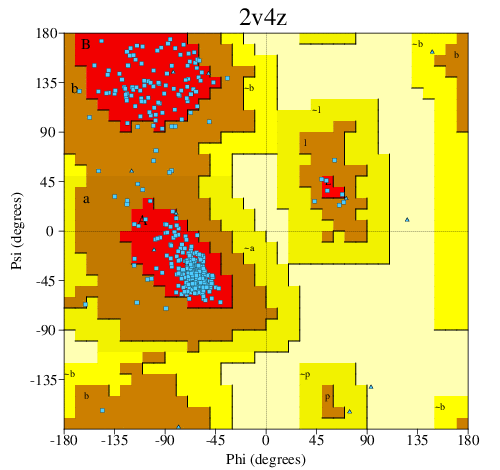
PROCHECK
|
|
|
|
|
|
Headers
|
|
|
|
References
|
|
|
|
|
|
|
|
|
|
|
|
|
|
|
|
 |
|
|
|
|
|
|
| |
|
DOI no:
|
J Biol Chem
284:19402-19411
(2009)
|
|
PubMed id:
|
|
|
|
|
|
| |
|
Structural Determinants of G-protein {alpha} Subunit Selectivity by Regulator of G-protein Signaling 2 (RGS2).
|
|
A.J.Kimple,
M.Soundararajan,
S.Q.Hutsell,
A.K.Roos,
D.J.Urban,
V.Setola,
B.R.Temple,
B.L.Roth,
S.Knapp,
F.S.Willard,
D.P.Siderovski.
|
|
|
|
|
| |
ABSTRACT
|
|
|
|
| |
|
|
"Regulator of G-protein signaling" (RGS) proteins facilitate the termination of
G protein-coupled receptor (GPCR) signaling via their ability to increase the
intrinsic GTP hydrolysis rate of Galpha subunits (known as GTPase-accelerating
protein or "GAP" activity). RGS2 is unique in its in vitro potency and
selectivity as a GAP for Galpha(q) subunits. As many vasoconstrictive hormones
signal via G(q) heterotrimer-coupled receptors, it is perhaps not surprising
that RGS2-deficient mice exhibit constitutive hypertension. However, to date the
particular structural features within RGS2 determining its selectivity for
Galpha(q) over Galpha(i/o) substrates have not been completely characterized.
Here, we examine a trio of point mutations to RGS2 that elicits
Galpha(i)-directed binding and GAP activities without perturbing its association
with Galpha(q). Using x-ray crystallography, we determined a model of the triple
mutant RGS2 in complex with a transition state mimetic form of Galpha(i) at
2.8-A resolution. Structural comparison with unliganded, wild type RGS2 and of
other RGS domain/Galpha complexes highlighted the roles of these residues in
wild type RGS2 that weaken Galpha(i) subunit association. Moreover, these three
amino acids are seen to be evolutionarily conserved among organisms with modern
cardiovascular systems, suggesting that RGS2 arose from the R4-subfamily of RGS
proteins to have specialized activity as a potent and selective Galpha(q) GAP
that modulates cardiovascular function.
|
|
|
|
|
|
| |
Selected figure(s)
|
|
|
|
| |
|
|

|
|

|
|
Figure 6.
The triple mutant RGS2(C106S,N184D,E191K), but not wild type
RGS2, inhibits dopamine D2-receptor influence on
forskolin-stimulated cAMP production. HEK293T cells were
transiently co-transfected with expression vectors for the
GloSensor cAMP biosensor and the G[i]-coupled dopamine
D2-receptor with empty vector, wild type RGS2, or the
RGS2(triple) mutant. Inhibition of forskolin-stimulated cAMP
production was determined after activation of the D2 receptor
with various concentrations of quinpirole as indicated. The
IC[50] (95% CI) for quinpirole was determined to be 18
(12–26), 14 (9–22), and 762 (498–1170) nm in the presence
of empty vector, wild type RGS2, and the triple mutant,
respectively. Inset, post-transfection cell lysates were
immunoblotted with anti-HA epitope tag antibody to confirm the
equivalent overexpression of HA-RGS2 and
HA-RGS2(C106S,N184D,E191K) proteins.
|
|
Figure 8.
Particular Gα selectivity determinants inferred from the
structural model of the triple mutant RGS2(C106S,N184D,E191K)
bound to Gα[i3].A, illustration of the αVII–αVIII region of
the RGS domain to highlight the intramolecular interaction
between the highly conserved αVIII helix arginine (Arg^188 of
RGS2) and position 184 (asparagine in wild type RGS2 and
aspartate in the triple mutant). RGS2(C106S,N184D,E191K) triple
mutant (yellow-green; PDB code 2V4Z), unliganded wild type RGS2
(gray; PDB code 2AF0), and the Gα[i1]-bound RGS16 (dark green;
PDB code 2IK8) were aligned by sequence and then structure (Cα
atoms) using the Align command with default align settings of
MacPyMOL (DeLano Scientific, Palo Alto, CA), resulting in root
mean square deviations of 0.92 and 0.80 Å, respectively.
The conserved Arg^188 makes salt bridges with the terminal
oxygens of the Asp^184 side chain in the RGS2(C106S,N184D,E191K)
mutant and the analogous asparate side chain in RGS16; however,
only one contact can be made between Arg^188 and the Asn^184
side chain of wild type RGS2. Loss of the second salt bridge
creates a torsion in the wild type RGS2 Asp^184 residue,
resulting of the loss of the stabilizing hydrogen bond to
Thr^182 in switch I of the Gα subunit. B, critical contacts
between the three mutated positions of RGS2(C106S,N184D,E191K)
(yellow-green) and its Gα binding partner (Ras-like domain in
red; all-helical domain in blue; switch regions in cyan; bound
GDP in magenta). The modeled terminal atoms of the Lys^191 side
chain (spheres) within RGS2(C106S,N184D,E191K) are in close
enough proximity to make a hydrogen bond with Glu^65 of the Gα
all-helical domain. Asp^184 makes two hydrogen bonds with
Arg^188 and an additional bond with the backbone amine of the
peptide bond connecting Thr^181 and Thr^182, both located within
switch I of Gα. Ser^106 of the RGS2 triple mutant is tightly
packed with the backbone carbonyl and γ-hydroxyl of Gα
Thr^182, both being less than 3.9 Å from β-carbon of
Ser^106. Additionally, the Gα switch II residue Lys^210 is 3.8
Å from the Ser^106 α-carbon.
|
|
|
|
|
|
| |
The above figures are
reprinted
by permission from the ASBMB:
J Biol Chem
(2009,
284,
19402-19411)
copyright 2009.
|
|
| |
Figures were
selected
by the author.
|
|
|
|
|
|
|
|
|
|
|
|
|
|
|
|
 |
 |
 |
|
Literature references that cite this PDB file's key reference
|
|
|
| |
PubMed id
|
|
Reference
|
|
|
|
|
|
A.A.Thompson,
W.Liu,
E.Chun,
V.Katritch,
H.Wu,
E.Vardy,
X.P.Huang,
C.Trapella,
R.Guerrini,
G.Calo,
B.L.Roth,
V.Cherezov,
and
R.C.Stevens
(2012).
Structure of the nociceptin/orphanin FQ receptor in complex with a peptide mimetic.
|
| |
Nature,
485,
395-399.
|
|
|
PDB code:
|
|
|
|
|
|
|
|
J.A.Allen,
and
B.L.Roth
(2011).
Strategies to discover unexpected targets for drugs active at g protein-coupled receptors.
|
| |
Annu Rev Pharmacol Toxicol,
51,
117-144.
|
|
|
|
|
|
|
M.Kosloff,
A.M.Travis,
D.E.Bosch,
D.P.Siderovski,
and
V.Y.Arshavsky
(2011).
Integrating energy calculations with functional assays to decipher the specificity of G protein-RGS protein interactions.
|
| |
Nat Struct Mol Biol,
18,
846-853.
|
|
|
|
|
|
The most recent references are shown first.
Citation data come partly from CiteXplore and partly
from an automated harvesting procedure. Note that this is likely to be
only a partial list as not all journals are covered by
either method. However, we are continually building up the citation data
so more and more references will be included with time.
Where a reference describes a PDB structure, the PDB
code is
shown on the right.
|
 |


 Links
Links





