 |
PDBsum entry 2q8c

|
|
|
|
|
|

|

|

|

|
|

|
|

|
|

|
|

|
|

|
|

|
|

|
|
|
 |

|

|
|
|
|
|
|
|
|
|
|
|
|
|
|
|
|
|
|
|
|
|
|
|
|
|
|
|
|
|
|
|
|
|
|
|
|
Oxidoreductase
|
PDB id
|
|
|
|
2q8c
|
|
|
|
|
|
|
|
|
|
|
|
|
|
|

|

|

|
|
|
|
|
|
|
|
 |
Contents |
 |
|
|
|
|
|
|
|
|
|
|
|
|
|
|
* Residue conservation analysis
|
|
|
|
|
|
PDB id:
|
|
|
|
| Name: |
|
Oxidoreductase
|
|
|
Title:
|
|
Crystal structure of jmjd2a in ternary complex with an histone h3k9me3 peptide and 2-oxoglutarate
|
|
Structure:
|
|
Jmjc domain-containing histone demethylation protein 3a. Chain: a, b. Fragment: jumonji domain. Synonym: jumonji domain-containing protein 2a. Engineered: yes. Histone 3 peptide. Chain: f, g. Engineered: yes
|
|
Source:
|
|
Homo sapiens. Human. Organism_taxid: 9606. Gene: jmjd2a, jhdm3a, jmjd2, kiaa0677. Expressed in: escherichia coli. Expression_system_taxid: 562. Synthetic: yes. Other_details: synthetic peptide
|
|
Resolution:
|
|
|
2.05Å
|
R-factor:
|
0.203
|
R-free:
|
0.236
|
|
|
Authors:
|
|
J.-F.Couture,E.Collazo,P.Ortiz-Tello,J.S.Brunzelle,R.C.Trievel
|
Key ref:

|
|
J.F.Couture
et al.
(2007).
Specificity and mechanism of JMJD2A, a trimethyllysine-specific histone demethylase.
Nat Struct Biol,
14,
689-695.
PubMed id:
DOI:

|
|
|
Date:
|
|
|
10-Jun-07
|
Release date:
|
03-Jul-07
|
|
|
|
|
|
|
PROCHECK
|

|
|
|
|
|
Headers
|
|
|
|
References
|
|
|
|
|
|

|
|
O75164
(KDM4A_HUMAN) -
Lysine-specific demethylase 4A from Homo sapiens
|
|
|
|
Seq:
Struc:
|
|
|
|
1064 a.a.
345 a.a.
|
|

|

|
|
|
|
|
|
|
|
|
|
|
|
Key: |
 |
PfamA domain |
|
|
 |
Secondary structure |
|
 |
CATH domain |
|
|
|
|
|
|
|
|
|
|
|
|
|
Enzyme class 2:
|
|
E.C.1.14.11.66
- [histone H3]-trimethyl-L-lysine(9) demethylase.
|
|
|
|
|
|
|
Reaction:
|
|
N6,N6,N6-trimethyl-L-lysyl9-[histone H3] + 2 2-oxoglutarate + 2 O2 = N6-methyl-L-lysyl9-[histone H3] + 2 formaldehyde + 2 succinate + 2 CO2
|
|
|
|
|
|
N(6),N(6),N(6)-trimethyl-L-lysyl(9)-[histone H3]
Bound ligand (Het Group name = )
corresponds exactly
|
+
|
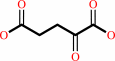 2
×
2-oxoglutarate
2
×
2-oxoglutarate
|
+
|
 2
×
O2
2
×
O2
|
=
|
N(6)-methyl-L-lysyl(9)-[histone H3]
Bound ligand (Het Group name = )
matches with 40.00% similarity
|
+
|
2
×
formaldehyde
Bound ligand (Het Group name = )
matches with 40.00% similarity
|
+
|
 2
×
succinate
2
×
succinate
|
+
|
 2
×
CO2
2
×
CO2
|
|
|
|
|
|
|
|
|
|
Enzyme class 3:
|
|
E.C.1.14.11.69
- [histone H3]-trimethyl-L-lysine(36) demethylase.
|
|
|
|
|
|
|
Reaction:
|
|
N6,N6,N6-trimethyl-L-lysyl36-[histone H3] + 2 2-oxoglutarate + 2 O2 = N6-methyl-L-lysyl36-[histone H3] + 2 formaldehyde + 2 succinate + 2 CO2
|
|
|
|
|
|
N(6),N(6),N(6)-trimethyl-L-lysyl(36)-[histone H3]
Bound ligand (Het Group name = )
corresponds exactly
|
+
|
2
×
2-oxoglutarate
|
+
|
2
×
O2
|
=
|
N(6)-methyl-L-lysyl(36)-[histone H3]
Bound ligand (Het Group name = )
matches with 40.00% similarity
|
+
|
2
×
formaldehyde
Bound ligand (Het Group name = )
matches with 40.00% similarity
|
+
|
2
×
succinate
|
+
|
2
×
CO2
|
|
|
|
|
|
|
|
|
|
|
|
|
Note, where more than one E.C. class is given (as above), each may
correspond to a different protein domain or, in the case of polyprotein
precursors, to a different mature protein.
|
|
|
|
Molecule diagrams generated from .mol files obtained from the
KEGG ftp site
|
|
|
|
|
|
|
|
|
|
|
|
|
|
 |
|
|
|
|
|
|
| |
|
|
| |
|
DOI no:
|
Nat Struct Biol
14:689-695
(2007)
|
|
PubMed id:
|
|
|
|
|
|
| |
|
Specificity and mechanism of JMJD2A, a trimethyllysine-specific histone demethylase.
|
|
J.F.Couture,
E.Collazo,
P.A.Ortiz-Tello,
J.S.Brunzelle,
R.C.Trievel.
|
|
|
|
|
| |
ABSTRACT
|
|
|
|
| |
|
|
JMJD2A is a JmjC histone demethylase (HDM) that catalyzes the demethylation of
di- and trimethylated Lys9 and Lys36 in histone H3 (H3K9me2/3 and H3K36me2/3).
Here we present the crystal structures of the JMJD2A catalytic domain in complex
with H3K9me3, H3K36me2 and H3K36me3 peptides. The structures reveal that histone
substrates are recognized through a network of backbone hydrogen bonds and
hydrophobic interactions that deposit the trimethyllysine into the active site.
The trimethylated epsilon-ammonium cation is coordinated within a
methylammonium-binding pocket through carbon-oxygen (CH...O) hydrogen bonds that
position one of the zeta-methyl groups adjacent to the Fe(II) center for
hydroxylation and demethylation. Mutations of the residues comprising this
pocket abrogate demethylation by JMJD2A, with the exception of an S288A
substitution, which augments activity, particularly toward H3K9me2. We propose
that this residue modulates the methylation-state specificities of JMJD2 enzymes
and other trimethyllysine-specific JmjC HDMs.
|
|
|
|
|
|
| |
Selected figure(s)
|
|
|
|
| |
|
|

|
|

|
|
Figure 1.
(a) Ribbon diagram of the JMJD2A–NOG–H3K36me3 complex,
with the JmjN domain (yellow),  -hairpin
and mixed region (red), JmjC domain (blue) and C-terminal domain
(green) depicted. NOG and H3K36me3 peptide are rendered as
sticks with green and cyan carbon atoms, respectively; Ni(II)
and Zn(II) atoms are in orange and gray, respectively. (b)
Electrostatic surface of JMJD2A bound to -hairpin
and mixed region (red), JmjC domain (blue) and C-terminal domain
(green) depicted. NOG and H3K36me3 peptide are rendered as
sticks with green and cyan carbon atoms, respectively; Ni(II)
and Zn(II) atoms are in orange and gray, respectively. (b)
Electrostatic surface of JMJD2A bound to  KG
(green carbons) and the H3K9me3 peptide (yellow carbons).
Electrostatic potential is contoured from +10 k[b]T e^-1 (blue)
to -10 k[b]T e^-1 (red). (c,d) Stereo views of simulated
annealing F[o] - F[c] omit maps of the bound H3K36me3 (c) and
H3K9me3 (d) peptides. Electron density is contoured at 2.0 KG
(green carbons) and the H3K9me3 peptide (yellow carbons).
Electrostatic potential is contoured from +10 k[b]T e^-1 (blue)
to -10 k[b]T e^-1 (red). (c,d) Stereo views of simulated
annealing F[o] - F[c] omit maps of the bound H3K36me3 (c) and
H3K9me3 (d) peptides. Electron density is contoured at 2.0  .
JMJD2A carbon atoms are in gray; hydrogen bonds are shown as
orange dashed lines. (e,f) Schematics of the interactions
between JMJD2A and the H3K36me3 (e) and H3K9me3 (f) substrates.
Residues engaging in van der Waals interactions (open ellipses)
and hydrogen-bonding (filled ellipses) with the histone H3
peptides are colored as in a. .
JMJD2A carbon atoms are in gray; hydrogen bonds are shown as
orange dashed lines. (e,f) Schematics of the interactions
between JMJD2A and the H3K36me3 (e) and H3K9me3 (f) substrates.
Residues engaging in van der Waals interactions (open ellipses)
and hydrogen-bonding (filled ellipses) with the histone H3
peptides are colored as in a.
|
|
Figure 3.
(a) Active site of JMJD2A bound to KG
(green carbons) and H3K9me3 (yellow carbons). Orange and green
dashed lines represent conventional and CH  O
hydrogen bonds; blue dashed lines represent bonds coordinating
Ni(II). Side chain or main chain atoms of certain residues are
omitted for clarity. (b) Trimethyl O
hydrogen bonds; blue dashed lines represent bonds coordinating
Ni(II). Side chain or main chain atoms of certain residues are
omitted for clarity. (b) Trimethyl  -ammonium
cation of H3K9me3 and methylammonium-binding pocket residue
interactions. CH O
hydrogen bonds are shown in green and labeled with distances.
Inset, electron density of the simulated annealing omit map
(contoured at 2.0 )
corresponding to the trimethylated -ammonium
cation. (c,d) JMJD2A active site in complex with H3K36me3 (cyan
carbons) and NOG (c) and with H3K36me2 (orange carbons) and
succinate (d). Hydrogen bonds are depicted as in a. -ammonium
cation of H3K9me3 and methylammonium-binding pocket residue
interactions. CH O
hydrogen bonds are shown in green and labeled with distances.
Inset, electron density of the simulated annealing omit map
(contoured at 2.0 )
corresponding to the trimethylated -ammonium
cation. (c,d) JMJD2A active site in complex with H3K36me3 (cyan
carbons) and NOG (c) and with H3K36me2 (orange carbons) and
succinate (d). Hydrogen bonds are depicted as in a.
|
|
|
|
|
|
| |
The above figures are
reprinted
by permission from Macmillan Publishers Ltd:
Nat Struct Biol
(2007,
14,
689-695)
copyright 2007.
|
|
| |
Figures were
selected
by an automated process.
|
|
|
|
|
|
|
|
|
|
|
|
|
|
|
|
 |
 |
 |
|
Literature references that cite this PDB file's key reference
|
|
|
| |
PubMed id
|
|
Reference
|
|
|
|
|
|
A.K.Upadhyay,
and
X.Cheng
(2011).
Dynamics of histone lysine methylation: structures of methyl writers and erasers.
|
| |
Prog Drug Res,
67,
107-124.
|
|
|
|
|
|
|
K.H.Chang,
O.N.King,
A.Tumber,
E.C.Woon,
T.D.Heightman,
M.A.McDonough,
C.J.Schofield,
and
N.R.Rose
(2011).
Inhibition of histone demethylases by 4-carboxy-2,2'-bipyridyl compounds.
|
| |
ChemMedChem,
6,
759-764.
|
|
|
PDB code:
|
|
|
|
|
|
|
|
R.Chowdhury,
K.K.Yeoh,
Y.M.Tian,
L.Hillringhaus,
E.A.Bagg,
N.R.Rose,
I.K.Leung,
X.S.Li,
E.C.Woon,
M.Yang,
M.A.McDonough,
O.N.King,
I.J.Clifton,
R.J.Klose,
T.D.Claridge,
P.J.Ratcliffe,
C.J.Schofield,
and
A.Kawamura
(2011).
The oncometabolite 2-hydroxyglutarate inhibits histone lysine demethylases.
|
| |
EMBO Rep,
12,
463-469.
|
|
|
PDB codes:
|
|
|
|
|
|
|
|
S.Krishnan,
S.Horowitz,
and
R.C.Trievel
(2011).
Structure and function of histone H3 lysine 9 methyltransferases and demethylases.
|
| |
Chembiochem,
12,
254-263.
|
|
|
|
|
|
|
V.Avdic,
P.Zhang,
S.Lanouette,
A.Groulx,
V.Tremblay,
J.Brunzelle,
and
J.F.Couture
(2011).
Structural and biochemical insights into MLL1 core complex assembly.
|
| |
Structure,
19,
101-108.
|
|
|
PDB code:
|
|
|
|
|
|
|
|
C.Huang,
Y.Xiang,
Y.Wang,
X.Li,
L.Xu,
Z.Zhu,
T.Zhang,
Q.Zhu,
K.Zhang,
N.Jing,
and
C.D.Chen
(2010).
Dual-specificity histone demethylase KIAA1718 (KDM7A) regulates neural differentiation through FGF4.
|
| |
Cell Res,
20,
154-165.
|
|
|
|
|
|
|
J.R.Horton,
A.K.Upadhyay,
H.H.Qi,
X.Zhang,
Y.Shi,
and
X.Cheng
(2010).
Enzymatic and structural insights for substrate specificity of a family of jumonji histone lysine demethylases.
|
| |
Nat Struct Mol Biol,
17,
38-43.
|
|
|
PDB codes:
|
|
|
|
|
|
|
|
L.Yu,
Y.Wang,
S.Huang,
J.Wang,
Z.Deng,
Q.Zhang,
W.Wu,
X.Zhang,
Z.Liu,
W.Gong,
and
Z.Chen
(2010).
Structural insights into a novel histone demethylase PHF8.
|
| |
Cell Res,
20,
166-173.
|
|
|
PDB codes:
|
|
|
|
|
|
|
|
M.L.Bellows,
and
C.A.Floudas
(2010).
Computational methods for de novo protein design and its applications to the human immunodeficiency virus 1, purine nucleoside phosphorylase, ubiquitin specific protease 7, and histone demethylases.
|
| |
Curr Drug Targets,
11,
264-278.
|
|
|
|
|
|
|
N.Mosammaparast,
and
Y.Shi
(2010).
Reversal of histone methylation: biochemical and molecular mechanisms of histone demethylases.
|
| |
Annu Rev Biochem,
79,
155-179.
|
|
|
|
|
|
|
O.N.King,
X.S.Li,
M.Sakurai,
A.Kawamura,
N.R.Rose,
S.S.Ng,
A.M.Quinn,
G.Rai,
B.T.Mott,
P.Beswick,
R.J.Klose,
U.Oppermann,
A.Jadhav,
T.D.Heightman,
D.J.Maloney,
C.J.Schofield,
and
A.Simeonov
(2010).
Quantitative high-throughput screening identifies 8-hydroxyquinolines as cell-active histone demethylase inhibitors.
|
| |
PLoS One,
5,
e15535.
|
|
|
PDB code:
|
|
|
|
|
|
|
|
X.Cheng,
and
R.M.Blumenthal
(2010).
Coordinated chromatin control: structural and functional linkage of DNA and histone methylation.
|
| |
Biochemistry,
49,
2999-3008.
|
|
|
|
|
|
|
X.Hong,
J.Zang,
J.White,
C.Wang,
C.H.Pan,
R.Zhao,
R.C.Murphy,
S.Dai,
P.Henson,
J.W.Kappler,
J.Hagman,
and
G.Zhang
(2010).
Interaction of JMJD6 with single-stranded RNA.
|
| |
Proc Natl Acad Sci U S A,
107,
14568-14572.
|
|
|
PDB codes:
|
|
|
|
|
|
|
|
X.Luo
(2010).
Snapshots of a hybrid transcription factor in the Hippo pathway.
|
| |
Protein Cell,
1,
811-819.
|
|
|
|
|
|
|
Y.Chang,
J.Wu,
X.J.Tong,
J.Q.Zhou,
and
J.Ding
(2010).
Crystal structure of the catalytic core of Saccharomyces cerevesiae histone demethylase Rph1: insights into the substrate specificity and catalytic mechanism.
|
| |
Biochem J,
433,
295-302.
|
|
|
PDB codes:
|
|
|
|
|
|
|
|
Y.Yang,
L.Hu,
P.Wang,
H.Hou,
Y.Lin,
Y.Liu,
Z.Li,
R.Gong,
X.Feng,
L.Zhou,
W.Zhang,
Y.Dong,
H.Yang,
H.Lin,
Y.Wang,
C.D.Chen,
and
Y.Xu
(2010).
Structural insights into a dual-specificity histone demethylase ceKDM7A from Caenorhabditis elegans.
|
| |
Cell Res,
20,
886-898.
|
|
|
PDB codes:
|
|
|
|
|
|
|
|
A.Tzatsos,
R.Pfau,
S.C.Kampranis,
and
P.N.Tsichlis
(2009).
Ndy1/KDM2B immortalizes mouse embryonic fibroblasts by repressing the Ink4a/Arf locus.
|
| |
Proc Natl Acad Sci U S A,
106,
2641-2646.
|
|
|
|
|
|
|
B.C.Smith,
and
J.M.Denu
(2009).
Chemical mechanisms of histone lysine and arginine modifications.
|
| |
Biochim Biophys Acta,
1789,
45-57.
|
|
|
|
|
|
|
B.Illi,
C.Colussi,
A.Grasselli,
A.Farsetti,
M.C.Capogrossi,
and
C.Gaetano
(2009).
NO sparks off chromatin: tales of a multifaceted epigenetic regulator.
|
| |
Pharmacol Ther,
123,
344-352.
|
|
|
|
|
|
|
J.Yang,
I.Ledaki,
H.Turley,
K.C.Gatter,
J.C.Montero,
J.L.Li,
and
A.L.Harris
(2009).
Role of hypoxia-inducible factors in epigenetic regulation via histone demethylases.
|
| |
Ann N Y Acad Sci,
1177,
185-197.
|
|
|
|
|
|
|
S.S.Ng,
W.W.Yue,
U.Oppermann,
and
R.J.Klose
(2009).
Dynamic protein methylation in chromatin biology.
|
| |
Cell Mol Life Sci,
66,
407-422.
|
|
|
|
|
|
|
J.F.Couture,
L.M.Dirk,
J.S.Brunzelle,
R.L.Houtz,
and
R.C.Trievel
(2008).
Structural origins for the product specificity of SET domain protein methyltransferases.
|
| |
Proc Natl Acad Sci U S A,
105,
20659-20664.
|
|
|
PDB codes:
|
|
|
|
|
|
|
|
J.Lee,
J.R.Thompson,
M.V.Botuyan,
and
G.Mer
(2008).
Distinct binding modes specify the recognition of methylated histones H3K4 and H4K20 by JMJD2A-tudor.
|
| |
Nat Struct Mol Biol,
15,
109-111.
|
|
|
PDB codes:
|
|
|
|
|
|
|
|
J.M.Simmons,
T.A.Müller,
and
R.P.Hausinger
(2008).
Fe(II)/alpha-ketoglutarate hydroxylases involved in nucleobase, nucleoside, nucleotide, and chromatin metabolism.
|
| |
Dalton Trans,
(),
5132-5142.
|
|
|
|
|
|
|
M.Lloret-Llinares,
C.Carré,
A.Vaquero,
N.de Olano,
and
F.Azorín
(2008).
Characterization of Drosophila melanogaster JmjC+N histone demethylases.
|
| |
Nucleic Acids Res,
36,
2852-2863.
|
|
|
|
|
|
|
P.A.Cloos,
J.Christensen,
K.Agger,
and
K.Helin
(2008).
Erasing the methyl mark: histone demethylases at the center of cellular differentiation and disease.
|
| |
Genes Dev,
22,
1115-1140.
|
|
|
|
|
|
|
G.Kustatscher,
and
A.G.Ladurner
(2007).
Modular paths to 'decoding' and 'wiping' histone lysine methylation.
|
| |
Curr Opin Chem Biol,
11,
628-635.
|
|
|
|
|
|
|
J.C.Culhane,
and
P.A.Cole
(2007).
LSD1 and the chemistry of histone demethylation.
|
| |
Curr Opin Chem Biol,
11,
561-568.
|
|
|
|
|
|
|
J.R.Wilson
(2007).
Targeting the JMJD2A histone lysine demethylase.
|
| |
Nat Struct Mol Biol,
14,
682-684.
|
|
|
|
|
|
|
S.Lall
(2007).
Primers on chromatin.
|
| |
Nat Struct Mol Biol,
14,
1110-1115.
|
|
|
|
|
|
The most recent references are shown first.
Citation data come partly from CiteXplore and partly
from an automated harvesting procedure. Note that this is likely to be
only a partial list as not all journals are covered by
either method. However, we are continually building up the citation data
so more and more references will be included with time.
Where a reference describes a PDB structure, the PDB
code is
shown on the right.
|
|


 Links
Links


