 |
PDBsum entry 2py3

|
|
|
|
|
 |
Contents |
 |
|
|
|
|
|
|
|
|
|
|
|
|
|
|
* Residue conservation analysis
|
|
|
|
|
|
|
|
|
|
|
Enzyme class:
|
|
E.C.2.7.10.1
- receptor protein-tyrosine kinase.
|
|
|
|
|
|
|
Reaction:
|
|
L-tyrosyl-[protein] + ATP = O-phospho-L-tyrosyl-[protein] + ADP + H+
|
|
|
|
|
|
L-tyrosyl-[protein]
|
+
|
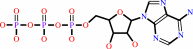 ATP
ATP
|
=
|
O-phospho-L-tyrosyl-[protein]
Bound ligand (Het Group name = )
matches with 81.25% similarity
|
+
|
 ADP
ADP
|
+
|
H(+)
|
|
|
|
|
|
|
|
|
|
|
|
|
Molecule diagrams generated from .mol files obtained from the
KEGG ftp site
|
|
|
|
|
|
|
|
|
|
|
|
|
|
 |
|
|
|
|
|
|
| |
|
|
| |
|
DOI no:
|
Mol Cell
27:717-730
(2007)
|
|
PubMed id:
|
|
|
|
|
|
| |
|
A molecular brake in the kinase hinge region regulates the activity of receptor tyrosine kinases.
|
|
H.Chen,
J.Ma,
W.Li,
A.V.Eliseenkova,
C.Xu,
T.A.Neubert,
W.T.Miller,
M.Mohammadi.
|
|
|
|
|
| |
ABSTRACT
|
|
|
|
| |
|
|
Activating mutations in the tyrosine kinase domain of receptor tyrosine kinases
(RTKs) cause cancer and skeletal disorders. Comparison of the crystal structures
of unphosphorylated and phosphorylated wild-type FGFR2 kinase domains with those
of seven unphosphorylated pathogenic mutants reveals an autoinhibitory
"molecular brake" mediated by a triad of residues in the kinase hinge
region of all FGFRs. Structural analysis shows that many other RTKs, including
PDGFRs, VEGFRs, KIT, CSF1R, FLT3, TEK, and TIE, are also subject to regulation
by this brake. Pathogenic mutations activate FGFRs and other RTKs by disengaging
the brake either directly or indirectly.
|
|
|
|
|
|
| |
Selected figure(s)
|
|
|
|
| |
|
|

|
|

|
|
Figure 3.
Figure 3. The Molecular Brake at the Kinase Hinge Region of
FGFR2K Regulates the Kinase Activation and Is Disengaged Either
by A Loop Tyrosine Phosphorylation or Directly by the Pathogenic
Mutations
(A) In the unphosphorylated wild-type structure,
residues N549, E565, and K641 form a network of hydrogen bonds
in the kinase hinge region, which serves as a molecular brake to
keep the enzyme in an inactive state.
(B) The molecular
brake is disengaged in the A loop tyrosine phosphorylated
wild-type FGFR2K structure. This molecular brake is also
disengaged in the unphosphorylated mutant FGFR2K structures
(C–G). To assist the readers, the whole unphosphorylated
wild-type FGFR2K structure is also shown in cartoon and solid
semitransparent surface, and the kinase hinge region is boxed.
Atom colorings are as follows: oxygens in red, nitrogens in
blue, and carbons are colored according to the kinase region to
which they belong. The kinase hinge, the αC-β4 loop (shown in
sticks in [A]–[G]), and β8 strand are colored green, wheat,
and cyan, respectively. The rest of the N lobe and C lobe is
colored light purple and light blue, respectively. The three
critical hydrogen bonds between N549 and the backbone atoms of
αC-β4 loop are highlighted by red dashed lines. The remaining
hydrogen bonds are shown as black dashed lines.
|
|
Figure 6.
Figure 6. The Autoinhibition by the Molecular Brake Is a
Common Regulatory Mechanism for Many RTKs
(A)–(E) show
the presence of the engaged molecular brake at the kinase hinge
region of unphosphorylated wild-type FGFR1 (PDB ID: 1FGK), CSF1R
(PDB ID: 2I1M), VEGFR2 (PDB ID: 1VR2), TEK (PDB ID: 1FVR), and
c-KIT (PDB ID: 1T45) kinases, respectively. (F) shows the
disengagement of the molecular brake at the kinase hinge region
of an “active” c-KIT kinase (PDB ID: 1PKG). Coloring scheme
is as in Figure 3.
|
|
|
|
|
|
| |
The above figures are
reprinted
from an Open Access publication published by Cell Press:
Mol Cell
(2007,
27,
717-730)
copyright 2007.
|
|
| |
Figures were
selected
by an automated process.
|
|
|
|
|
|
|
|
|
|
|
|
|
|
|
|
 |
 |
 |
|
Literature references that cite this PDB file's key reference
|
|
|
| |
PubMed id
|
|
Reference
|
|
|
|
|
|
H.Greulich,
and
P.M.Pollock
(2011).
Targeting mutant fibroblast growth factor receptors in cancer.
|
| |
Trends Mol Med,
17,
283-292.
|
|
|
|
|
|
|
C.R.Degnin,
M.B.Laederich,
and
W.A.Horton
(2010).
FGFs in endochondral skeletal development.
|
| |
J Cell Biochem,
110,
1046-1057.
|
|
|
|
|
|
|
F.Grimminger,
R.T.Schermuly,
and
H.A.Ghofrani
(2010).
Targeting non-malignant disorders with tyrosine kinase inhibitors.
|
| |
Nat Rev Drug Discov,
9,
956-970.
|
|
|
|
|
|
|
J.H.Bae,
and
J.Schlessinger
(2010).
Asymmetric tyrosine kinase arrangements in activation or autophosphorylation of receptor tyrosine kinases.
|
| |
Mol Cells,
29,
443-448.
|
|
|
|
|
|
|
M.B.Laederich,
and
W.A.Horton
(2010).
Achondroplasia: pathogenesis and implications for future treatment.
|
| |
Curr Opin Pediatr,
22,
516-523.
|
|
|
|
|
|
|
O.A.Gani,
and
R.A.Engh
(2010).
Protein kinase inhibition of clinically important staurosporine analogues.
|
| |
Nat Prod Rep,
27,
489-498.
|
|
|
|
|
|
|
S.Mai,
K.Wei,
A.Flenniken,
S.L.Adamson,
J.Rossant,
J.E.Aubin,
and
S.G.Gong
(2010).
The missense mutation W290R in Fgfr2 causes developmental defects from aberrant IIIb and IIIc signaling.
|
| |
Dev Dyn,
239,
1888-1900.
|
|
|
|
|
|
|
A.Beenken,
and
M.Mohammadi
(2009).
The FGF family: biology, pathophysiology and therapy.
|
| |
Nat Rev Drug Discov,
8,
235-253.
|
|
|
|
|
|
|
A.Goriely,
R.M.Hansen,
I.B.Taylor,
I.A.Olesen,
G.K.Jacobsen,
S.J.McGowan,
S.P.Pfeifer,
G.A.McVean,
E.R.Meyts,
and
A.O.Wilkie
(2009).
Activating mutations in FGFR3 and HRAS reveal a shared genetic origin for congenital disorders and testicular tumors.
|
| |
Nat Genet,
41,
1247-1252.
|
|
|
|
|
|
|
B.B.Au-Yeung,
S.Deindl,
L.Y.Hsu,
E.H.Palacios,
S.E.Levin,
J.Kuriyan,
and
A.Weiss
(2009).
The structure, regulation, and function of ZAP-70.
|
| |
Immunol Rev,
228,
41-57.
|
|
|
|
|
|
|
D.J.Kemble,
and
G.Sun
(2009).
Direct and specific inactivation of protein tyrosine kinases in the Src and FGFR families by reversible cysteine oxidation.
|
| |
Proc Natl Acad Sci U S A,
106,
5070-5075.
|
|
|
|
|
|
|
E.D.Lew,
C.M.Furdui,
K.S.Anderson,
and
J.Schlessinger
(2009).
The precise sequence of FGF receptor autophosphorylation is kinetically driven and is disrupted by oncogenic mutations.
|
| |
Sci Signal,
2,
ra6.
|
|
|
|
|
|
|
E.G.Bochukova,
T.Roscioli,
D.J.Hedges,
I.B.Taylor,
D.Johnson,
D.J.David,
P.L.Deininger,
and
A.O.Wilkie
(2009).
Rare mutations of FGFR2 causing apert syndrome: identification of the first partial gene deletion, and an Alu element insertion from a new subfamily.
|
| |
Hum Mutat,
30,
204-211.
|
|
|
|
|
|
|
J.G.Taylor,
A.T.Cheuk,
P.S.Tsang,
J.Y.Chung,
Y.K.Song,
K.Desai,
Y.Yu,
Q.R.Chen,
K.Shah,
V.Youngblood,
J.Fang,
S.Y.Kim,
C.Yeung,
L.J.Helman,
A.Mendoza,
V.Ngo,
L.M.Staudt,
J.S.Wei,
C.Khanna,
D.Catchpoole,
S.J.Qualman,
S.M.Hewitt,
G.Merlino,
S.J.Chanock,
and
J.Khan
(2009).
Identification of FGFR4-activating mutations in human rhabdomyosarcomas that promote metastasis in xenotransplanted models.
|
| |
J Clin Invest,
119,
3395-3407.
|
|
|
|
|
|
|
J.Kalinina,
S.A.Byron,
H.P.Makarenkova,
S.K.Olsen,
A.V.Eliseenkova,
W.J.Larochelle,
M.Dhanabal,
S.Blais,
D.M.Ornitz,
L.A.Day,
T.A.Neubert,
P.M.Pollock,
and
M.Mohammadi
(2009).
Homodimerization controls the fibroblast growth factor 9 subfamily's receptor binding and heparan sulfate-dependent diffusion in the extracellular matrix.
|
| |
Mol Cell Biol,
29,
4663-4678.
|
|
|
PDB code:
|
|
|
|
|
|
|
|
M.Katoh
(2009).
FGFR2 abnormalities underlie a spectrum of bone, skin, and cancer pathologies.
|
| |
J Invest Dermatol,
129,
1861-1867.
|
|
|
|
|
|
|
N.Jura,
N.F.Endres,
K.Engel,
S.Deindl,
R.Das,
M.H.Lamers,
D.E.Wemmer,
X.Zhang,
and
J.Kuriyan
(2009).
Mechanism for activation of the EGF receptor catalytic domain by the juxtamembrane segment.
|
| |
Cell,
137,
1293-1307.
|
|
|
PDB code:
|
|
|
|
|
|
|
|
P.A.Insel,
and
H.H.Patel
(2009).
Membrane rafts and caveolae in cardiovascular signaling.
|
| |
Curr Opin Nephrol Hypertens,
18,
50-56.
|
|
|
|
|
|
|
P.G.Young,
R.Walanj,
V.Lakshmi,
L.J.Byrnes,
P.Metcalf,
E.N.Baker,
S.B.Vakulenko,
and
C.A.Smith
(2009).
The crystal structures of substrate and nucleotide complexes of Enterococcus faecium aminoglycoside-2''-phosphotransferase-IIa [APH(2'')-IIa] provide insights into substrate selectivity in the APH(2'') subfamily.
|
| |
J Bacteriol,
191,
4133-4143.
|
|
|
PDB codes:
|
|
|
|
|
|
|
|
S.A.Byron,
and
P.M.Pollock
(2009).
FGFR2 as a molecular target in endometrial cancer.
|
| |
Future Oncol,
5,
27-32.
|
|
|
|
|
|
|
S.Pannier,
J.Martinovic,
S.Heuertz,
A.L.Delezoide,
A.Munnich,
L.Schibler,
V.Serre,
and
L.Legeai-Mallet
(2009).
Thanatophoric dysplasia caused by double missense FGFR3 mutations.
|
| |
Am J Med Genet A,
149,
1296-1301.
|
|
|
|
|
|
|
W.A.Horton,
and
C.R.Degnin
(2009).
FGFs in endochondral skeletal development.
|
| |
Trends Endocrinol Metab,
20,
341-348.
|
|
|
|
|
|
|
A.Dutt,
H.B.Salvesen,
T.H.Chen,
A.H.Ramos,
R.C.Onofrio,
C.Hatton,
R.Nicoletti,
W.Winckler,
R.Grewal,
M.Hanna,
N.Wyhs,
L.Ziaugra,
D.J.Richter,
J.Trovik,
I.B.Engelsen,
I.M.Stefansson,
T.Fennell,
K.Cibulskis,
M.C.Zody,
L.A.Akslen,
S.Gabriel,
K.K.Wong,
W.R.Sellers,
M.Meyerson,
and
H.Greulich
(2008).
Drug-sensitive FGFR2 mutations in endometrial carcinoma.
|
| |
Proc Natl Acad Sci U S A,
105,
8713-8717.
|
|
|
|
|
|
|
H.Chen,
C.F.Xu,
J.Ma,
A.V.Eliseenkova,
W.Li,
P.M.Pollock,
N.Pitteloud,
W.T.Miller,
T.A.Neubert,
and
M.Mohammadi
(2008).
A crystallographic snapshot of tyrosine trans-phosphorylation in action.
|
| |
Proc Natl Acad Sci U S A,
105,
19660-19665.
|
|
|
PDB code:
|
|
|
|
|
|
|
|
L.Ding,
G.Getz,
D.A.Wheeler,
E.R.Mardis,
M.D.McLellan,
K.Cibulskis,
C.Sougnez,
H.Greulich,
D.M.Muzny,
M.B.Morgan,
L.Fulton,
R.S.Fulton,
Q.Zhang,
M.C.Wendl,
M.S.Lawrence,
D.E.Larson,
K.Chen,
D.J.Dooling,
A.Sabo,
A.C.Hawes,
H.Shen,
S.N.Jhangiani,
L.R.Lewis,
O.Hall,
Y.Zhu,
T.Mathew,
Y.Ren,
J.Yao,
S.E.Scherer,
K.Clerc,
G.A.Metcalf,
B.Ng,
A.Milosavljevic,
M.L.Gonzalez-Garay,
J.R.Osborne,
R.Meyer,
X.Shi,
Y.Tang,
D.C.Koboldt,
L.Lin,
R.Abbott,
T.L.Miner,
C.Pohl,
G.Fewell,
C.Haipek,
H.Schmidt,
B.H.Dunford-Shore,
A.Kraja,
S.D.Crosby,
C.S.Sawyer,
T.Vickery,
S.Sander,
J.Robinson,
W.Winckler,
J.Baldwin,
L.R.Chirieac,
A.Dutt,
T.Fennell,
M.Hanna,
B.E.Johnson,
R.C.Onofrio,
R.K.Thomas,
G.Tonon,
B.A.Weir,
X.Zhao,
L.Ziaugra,
M.C.Zody,
T.Giordano,
M.B.Orringer,
J.A.Roth,
M.R.Spitz,
I.I.Wistuba,
B.Ozenberger,
P.J.Good,
A.C.Chang,
D.G.Beer,
M.A.Watson,
M.Ladanyi,
S.Broderick,
A.Yoshizawa,
W.D.Travis,
W.Pao,
M.A.Province,
G.M.Weinstock,
H.E.Varmus,
S.B.Gabriel,
E.S.Lander,
R.A.Gibbs,
M.Meyerson,
and
R.K.Wilson
(2008).
Somatic mutations affect key pathways in lung adenocarcinoma.
|
| |
Nature,
455,
1069-1075.
|
|
|
|
|
|
|
Y.Ohne,
T.Takahara,
R.Hatakeyama,
T.Matsuzaki,
M.Noda,
N.Mizushima,
and
T.Maeda
(2008).
Isolation of hyperactive mutants of mammalian target of rapamycin.
|
| |
J Biol Chem,
283,
31861-31870.
|
|
|
|
|
|
|
E.D.Lew,
J.H.Bae,
E.Rohmann,
B.Wollnik,
and
J.Schlessinger
(2007).
Structural basis for reduced FGFR2 activity in LADD syndrome: Implications for FGFR autoinhibition and activation.
|
| |
Proc Natl Acad Sci U S A,
104,
19802-19807.
|
|
|
PDB code:
|
|
|
|
|
|
|
The most recent references are shown first.
Citation data come partly from CiteXplore and partly
from an automated harvesting procedure. Note that this is likely to be
only a partial list as not all journals are covered by
either method. However, we are continually building up the citation data
so more and more references will be included with time.
Where a reference describes a PDB structure, the PDB
code is
shown on the right.
|
|


 Links
Links


