 |
PDBsum entry 2pph

|
|
|
|
|
 |
Contents |
 |
|
|
|
|
|
|
|
|
* Residue conservation analysis
|
|
|
|
|
|
|
|
|
|
|
Enzyme class:
|
|
E.C.2.7.11.25
- mitogen-activated protein kinase kinase kinase.
|
|
|
|
|
|
|
Reaction:
|
|
|
1.
|
L-seryl-[protein] + ATP = O-phospho-L-seryl-[protein] + ADP + H+
|
|
2.
|
L-threonyl-[protein] + ATP = O-phospho-L-threonyl-[protein] + ADP + H+
|
|
|
|
|
|
|
L-seryl-[protein]
|
+
|
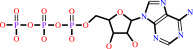 ATP
ATP
|
=
|
O-phospho-L-seryl-[protein]
|
+
|
 ADP
ADP
|
+
|
H(+)
|
|
|
|
|
|
|
L-threonyl-[protein]
|
+
|
ATP
|
=
|
O-phospho-L-threonyl-[protein]
|
+
|
ADP
|
+
|
H(+)
|
|
|
|
|
|
|
|
|
|
|
|
|
Molecule diagrams generated from .mol files obtained from the
KEGG ftp site
|
|
|
|
|
|
|
|
|
|
|
|
|
|
 |
|
|
|
|
|
|
| |
|
|
| |
|
|
Biochemistry
46:13478-13489
(2007)
|
|
PubMed id:
|
|
|
|
|
|
| |
|
Insight into the binding properties of MEKK3 PB1 to MEK5 PB1 from its solution structure.
|
|
Q.Hu,
W.Shen,
H.Huang,
J.Liu,
J.Zhang,
X.Huang,
J.Wu,
Y.Shi.
|
|
|
|
|
| |
ABSTRACT
|
|
|
|
| |
|
|
MEKK3 is a mitogen-activated protein kinase kinase kinase that participates in
various signaling pathways. One of its functions is to activate the ERK5 signal
pathway by phosphorylating and activating MEK5. MEKK3 and MEK5 each harbors a
PB1 domain in the N-terminus, and they form a heterodimer via PB1-PB1 domain
interaction that was reported to be indispensable to the activation of MEK5.
Using NMR spectroscopy, we show here that a prolyl isomerization of the
Gln38-Pro39 bond is present in MEKK3 PB1, which is the first case of structural
heterogeneity within PB1 domains. We have solved the solution structures of both
isomers and found a major difference between them in the Pro39 region. Residues
Gly37-Leu40 form a type VIb beta-turn in the cis conformation, whereas no
obvious character of beta-turn was observed in the trans conformation. Backbone
dynamics studies have unraveled internal motions in the beta3/beta4-turn on a
microsecond-millisecond time scale. Further investigation of its binding
properties with MEK5 PB1 has demonstrated that MEKK3 PB1 binds MEK5 PB1 tightly
with a Kd of about 10(-8) M. Mutagenesis analysis revealed that residues in the
basic cluster of MEKK3 PB1 contributes differently to the PB1-PB1 interaction.
Residues Lys 7 and Arg 5 play important roles in the interaction with MEK5 PB1.
Taken together, this study provides new insights into structural details of
MEKK3 PB1 and its binding properties with MEK5 PB1.
|
|
|
|
|
|
|
|
|
|
|
|
|
|
|
|
|
|
 |
 |
 |
|
Literature references that cite this PDB file's key reference
|
|
|
| |
PubMed id
|
|
Reference
|
|
|
|
|
|
K.Ogura,
T.Tandai,
S.Yoshinaga,
Y.Kobashigawa,
H.Kumeta,
T.Ito,
H.Sumimoto,
and
F.Inagaki
(2009).
NMR structure of the heterodimer of Bem1 and Cdc24 PB1 domains from Saccharomyces cerevisiae.
|
| |
J Biochem,
146,
317-325.
|
|
|
PDB codes:
|
|
|
|
|
|
|
The most recent references are shown first.
Citation data come partly from CiteXplore and partly
from an automated harvesting procedure. Note that this is likely to be
only a partial list as not all journals are covered by
either method. However, we are continually building up the citation data
so more and more references will be included with time.
Where a reference describes a PDB structure, the PDB
codes are
shown on the right.
|
|


 Links
Links


