 |
PDBsum entry 2kfw

|
|
|
|
|
 |
Contents |
 |
|
|
|
|
|
|
|
|
* Residue conservation analysis
|
|
|
|
|
|
PDB id:
|
|
|
|
| Name: |
|
Isomerase
|
|
|
Title:
|
|
Solution structure of full-length slyd from e.Coli
|
|
Structure:
|
|
Fkbp-type peptidyl-prolyl cis-trans isomerase slyd. Chain: a. Synonym: ppiase, rotamase, histidine-rich protein, whp. Engineered: yes
|
|
Source:
|
|
Escherichia coli. Organism_taxid: 562. Gene: slyd, b3349, jw3311. Expressed in: escherichia coli. Expression_system_taxid: 562.
|
|
NMR struc:
|
|
20 models
|
|
|
Authors:
|
|
L.Martino,Y.He,K.L.Hands-Taylor,E.R.Valentine,G.Kelly,C.Giancola, M.R.Conte
|
|
Key ref:
|
|
L.Martino
et al.
(2009).
The interaction of the Escherichia coli protein SlyD with nickel ions illuminates the mechanism of regulation of its peptidyl-prolyl isomerase activity.
Febs J,
276,
4529-4544.
PubMed id:
|
|
|
Date:
|
|
|
28-Feb-09
|
Release date:
|
15-Sep-09
|
|
|
|
|
|
|
PROCHECK
|

|
|
|
|
|
Headers
|
|
|
|
References
|
|
|
|
|
|

|
|
P0A9K9
(SLYD_ECOLI) -
FKBP-type peptidyl-prolyl cis-trans isomerase SlyD from Escherichia coli (strain K12)
|
|
|
|
Seq:
Struc:
|
|
|
|
196 a.a.
196 a.a.
|
|

|

|
|
|
|
|
|
|
|
|
|
|
|
Key: |
 |
PfamA domain |
|
|
 |
Secondary structure |
|
 |
CATH domain |
|
|
|
|
|
|
|
|
|
|
|
|
|
Enzyme class:
|
|
E.C.5.2.1.8
- peptidylprolyl isomerase.
|
|
|
|
|
|
|
Reaction:
|
|
[protein]-peptidylproline (omega=180) = [protein]-peptidylproline (omega=0)
|
|
|
|
|
|
 Peptidylproline (omega=180)
|
=
|
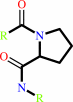 peptidylproline (omega=0)
|
|
|
|
|
|
|
|
|
|
|
|
|
Molecule diagrams generated from .mol files obtained from the
KEGG ftp site
|
|
|
|
|
|
|
|
|
|
|
|
|
|
 |
|
|
|
|
|
|
| |
|
|
| |
|
|
Febs J
276:4529-4544
(2009)
|
|
PubMed id:
|
|
|
|
|
|
| |
|
The interaction of the Escherichia coli protein SlyD with nickel ions illuminates the mechanism of regulation of its peptidyl-prolyl isomerase activity.
|
|
L.Martino,
Y.He,
K.L.Hands-Taylor,
E.R.Valentine,
G.Kelly,
C.Giancola,
M.R.Conte.
|
|
|
|
|
| |
ABSTRACT
|
|
|
|
| |
|
|
The sensitive to lysis D (SlyD) protein from Escherichia coli is related to the
FK506-binding protein family, and it harbours both peptidyl-prolyl cis-trans
isomerase (PPIase) and chaperone-like activity, preventing aggregation and
promoting the correct folding of other proteins. Whereas a functional role of
SlyD as a protein-folding catalyst in vivo remains unclear, SlyD has been shown
to be an essential component for [Ni-Fe]-hydrogenase metallocentre assembly in
bacteria. Interestingly, the isomerase activity of SlyD is uniquely modulated by
nickel ions, which possibly regulate its functions in response to external
stimuli. In this work, we investigated the solution structure of SlyD and its
interaction with nickel ions, enabling us to gain insights into the molecular
mechanism of this regulation. We have revealed that the PPIase module of SlyD
contains an additional C-terminal alpha-helix packed against the catalytic site
of the domain; unexpectedly, our results show that the interaction of SlyD with
nickel ions entails participation of the novel structural features of the PPIase
domain, eliciting structural alterations of the catalytic pocket. We suggest
that such conformational rearrangements upon metal binding underlie the ability
of nickel ions to regulate the isomerase activity of SlyD.
|
|
|
|
|
|
|
|
|
|
|
|
|
|
|
|
|
|
 |
 |
 |
|
Literature references that cite this PDB file's key reference
|
|
|
| |
PubMed id
|
|
Reference
|
|
|
|
|
|
H.Kaluarachchi,
K.C.Chan Chung,
and
D.B.Zamble
(2010).
Microbial nickel proteins.
|
| |
Nat Prod Rep,
27,
681-694.
|
|
|
|
|
|
|
K.L.Hands-Taylor,
L.Martino,
R.Tata,
J.J.Babon,
T.T.Bui,
A.F.Drake,
R.L.Beavil,
G.J.Pruijn,
P.R.Brown,
and
M.R.Conte
(2010).
Heterodimerization of the human RNase P/MRP subunits Rpp20 and Rpp25 is a prerequisite for interaction with the P3 arm of RNase MRP RNA.
|
| |
Nucleic Acids Res,
38,
4052-4066.
|
|
|
|
|
|
The most recent references are shown first.
Citation data come partly from CiteXplore and partly
from an automated harvesting procedure. Note that this is likely to be
only a partial list as not all journals are covered by
either method. However, we are continually building up the citation data
so more and more references will be included with time.
|
|


 Links
Links


