
|
|
|
|
|
 |
Contents |
 |
|
|
|
|
|
|
|
|
|
|
* Residue conservation analysis
|
|
|
|
|
|
PDB id:
|
|
|
|
| Name: |
|
Metal binding protein
|
|
|
Title:
|
|
Calmodulin complexed with calmodulin-binding peptide from smooth muscle myosin light chain kinase
|
|
Structure:
|
|
Calmodulin. Chain: a. Engineered: yes. 19-mer peptide from myosin light chain kinase. Chain: b. Synonym: 19-mer peptide from telokin. 19-mer peptide from kinase- related protein. Engineered: yes
|
|
Source:
|
|
Homo sapiens. Human. Gene: calm1, calm, cam, cam1. Expressed in: escherichia coli. Synthetic: yes. Other_details: sequence occurs naturally in humans
|
|
NMR struc:
|
|
160 models
|
|
|
Authors:
|
|
J.Gsponer,J.Christodoulou,A.Cavalli,J.M.Bui,B.Richter,C.M.Dobson, M.Vendruscolo
|
Key ref:

|
|
J.Gsponer
et al.
(2008).
A coupled equilibrium shift mechanism in calmodulin-mediated signal transduction.
Structure,
16,
736-746.
PubMed id:
DOI:

|
|
|
Date:
|
|
|
02-Feb-08
|
Release date:
|
10-Jun-08
|
|
|
|
|
|
|
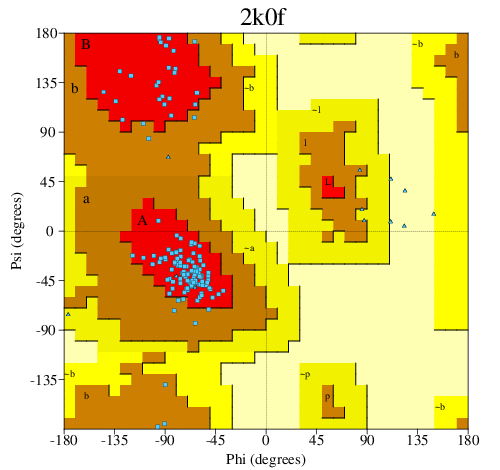
PROCHECK
|
|
|
|
|
|
Headers
|
|
|
|
References
|
|
|
|
|
|
|
|
|
|
|
|
Enzyme class:
|
|
Chain B:
E.C.2.7.11.18
- [myosin light-chain] kinase.
|
|
|
|
|
|
|
Reaction:
|
|
|
1.
|
L-seryl-[myosin light chain] + ATP = O-phospho-L-seryl-[myosin light chain] + ADP + H+
|
|
2.
|
L-threonyl-[myosin light chain] + ATP = O-phospho-L-threonyl-[myosin light chain] + ADP + H+
|
|
|
|
|
|
|
L-seryl-[myosin light chain]
|
+
|
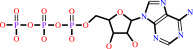 ATP
ATP
|
=
|
O-phospho-L-seryl-[myosin light chain]
|
+
|
 ADP
ADP
|
+
|
H(+)
|
|
|
|
|
|
|
L-threonyl-[myosin light chain]
|
+
|
ATP
|
=
|
O-phospho-L-threonyl-[myosin light chain]
|
+
|
ADP
|
+
|
H(+)
|
|
|
|
|
|
|
|
|
|
Cofactor:
|
|
Ca(2+)
|
|
|
|
|
|
|
|
|
Molecule diagrams generated from .mol files obtained from the
KEGG ftp site
|
|
|
|
|
|
|
|
|
|
|
|
|
|
 |
|
|
|
|
|
|
| |
|
|
| |
|
DOI no:
|
Structure
16:736-746
(2008)
|
|
PubMed id:
|
|
|
|
|
|
| |
|
A coupled equilibrium shift mechanism in calmodulin-mediated signal transduction.
|
|
J.Gsponer,
J.Christodoulou,
A.Cavalli,
J.M.Bui,
B.Richter,
C.M.Dobson,
M.Vendruscolo.
|
|
|
|
|
| |
ABSTRACT
|
|
|
|
| |
|
|
We used nuclear magnetic resonance data to determine ensembles of conformations
representing the structure and dynamics of calmodulin (CaM) in the calcium-bound
state (Ca(2+)-CaM) and in the state bound to myosin light chain kinase
(CaM-MLCK). These ensembles reveal that the Ca(2+)-CaM state includes a range of
structures similar to those present when CaM is bound to MLCK. Detailed analysis
of the ensembles demonstrates that correlated motions within the Ca(2+)-CaM
state direct the structural fluctuations toward complex-like substates. This
phenomenon enables initial ligation of MLCK at the C-terminal domain of CaM and
induces a population shift among the substates accessible to the N-terminal
domain, thus giving rise to the cooperativity associated with binding. Based on
these results and the combination of modern free energy landscape theory with
classical allostery models, we suggest that a coupled equilibrium shift
mechanism controls the efficient binding of CaM to a wide range of ligands.
|
|
|
|
|
|
| |
Selected figure(s)
|
|
|
|
| |
|
|

|
|

|
|
Figure 4.
Figure 4.
|
|
Figure 7.
Figure 7. Comparison between FRET-Derived Distances and the
Corresponding Ones Calculated from the Ca^2+-CaM Ensemble
The distance distribution measured by FRET between a donor
fluorophore and acceptor fluorophore on residues 34 in the NTD
and 110 in the CTD of Ca^2+-CaM is shown in red; the distance
distribution calculated from the Ca^2+-CaM ensemble is shown in
black. See Johnson, 2006.
|
|
|
|
|
|
| |
The above figures are
reprinted
from an Open Access publication published by Cell Press:
Structure
(2008,
16,
736-746)
copyright 2008.
|
|
| |
Figures were
selected
by an automated process.
|
|
|
|
|
|
|
|
|
|
|
|
|
|
|
|
 |
 |
 |
|
Literature references that cite this PDB file's key reference
|
|
|
| |
PubMed id
|
|
Reference
|
|
|
|
|
|
C.Leyrat,
M.R.Jensen,
E.A.Ribeiro,
F.C.Gérard,
R.W.Ruigrok,
M.Blackledge,
and
M.Jamin
(2011).
The N(0)-binding region of the vesicular stomatitis virus phosphoprotein is globally disordered but contains transient α-helices.
|
| |
Protein Sci,
20,
542-556.
|
|
|
|
|
|
|
M.Figueroa,
M.González-Andrade,
A.Sosa-Peinado,
A.Madariaga-Mazón,
F.Del Río-Portilla,
M.d.e.l. .C.González,
and
R.Mata
(2011).
Fluorescence, circular dichroism, NMR, and docking studies of the interaction of the alkaloid malbrancheamide with calmodulin.
|
| |
J Enzyme Inhib Med Chem,
26,
378-385.
|
|
|
|
|
|
|
S.R.Tzeng,
and
C.G.Kalodimos
(2011).
Protein dynamics and allostery: an NMR view.
|
| |
Curr Opin Struct Biol,
21,
62-67.
|
|
|
|
|
|
|
E.S.Price,
M.S.DeVore,
and
C.K.Johnson
(2010).
Detecting intramolecular dynamics and multiple Förster resonance energy transfer states by fluorescence correlation spectroscopy.
|
| |
J Phys Chem B,
114,
5895-5902.
|
|
|
|
|
|
|
K.G.Neumüller,
K.Elsayad,
J.M.Reisecker,
M.N.Waxham,
and
K.G.Heinze
(2010).
Photounbinding of calmodulin from a family of CaM binding peptides.
|
| |
PLoS One,
5,
e14050.
|
|
|
|
|
|
|
L.R.Masterson,
C.Cheng,
T.Yu,
M.Tonelli,
A.Kornev,
S.S.Taylor,
and
G.Veglia
(2010).
Dynamics connect substrate recognition to catalysis in protein kinase A.
|
| |
Nat Chem Biol,
6,
821-828.
|
|
|
PDB code:
|
|
|
|
|
|
|
|
P.Csermely,
R.Palotai,
and
R.Nussinov
(2010).
Induced fit, conformational selection and independent dynamic segments: an extended view of binding events.
|
| |
Trends Biochem Sci,
35,
539-546.
|
|
|
|
|
|
|
S.J.Edelstein,
M.I.Stefan,
and
N.Le Novère
(2010).
Ligand depletion in vivo modulates the dynamic range and cooperativity of signal transduction.
|
| |
PLoS One,
5,
e8449.
|
|
|
|
|
|
|
A.Bakan,
and
I.Bahar
(2009).
The intrinsic dynamics of enzymes plays a dominant role in determining the structural changes induced upon inhibitor binding.
|
| |
Proc Natl Acad Sci U S A,
106,
14349-14354.
|
|
|
|
|
|
|
A.Kurakin
(2009).
Scale-free flow of life: on the biology, economics, and physics of the cell.
|
| |
Theor Biol Med Model,
6,
6.
|
|
|
|
|
|
|
A.Vallée-Bélisle,
F.Ricci,
and
K.W.Plaxco
(2009).
Thermodynamic basis for the optimization of binding-induced biomolecular switches and structure-switching biosensors.
|
| |
Proc Natl Acad Sci U S A,
106,
13802-13807.
|
|
|
|
|
|
|
D.D.Boehr,
R.Nussinov,
and
P.E.Wright
(2009).
The role of dynamic conformational ensembles in biomolecular recognition.
|
| |
Nat Chem Biol,
5,
789-796.
|
|
|
|
|
|
|
M.Fromer,
and
J.M.Shifman
(2009).
Tradeoff between stability and multispecificity in the design of promiscuous proteins.
|
| |
PLoS Comput Biol,
5,
e1000627.
|
|
|
|
|
|
|
R.G.Smock,
and
L.M.Gierasch
(2009).
Sending signals dynamically.
|
| |
Science,
324,
198-203.
|
|
|
|
|
|
|
J.Völker,
H.H.Klump,
and
K.J.Breslauer
(2008).
DNA energy landscapes via calorimetric detection of microstate ensembles of metastable macrostates and triplet repeat diseases.
|
| |
Proc Natl Acad Sci U S A,
105,
18326-18330.
|
|
|
|
|
|
The most recent references are shown first.
Citation data come partly from CiteXplore and partly
from an automated harvesting procedure. Note that this is likely to be
only a partial list as not all journals are covered by
either method. However, we are continually building up the citation data
so more and more references will be included with time.
Where a reference describes a PDB structure, the PDB
code is
shown on the right.
|
 |


 Links
Links


