
|
|
|
|
|
 |
Contents |
 |
|
|
|
|
|
|
|
|
|
|
|
 1421 a.a.
|
|
|
|
|
|
|
|
|
|
|
 1115 a.a.
|
|
|
|
|
|
|
|
|
|
|
 267 a.a.
|
|
|
|
|
|
|
|
|
|
|
 177 a.a.
|
|
|
|
|
|
|
|
|
|
|
 214 a.a.
|
|
|
|
|
|
|
|
|
|
|
 87 a.a.
|
|
|
|
|
|
|
|
|
|
|
 171 a.a.
|
|
|
|
|
|
|
|
|
|
|
 135 a.a.
|
|
|
|
|
|
|
|
|
|
|
 116 a.a.
|
|
|
|
|
|
|
|
|
|
|
 65 a.a.
|
|
|
|
|
|
|
|
|
|
|
 114 a.a.
|
|
|
|
|
|
|
|
|
|
|
 46 a.a.
|
|
|
|
|
|
|
|
|
|
|
* Residue conservation analysis
|
|
|
|
|
|
PDB id:
|
|
|
|
| Name: |
|
Transferase
|
|
|
Title:
|
|
Cpd lesion containing RNA polymerase ii elongation complex d
|
|
Structure:
|
|
DNA-directed RNA polymerase ii largest subunit. Chain: a. Synonym: RNA polymerase ii subunit 1, b220. DNA-directed RNA polymerase ii 140 kda polypeptide. Chain: b. Synonym: b150, RNA polymerase ii subunit 2. DNA-directed RNA polymerase ii 45kda polypeptide. Chain: c. Synonym: b44.5.
|
|
Source:
|
|
Saccharomyces cerevisiae. Baker's yeast. Organism_taxid: 4932. Synthetic: yes. Synthetic construct. Organism_taxid: 32630. Other_details: synthetic oligonucleotide. Other_details: synthetic oligonucleotide
|
|
Resolution:
|
|
|
3.80Å
|
R-factor:
|
0.269
|
R-free:
|
0.288
|
|
|
Authors:
|
|
F.Brueckner,U.Hennecke,T.Carell,P.Cramer
|
Key ref:

|
|
F.Brueckner
et al.
(2007).
CPD Damage Recognition by Transcribing RNA Polymerase II.
Science,
315,
859-862.
PubMed id:
DOI:

|
|
|
Date:
|
|
|
23-Nov-06
|
Release date:
|
20-Feb-07
|
|
|
|
|
|
|
PROCHECK
|

|
|
|
|
|
Headers
|
|
|
|
References
|
|
|
|
|
|

|
|
P04050
(RPB1_YEAST) -
DNA-directed RNA polymerase II subunit RPB1 from Saccharomyces cerevisiae (strain ATCC 204508 / S288c)
|
|
|
|
Seq:
Struc:
|
|
|
|
1733 a.a.
1421 a.a.
|
|

|

|
|
|
|
|
|
|
|
|
|
|
|
|

|
|
P08518
(RPB2_YEAST) -
DNA-directed RNA polymerase II subunit RPB2 from Saccharomyces cerevisiae (strain ATCC 204508 / S288c)
|
|
|
|
Seq:
Struc:
|
|
|
|
1224 a.a.
1115 a.a.
|
|
|

|
|
|
|
|
|
|
|
|
|
|
|
|

|
|
P16370
(RPB3_YEAST) -
DNA-directed RNA polymerase II subunit RPB3 from Saccharomyces cerevisiae (strain ATCC 204508 / S288c)
|
|
|
|
Seq:
Struc:
|
|
|
|
318 a.a.
267 a.a.
|
|
|

|

|
|
|
|
|
|
|
|
|
|
|
|

|
|
P20433
(RPB4_YEAST) -
DNA-directed RNA polymerase II subunit RPB4 from Saccharomyces cerevisiae (strain ATCC 204508 / S288c)
|
|
|
|
Seq:
Struc:
|
|
|
|
221 a.a.
177 a.a.
|
|
|

|
|
|
|
|
|
|
|
|
|
|
|
|

|
|
P20434
(RPAB1_YEAST) -
DNA-directed RNA polymerases I, II, and III subunit RPABC1 from Saccharomyces cerevisiae (strain ATCC 204508 / S288c)
|
|
|
|
Seq:
Struc:
|
|
|
|
215 a.a.
214 a.a.
|
|
|

|
|
|
|
|
|
|
|
|
|
|
|
|

|
|
P20435
(RPAB2_YEAST) -
DNA-directed RNA polymerases I, II, and III subunit RPABC2 from Saccharomyces cerevisiae (strain ATCC 204508 / S288c)
|
|
|
|
Seq:
Struc:
|
|
|
|
155 a.a.
87 a.a.
|
|
|

|
|
|
|
|
|
|
|
|
|
|
|
|

|
|
P34087
(RPB7_YEAST) -
DNA-directed RNA polymerase II subunit RPB7 from Saccharomyces cerevisiae (strain ATCC 204508 / S288c)
|
|
|
|
Seq:
Struc:
|
|
|
|
171 a.a.
171 a.a.
|
|
|

|
|
|
|
|
|
|
|
|
|
|
|
|

|
|
P20436
(RPAB3_YEAST) -
DNA-directed RNA polymerases I, II, and III subunit RPABC3 from Saccharomyces cerevisiae (strain ATCC 204508 / S288c)
|
|
|
|
Seq:
Struc:
|
|
|
|
146 a.a.
135 a.a.
|
|
|

|
|
|
|
|
|
|
|
|
|
|
|
|

|
|
P27999
(RPB9_YEAST) -
DNA-directed RNA polymerase II subunit RPB9 from Saccharomyces cerevisiae (strain ATCC 204508 / S288c)
|
|
|
|
Seq:
Struc:
|
|
|
|
122 a.a.
116 a.a.
|
|
|

|
|
|
|
|
|
|
|
|
|
|
|
|

|
|
P22139
(RPAB5_YEAST) -
DNA-directed RNA polymerases I, II, and III subunit RPABC5 from Saccharomyces cerevisiae (strain ATCC 204508 / S288c)
|
|
|
|
Seq:
Struc:
|
|
|
|
70 a.a.
65 a.a.
|
|
|

|
|
|
|
|
|
|
|
|
|
|
|
|
|
|
|
|
|
Enzyme class:
|
|
Chains A, B, C, D, E, F, G, H, I, J, K, L:
E.C.2.7.7.6
- DNA-directed Rna polymerase.
|
|
|
|
|
|
|
Reaction:
|
|
RNA(n) + a ribonucleoside 5'-triphosphate = RNA(n+1) + diphosphate
|
|
|
|
|
|
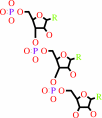 RNA(n)
|
+
|
ribonucleoside 5'-triphosphate
|
=
|
RNA(n+1)
|
+
|
 diphosphate
|
|
|
|
|
|
|
|
|
|
|
|
|
Molecule diagrams generated from .mol files obtained from the
KEGG ftp site
|
|
|
|
|
|
|
|
|
|
|
|
|
|
 |
|
|
|
|
|
|
| |
|
|
| |
|
DOI no:
|
Science
315:859-862
(2007)
|
|
PubMed id:
|
|
|
|
|
|
| |
|
CPD Damage Recognition by Transcribing RNA Polymerase II.
|
|
F.Brueckner,
U.Hennecke,
T.Carell,
P.Cramer.
|
|
|
|
|
| |
ABSTRACT
|
|
|
|
| |
|
|
Cells use transcription-coupled repair (TCR) to efficiently eliminate DNA
lesions such as ultraviolet light-induced cyclobutane pyrimidine dimers (CPDs).
Here we present the structure-based mechanism for the first step in eukaryotic
TCR, CPD-induced stalling of RNA polymerase (Pol) II. A CPD in the transcribed
strand slowly passes a translocation barrier and enters the polymerase active
site. The CPD 5'-thymine then directs uridine misincorporation into messenger
RNA, which blocks translocation. Artificial replacement of the uridine by
adenosine enables CPD bypass; thus, Pol II stalling requires CPD-directed
misincorporation. In the stalled complex, the lesion is inaccessible, and the
polymerase conformation is unchanged. This is consistent with nonallosteric
recruitment of repair factors and excision of a lesion-containing DNA fragment
in the presence of Pol II.
|
|
|
|
|
|
| |
Selected figure(s)
|
|
|
|
| |
|
|

|
|

|
|
Figure 1.
Fig. 1. Pol II elongation complex structures with
thymine-thymine CPD lesions in the template. (A) Nucleic acid
scaffolds A to D. The color code is used throughout. Filled
circles denote nucleotides with interpretable electron density
that were included in the structures in (B). Open circles denote
nucleotides having electron density that could not be
interpreted or that was lacking. (B) Structure of nucleic acids
in the Pol II elongation complexes A to D. The view is from the
side (11). Figures prepared with PYMOL (DeLano Scientific). (C)
Overview of complex C with a CPD lesion at the active site. The
view is as in (B). Protein is in gray, the bridge helix in
green. The CPD is shown as a stick model in orange. A large
portion of the second largest Pol II subunit was omitted for
clarity. (D) Superposition of nucleic acids in structures A to
D. The protein molecules were superimposed and then omitted. The
nucleic acids are depicted as ribbon models, the CPDs as stick
models. Upper and lower views are related by a 90° rotation
around a horizontal axis.
|
|
Figure 3.
Fig. 3. Mechanism of CPD recognition by transcribing Pol II.
Schematic representation of RNA extension in complex A. The
initial RNA (top) corresponds to the nonextended RNA of scaffold
A. The translocation barrier and the translocation block are
indicated with a dashed and a solid horizontal line,
respectively. The artificial situation leading to lesion bypass
(Fig. 2E) is depicted at the bottom.
|
|
|
|
|
|
| |
The above figures are
reprinted
by permission from the AAAs:
Science
(2007,
315,
859-862)
copyright 2007.
|
|
| |
Figures were
selected
by an automated process.
|
|
|
|
|
|
|
|
|
|
|
|
|
|
|
|
 |
 |
 |
|
Literature references that cite this PDB file's key reference
|
|
|
| |
PubMed id
|
|
Reference
|
|
|
|
|
|
K.Howan,
A.J.Smith,
L.F.Westblade,
N.Joly,
W.Grange,
S.Zorman,
S.A.Darst,
N.J.Savery,
and
T.R.Strick
(2012).
Initiation of transcription-coupled repair characterized at single-molecule resolution.
|
| |
Nature,
490,
431-434.
|
|
|
|
|
|
|
C.Miller,
B.Schwalb,
K.Maier,
D.Schulz,
S.Dümcke,
B.Zacher,
A.Mayer,
J.Sydow,
L.Marcinowski,
L.Dölken,
D.E.Martin,
A.Tresch,
and
P.Cramer
(2011).
Dynamic transcriptome analysis measures rates of mRNA synthesis and decay in yeast.
|
| |
Mol Syst Biol,
7,
458.
|
|
|
|
|
|
|
J.An,
T.Yang,
Y.Huang,
F.Liu,
J.Sun,
Y.Wang,
Q.Xu,
D.Wu,
and
P.Zhou
(2011).
Strand-specific PCR of UV radiation-damaged genomic DNA revealed an essential role of DNA-PKcs in the transcription-coupled repair.
|
| |
BMC Biochem,
12,
2.
|
|
|
|
|
|
|
D.Wang,
G.Zhu,
X.Huang,
and
S.J.Lippard
(2010).
X-ray structure and mechanism of RNA polymerase II stalled at an antineoplastic monofunctional platinum-DNA adduct.
|
| |
Proc Natl Acad Sci U S A,
107,
9584-9589.
|
|
|
PDB codes:
|
|
|
|
|
|
|
|
H.H.Arab,
G.Wani,
A.Ray,
Z.I.Shah,
Q.Zhu,
and
A.A.Wani
(2010).
Dissociation of CAK from core TFIIH reveals a functional link between XP-G/CS and the TFIIH disassembly state.
|
| |
PLoS One,
5,
e11007.
|
|
|
|
|
|
|
P.Cramer
(2010).
Towards molecular systems biology of gene transcription and regulation.
|
| |
Biol Chem,
391,
731-735.
|
|
|
|
|
|
|
Z.A.Chen,
A.Jawhari,
L.Fischer,
C.Buchen,
S.Tahir,
T.Kamenski,
M.Rasmussen,
L.Lariviere,
J.C.Bukowski-Wills,
M.Nilges,
P.Cramer,
and
J.Rappsilber
(2010).
Architecture of the RNA polymerase II-TFIIF complex revealed by cross-linking and mass spectrometry.
|
| |
EMBO J,
29,
717-726.
|
|
|
|
|
|
|
C.W.McAndrew,
R.F.Gastwirt,
and
D.J.Donoghue
(2009).
The atypical CDK activator Spy1 regulates the intrinsic DNA damage response and is dependent upon p53 to inhibit apoptosis.
|
| |
Cell Cycle,
8,
66-75.
|
|
|
|
|
|
|
D.G.Vassylyev
(2009).
Elongation by RNA polymerase: a race through roadblocks.
|
| |
Curr Opin Struct Biol,
19,
691-700.
|
|
|
|
|
|
|
F.Brueckner,
K.J.Armache,
A.Cheung,
G.E.Damsma,
H.Kettenberger,
E.Lehmann,
J.Sydow,
and
P.Cramer
(2009).
Structure-function studies of the RNA polymerase II elongation complex.
|
| |
Acta Crystallogr D Biol Crystallogr,
65,
112-120.
|
|
|
|
|
|
|
G.E.Damsma,
and
P.Cramer
(2009).
Molecular basis of transcriptional mutagenesis at 8-oxoguanine.
|
| |
J Biol Chem,
284,
31658-31663.
|
|
|
PDB codes:
|
|
|
|
|
|
|
|
J.F.Sydow,
F.Brueckner,
A.C.Cheung,
G.E.Damsma,
S.Dengl,
E.Lehmann,
D.Vassylyev,
and
P.Cramer
(2009).
Structural basis of transcription: mismatch-specific fidelity mechanisms and paused RNA polymerase II with frayed RNA.
|
| |
Mol Cell,
34,
710-721.
|
|
|
PDB codes:
|
|
|
|
|
|
|
|
M.Winnacker,
S.Breeger,
R.Strasser,
and
T.Carell
(2009).
Novel diazirine-containing DNA photoaffinity probes for the investigation of DNA-protein-interactions.
|
| |
Chembiochem,
10,
109-118.
|
|
|
|
|
|
|
P.A.Meyer,
P.Ye,
M.H.Suh,
M.Zhang,
and
J.Fu
(2009).
Structure of the 12-subunit RNA polymerase II refined with the aid of anomalous diffraction data.
|
| |
J Biol Chem,
284,
12933-12939.
|
|
|
PDB code:
|
|
|
|
|
|
|
|
Q.Zhu,
G.Wani,
H.H.Arab,
M.A.El-Mahdy,
A.Ray,
and
A.A.Wani
(2009).
Chromatin restoration following nucleotide excision repair involves the incorporation of ubiquitinated H2A at damaged genomic sites.
|
| |
DNA Repair (Amst),
8,
262-273.
|
|
|
|
|
|
|
S.Dengl,
and
P.Cramer
(2009).
Torpedo nuclease Rat1 is insufficient to terminate RNA polymerase II in vitro.
|
| |
J Biol Chem,
284,
21270-21279.
|
|
|
PDB code:
|
|
|
|
|
|
|
|
Y.H.Lo,
K.L.Tsai,
Y.J.Sun,
W.T.Chen,
C.Y.Huang,
and
C.D.Hsiao
(2009).
The crystal structure of a replicative hexameric helicase DnaC and its complex with single-stranded DNA.
|
| |
Nucleic Acids Res,
37,
804-814.
|
|
|
PDB codes:
|
|
|
|
|
|
|
|
A.Dimitri,
A.K.Goodenough,
F.P.Guengerich,
S.Broyde,
and
D.A.Scicchitano
(2008).
Transcription processing at 1,N2-ethenoguanine by human RNA polymerase II and bacteriophage T7 RNA polymerase.
|
| |
J Mol Biol,
375,
353-366.
|
|
|
|
|
|
|
A.Dimitri,
J.A.Burns,
S.Broyde,
and
D.A.Scicchitano
(2008).
Transcription elongation past O6-methylguanine by human RNA polymerase II and bacteriophage T7 RNA polymerase.
|
| |
Nucleic Acids Res,
36,
6459-6471.
|
|
|
|
|
|
|
A.Dimitri,
L.Jia,
V.Shafirovich,
N.E.Geacintov,
S.Broyde,
and
D.A.Scicchitano
(2008).
Transcription of DNA containing the 5-guanidino-4-nitroimidazole lesion by human RNA polymerase II and bacteriophage T7 RNA polymerase.
|
| |
DNA Repair (Amst),
7,
1276-1288.
|
|
|
|
|
|
|
A.E.Rumora,
K.M.Kolodziejczak,
A.Malhowski Wagner,
and
M.E.Núñez
(2008).
Thymine dimer-induced structural changes to the DNA duplex examined with reactive probes (†).
|
| |
Biochemistry,
47,
13026-13035.
|
|
|
|
|
|
|
E.J.Song,
S.M.Babar,
E.Oh,
M.N.Hasan,
H.M.Hong,
and
Y.S.Yoo
(2008).
CE at the omics level: towards systems biology--an update.
|
| |
Electrophoresis,
29,
129-142.
|
|
|
|
|
|
|
F.Brueckner,
and
P.Cramer
(2008).
Structural basis of transcription inhibition by alpha-amanitin and implications for RNA polymerase II translocation.
|
| |
Nat Struct Mol Biol,
15,
811-818.
|
|
|
PDB code:
|
|
|
|
|
|
|
|
G.J.Aune,
K.Takagi,
O.Sordet,
J.Guirouilh-Barbat,
S.Antony,
V.A.Bohr,
and
Y.Pommier
(2008).
Von Hippel-Lindau-coupled and transcription-coupled nucleotide excision repair-dependent degradation of RNA polymerase II in response to trabectedin.
|
| |
Clin Cancer Res,
14,
6449-6455.
|
|
|
|
|
|
|
J.Andrecka,
R.Lewis,
F.Brückner,
E.Lehmann,
P.Cramer,
and
J.Michaelis
(2008).
Single-molecule tracking of mRNA exiting from RNA polymerase II.
|
| |
Proc Natl Acad Sci U S A,
105,
135-140.
|
|
|
|
|
|
|
N.Mirkin,
D.Fonseca,
S.Mohammed,
M.A.Cevher,
J.L.Manley,
and
F.E.Kleiman
(2008).
The 3' processing factor CstF functions in the DNA repair response.
|
| |
Nucleic Acids Res,
36,
1792-1804.
|
|
|
|
|
|
|
O.D.Schärer
(2008).
A molecular basis for damage recognition in eukaryotic nucleotide excision repair.
|
| |
Chembiochem,
9,
21-23.
|
|
|
|
|
|
|
O.Sordet,
S.Larochelle,
E.Nicolas,
E.V.Stevens,
C.Zhang,
K.M.Shokat,
R.P.Fisher,
and
Y.Pommier
(2008).
Hyperphosphorylation of RNA polymerase II in response to topoisomerase I cleavage complexes and its association with transcription- and BRCA1-dependent degradation of topoisomerase I.
|
| |
J Mol Biol,
381,
540-549.
|
|
|
|
|
|
|
P.C.Hanawalt,
and
G.Spivak
(2008).
Transcription-coupled DNA repair: two decades of progress and surprises.
|
| |
Nat Rev Mol Cell Biol,
9,
958-970.
|
|
|
|
|
|
|
P.Cramer,
K.J.Armache,
S.Baumli,
S.Benkert,
F.Brueckner,
C.Buchen,
G.E.Damsma,
S.Dengl,
S.R.Geiger,
A.J.Jasiak,
A.Jawhari,
S.Jennebach,
T.Kamenski,
H.Kettenberger,
C.D.Kuhn,
E.Lehmann,
K.Leike,
J.F.Sydow,
and
A.Vannini
(2008).
Structure of eukaryotic RNA polymerases.
|
| |
Annu Rev Biophys,
37,
337-352.
|
|
|
|
|
|
|
A.K.Ganesan,
A.J.Smith,
N.J.Savery,
P.Zamos,
and
P.C.Hanawalt
(2007).
Transcription coupled nucleotide excision repair in Escherichia coli can be affected by changing the arginine at position 529 of the beta subunit of RNA polymerase.
|
| |
DNA Repair (Amst),
6,
1434-1440.
|
|
|
|
|
|
|
B.Ding,
C.Ruggiero,
X.Chen,
and
S.Li
(2007).
Tfb5 is partially dispensable for Rad26 mediated transcription coupled nucleotide excision repair in yeast.
|
| |
DNA Repair (Amst),
6,
1661-1669.
|
|
|
|
|
|
|
C.D.Kuhn,
S.R.Geiger,
S.Baumli,
M.Gartmann,
J.Gerber,
S.Jennebach,
T.Mielke,
H.Tschochner,
R.Beckmann,
and
P.Cramer
(2007).
Functional architecture of RNA polymerase I.
|
| |
Cell,
131,
1260-1272.
|
|
|
PDB code:
|
|
|
|
|
|
|
|
C.Marietta,
and
P.J.Brooks
(2007).
Transcriptional bypass of bulky DNA lesions causes new mutant RNA transcripts in human cells.
|
| |
EMBO Rep,
8,
388-393.
|
|
|
|
|
|
|
E.Lehmann,
F.Brueckner,
and
P.Cramer
(2007).
Molecular basis of RNA-dependent RNA polymerase II activity.
|
| |
Nature,
450,
445-449.
|
|
|
PDB codes:
|
|
|
|
|
|
|
|
G.E.Damsma,
A.Alt,
F.Brueckner,
T.Carell,
and
P.Cramer
(2007).
Mechanism of transcriptional stalling at cisplatin-damaged DNA.
|
| |
Nat Struct Mol Biol,
14,
1127-1133.
|
|
|
PDB code:
|
|
|
|
|
|
|
|
G.Frosina
(2007).
The current evidence for defective repair of oxidatively damaged DNA in Cockayne syndrome.
|
| |
Free Radic Biol Med,
43,
165-177.
|
|
|
|
|
|
|
K.Lorenzen,
A.Vannini,
P.Cramer,
and
A.J.Heck
(2007).
Structural biology of RNA polymerase III: mass spectrometry elucidates subcomplex architecture.
|
| |
Structure,
15,
1237-1245.
|
|
|
|
|
|
|
N.J.Savery
(2007).
The molecular mechanism of transcription-coupled DNA repair.
|
| |
Trends Microbiol,
15,
326-333.
|
|
|
|
|
|
The most recent references are shown first.
Citation data come partly from CiteXplore and partly
from an automated harvesting procedure. Note that this is likely to be
only a partial list as not all journals are covered by
either method. However, we are continually building up the citation data
so more and more references will be included with time.
Where a reference describes a PDB structure, the PDB
codes are
shown on the right.
|

| |


 Links
Links


