 |
PDBsum entry 2j2s

|
|
|
|
|
|

|

|

|

|
|

|
|

|
|

|
|
|
 |

|

|
|
|
|
|
|
|
|
|
|
|
|
|
|
|
|
|
|
|
|
|
|
|
|
|
|
|
|
|
|
|
|
Transcription regulation
|
PDB id
|
|
|
|
2j2s
|
|
|
|
|
|
|
|
|
|
|
|
|
|
|

|

|

|
|
|
|
|
|
|
|
 |
Contents |
 |
|
|
|
|
|
|
|
|
|
|
* Residue conservation analysis
|
|
|
|
|
|
PDB id:
|
|
|
|
| Name: |
|
Transcription regulation
|
|
|
Title:
|
|
Solution structure of the nonmethyl-cpg-binding cxxc domain of the leukaemia-associated mll histone methyltransferase
|
|
Structure:
|
|
Zinc finger protein hrx. Chain: a. Fragment: residues 1146-1214. Synonym: all-1, trithorax-like protein, cxxc domain of mll-1. Engineered: yes. Mutation: yes
|
|
Source:
|
|
Homo sapiens. Human. Organism_taxid: 9606. Expressed in: escherichia coli. Expression_system_taxid: 562.
|
|
NMR struc:
|
|
20 models
|
|
|
Authors:
|
|
M.D.Allen,C.G.Grummitt,C.Hilcenko,S.Young-Min,L.M.Tonkin,C.M.Johnson, M.Bycroft,A.J.Warren
|
Key ref:

|
|
M.D.Allen
et al.
(2006).
Solution structure of the nonmethyl-CpG-binding CXXC domain of the leukaemia-associated MLL histone methyltransferase.
EMBO J,
25,
4503-4512.
PubMed id:
DOI:

|
|
|
Date:
|
|
|
17-Aug-06
|
Release date:
|
21-Aug-06
|
|
|
|
|
|
|
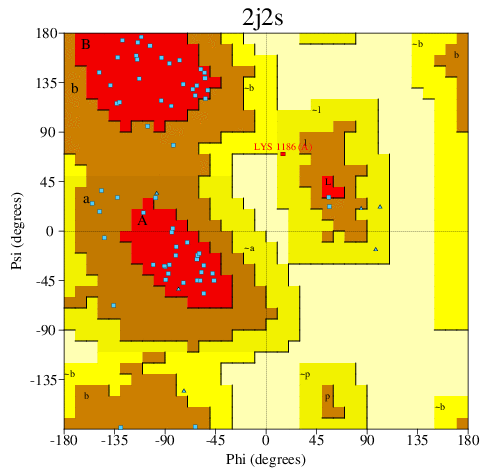
PROCHECK
|
|
|
|
|
|
Headers
|
|
|
|
References
|
|
|
|
|
|

|
|
Q03164
(KMT2A_HUMAN) -
Histone-lysine N-methyltransferase 2A from Homo sapiens
|
|
|
|
Seq:
Struc:
|
|
|
|
3969 a.a.
72 a.a.*
|
|

|

|

|
|
|
|
|
|
|
|
|
|
|
Key: |
 |
PfamA domain |
|
|
 |
Secondary structure |
|
|
*
PDB and UniProt seqs differ
at 3 residue positions (black
crosses)
|
|
|
|
|
|
|
|
|
|
|
|
|
Enzyme class 1:
|
|
E.C.2.1.1.-
- ?????
|
|
|
|
|
|
|
Enzyme class 2:
|
|
E.C.2.1.1.364
- [histone H3]-lysine(4) N-methyltransferase.
|
|
|
|
|
|
|
Reaction:
|
|
L-lysyl4-[histone H3] + S-adenosyl-L-methionine = N6-methyl-L- lysyl4-[histone H3] + S-adenosyl-L-homocysteine + H+
|
|
|
|
|
|
L-lysyl(4)-[histone H3]
|
+
|
 S-adenosyl-L-methionine
|
=
|
N(6)-methyl-L- lysyl(4)-[histone H3]
|
+
|
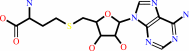 S-adenosyl-L-homocysteine
|
+
|
H(+)
|
|
|
|
|
|
|
|
|
|
|
|
|
Note, where more than one E.C. class is given (as above), each may
correspond to a different protein domain or, in the case of polyprotein
precursors, to a different mature protein.
|
|
|
|
Molecule diagrams generated from .mol files obtained from the
KEGG ftp site
|
|
|
|
|
|
|
|
|
|
|
|
|
|
 |
|
|
|
|
|
|
| |
|
|
| |
|
DOI no:
|
EMBO J
25:4503-4512
(2006)
|
|
PubMed id:
|
|
|
|
|
|
| |
|
Solution structure of the nonmethyl-CpG-binding CXXC domain of the leukaemia-associated MLL histone methyltransferase.
|
|
M.D.Allen,
C.G.Grummitt,
C.Hilcenko,
S.Y.Min,
L.M.Tonkin,
C.M.Johnson,
S.M.Freund,
M.Bycroft,
A.J.Warren.
|
|
|
|
|
| |
ABSTRACT
|
|
|
|
| |
|
|
Methylation of CpG dinucleotides is the major epigenetic modification of
mammalian genomes, critical for regulating chromatin structure and gene
activity. The mixed-lineage leukaemia (MLL) CXXC domain selectively binds
nonmethyl-CpG DNA, and is required for transformation by MLL fusion proteins
that commonly arise from recurrent chromosomal translocations in infant and
secondary treatment-related acute leukaemias. To elucidate the molecular basis
of nonmethyl-CpG DNA recognition, we determined the structure of the human MLL
CXXC domain by multidimensional NMR spectroscopy. The CXXC domain has a novel
fold in which two zinc ions are each coordinated tetrahedrally by four conserved
cysteine ligands provided by two CGXCXXC motifs and two distal cysteine
residues. We have identified the CXXC domain DNA binding interface by means of
chemical shift perturbation analysis, cross-saturation transfer and
site-directed mutagenesis. In particular, we have shown that residues in an
extended surface loop are in close contact with the DNA. These data provide a
template for the design of specifically targeted therapeutics for poor prognosis
MLL-associated leukaemias.
|
|
|
|
|
|
| |
Selected figure(s)
|
|
|
|
| |
|
|

|
|

|
|
Figure 1.
Figure 1 Solution structure of the MLL CXXC domain. (A) An
overlay of the backbone atoms of the 20 lowest energy structures
in stereo. (B) A ribbon representation of the lowest energy
structure (same orientation as in (A)), prepared using the
program PyMOL (http://www.pymol.org). Zn ions are shown as
spheres. (C) A ribbon representation of the Zn coordination
sites in MLL (PyMOL).
|
|
Figure 2.
Figure 2 Ribbon representation of the elaborate turn in the CXXC
domain of MLL showing the side chains of the residues from the
KFGG motif and the second Zn coordination site (PyMOL). An
extended loop is formed between residues G1181 and C1189.
|
|
|
|
|
|
| |
The above figures are
reprinted
by permission from Macmillan Publishers Ltd:
EMBO J
(2006,
25,
4503-4512)
copyright 2006.
|
|
| |
Figures were
selected
by the author.
|
|
|
|
|
|
|
|
|
|
|
|
|
|
|
|
 |
 |
 |
|
Literature references that cite this PDB file's key reference
|
|
|
| |
PubMed id
|
|
Reference
|
|
|
|
|
|
B.W.Robinson,
G.Germano,
Y.Song,
J.Abrams,
M.Scott,
I.Guariento,
N.Tiso,
F.Argenton,
G.Basso,
J.Rhodes,
J.P.Kanki,
A.T.Look,
R.J.Balice-Gordon,
and
C.A.Felix
(2011).
mll ortholog containing functional domains of human MLL is expressed throughout the zebrafish lifespan and in haematopoietic tissues.
|
| |
Br J Haematol,
152,
307-321.
|
|
|
|
|
|
|
C.Frauer,
A.Rottach,
D.Meilinger,
S.Bultmann,
K.Fellinger,
S.Hasenöder,
M.Wang,
W.Qin,
J.Söding,
F.Spada,
and
H.Leonhardt
(2011).
Different binding properties and function of CXXC zinc finger domains in Dnmt1 and Tet1.
|
| |
PLoS One,
6,
e16627.
|
|
|
|
|
|
|
C.Xu,
C.Bian,
R.Lam,
A.Dong,
and
J.Min
(2011).
The structural basis for selective binding of non-methylated CpG islands by the CFP1 CXXC domain.
|
| |
Nat Commun,
2,
227.
|
|
|
PDB codes:
|
|
|
|
|
|
|
|
J.Song,
O.Rechkoblit,
T.H.Bestor,
and
D.J.Patel
(2011).
Structure of DNMT1-DNA complex reveals a role for autoinhibition in maintenance DNA methylation.
|
| |
Science,
331,
1036-1040.
|
|
|
PDB codes:
|
|
|
|
|
|
|
|
R.Z.Jurkowska,
T.P.Jurkowski,
and
A.Jeltsch
(2011).
Structure and function of mammalian DNA methyltransferases.
|
| |
Chembiochem,
12,
206-222.
|
|
|
|
|
|
|
A.G.Muntean,
J.Tan,
K.Sitwala,
Y.Huang,
J.Bronstein,
J.A.Connelly,
V.Basrur,
K.S.Elenitoba-Johnson,
and
J.L.Hess
(2010).
The PAF complex synergizes with MLL fusion proteins at HOX loci to promote leukemogenesis.
|
| |
Cancer Cell,
17,
609-621.
|
|
|
|
|
|
|
H.Hashimoto,
P.M.Vertino,
and
X.Cheng
(2010).
Molecular coupling of DNA methylation and histone methylation.
|
| |
Epigenomics,
2,
657-669.
|
|
|
|
|
|
|
H.Zhang,
X.Zhang,
E.Clark,
M.Mulcahey,
S.Huang,
and
Y.G.Shi
(2010).
TET1 is a DNA-binding protein that modulates DNA methylation and gene transcription via hydroxylation of 5-methylcytosine.
|
| |
Cell Res,
20,
1390-1393.
|
|
|
|
|
|
|
M.S.Cosgrove,
and
A.Patel
(2010).
Mixed lineage leukemia: a structure-function perspective of the MLL1 protein.
|
| |
FEBS J,
277,
1832-1842.
|
|
|
|
|
|
|
S.C.Wu,
and
Y.Zhang
(2010).
Active DNA demethylation: many roads lead to Rome.
|
| |
Nat Rev Mol Cell Biol,
11,
607-620.
|
|
|
|
|
|
|
T.Cierpicki,
L.E.Risner,
J.Grembecka,
S.M.Lukasik,
R.Popovic,
M.Omonkowska,
D.D.Shultis,
N.J.Zeleznik-Le,
and
J.H.Bushweller
(2010).
Structure of the MLL CXXC domain-DNA complex and its functional role in MLL-AF9 leukemia.
|
| |
Nat Struct Mol Biol,
17,
62-68.
|
|
|
PDB code:
|
|
|
|
|
|
|
|
T.Clouaire,
J.I.de Las Heras,
C.Merusi,
and
I.Stancheva
(2010).
Recruitment of MBD1 to target genes requires sequence-specific interaction of the MBD domain with methylated DNA.
|
| |
Nucleic Acids Res,
38,
4620-4634.
|
|
|
|
|
|
|
X.Cheng,
and
R.M.Blumenthal
(2010).
Coordinated chromatin control: structural and functional linkage of DNA and histone methylation.
|
| |
Biochemistry,
49,
2999-3008.
|
|
|
|
|
|
|
Y.Okada,
K.Yamagata,
K.Hong,
T.Wakayama,
and
Y.Zhang
(2010).
A role for the elongator complex in zygotic paternal genome demethylation.
|
| |
Nature,
463,
554-558.
|
|
|
|
|
|
|
A.Murati,
C.Gervais,
N.Carbuccia,
P.Finetti,
N.Cervera,
J.Adélaïde,
S.Struski,
E.Lippert,
F.Mugneret,
I.Tigaud,
D.Penther,
C.Bastard,
B.Poppe,
F.Speleman,
L.Baranger,
I.Luquet,
P.Cornillet-Lefebvre,
N.Nadal,
F.Nguyen-Khac,
C.Pérot,
S.Olschwang,
F.Bertucci,
M.Chaffanet,
M.Lessard,
M.J.Mozziconacci,
and
D.Birnbaum
(2009).
Genome profiling of acute myelomonocytic leukemia: alteration of the MYB locus in MYST3-linked cases.
|
| |
Leukemia,
23,
85-94.
|
|
|
|
|
|
|
A.Ruzov,
E.Savitskaya,
J.A.Hackett,
J.P.Reddington,
A.Prokhortchouk,
M.J.Madej,
N.Chekanov,
M.Li,
D.S.Dunican,
E.Prokhortchouk,
S.Pennings,
and
R.R.Meehan
(2009).
The non-methylated DNA-binding function of Kaiso is not required in early Xenopus laevis development.
|
| |
Development,
136,
729-738.
|
|
|
|
|
|
|
C.Bach,
D.Mueller,
S.Buhl,
M.P.Garcia-Cuellar,
and
R.K.Slany
(2009).
Alterations of the CxxC domain preclude oncogenic activation of mixed-lineage leukemia 2.
|
| |
Oncogene,
28,
815-823.
|
|
|
|
|
|
|
C.Bach,
and
R.K.Slany
(2009).
Molecular pathology of mixed-lineage leukemia.
|
| |
Future Oncol,
5,
1271-1281.
|
|
|
|
|
|
|
F.Pendino,
E.Nguyen,
I.Jonassen,
B.Dysvik,
A.Azouz,
M.Lanotte,
E.Ségal-Bendirdjian,
and
J.R.Lillehaug
(2009).
Functional involvement of RINF, retinoid-inducible nuclear factor (CXXC5), in normal and tumoral human myelopoiesis.
|
| |
Blood,
113,
3172-3181.
|
|
|
|
|
|
|
L.M.Iyer,
M.Tahiliani,
A.Rao,
and
L.Aravind
(2009).
Prediction of novel families of enzymes involved in oxidative and other complex modifications of bases in nucleic acids.
|
| |
Cell Cycle,
8,
1698-1710.
|
|
|
|
|
|
|
M.Liedtke,
and
M.L.Cleary
(2009).
Therapeutic targeting of MLL.
|
| |
Blood,
113,
6061-6068.
|
|
|
|
|
|
|
M.Tahiliani,
K.P.Koh,
Y.Shen,
W.A.Pastor,
H.Bandukwala,
Y.Brudno,
S.Agarwal,
L.M.Iyer,
D.R.Liu,
L.Aravind,
and
A.Rao
(2009).
Conversion of 5-methylcytosine to 5-hydroxymethylcytosine in mammalian DNA by MLL partner TET1.
|
| |
Science,
324,
930-935.
|
|
|
|
|
|
|
R.K.Slany
(2009).
The molecular biology of mixed lineage leukemia.
|
| |
Haematologica,
94,
984-993.
|
|
|
|
|
|
|
C.Qian,
S.Li,
J.Jakoncic,
L.Zeng,
M.J.Walsh,
and
M.M.Zhou
(2008).
Structure and Hemimethylated CpG Binding of the SRA Domain from Human UHRF1.
|
| |
J Biol Chem,
283,
34490-34494.
|
|
|
PDB code:
|
|
|
|
|
|
|
|
O.Okhrimenko,
and
I.Jelesarov
(2008).
A survey of the year 2006 literature on applications of isothermal titration calorimetry.
|
| |
J Mol Recognit,
21,
1.
|
|
|
|
|
|
|
Y.Dou,
and
J.L.Hess
(2008).
Mechanisms of transcriptional regulation by MLL and its disruption in acute leukemia.
|
| |
Int J Hematol,
87,
10-18.
|
|
|
|
|
|
|
S.Lall
(2007).
Primers on chromatin.
|
| |
Nat Struct Mol Biol,
14,
1110-1115.
|
|
|
|
|
|
The most recent references are shown first.
Citation data come partly from CiteXplore and partly
from an automated harvesting procedure. Note that this is likely to be
only a partial list as not all journals are covered by
either method. However, we are continually building up the citation data
so more and more references will be included with time.
Where a reference describes a PDB structure, the PDB
codes are
shown on the right.
|
|


 Links
Links


