
|
|
|
|
|
 |
Contents |
 |
|
|
|
|
|
|
|
|
|
|
|
 391 a.a.
|
|
|
|
|
|
|
|
|
|
|
 143 a.a.
|
|
|
|
|
|
|
|
|
|
|
 89 a.a.
|
|
|
|
|
|
|
|
|
|
|
 44 a.a.
|
|
|
|
|
|
|
|
|
|
|
|
|
|
|
* Residue conservation analysis
|
|
|
|
|
|
PDB id:
|
|
|
|
| Name: |
|
Hydrolase
|
|
|
Title:
|
|
The crystal structure of the exon junction complex at 2.2 a resolution
|
|
Structure:
|
|
Atp-dependent RNA helicase ddx48. Chain: a. Synonym: eif4aiii RNA-helicase, dead box protein 48, eukaryotic initiation factor 4a-like nuk-34, nuclear matrix protein 265, hnmp 265, eukaryotic translation initiation factor 4a isoform 3. Engineered: yes. Protein mago nashi homolog. Chain: c. Engineered: yes.
|
|
Source:
|
|
Homo sapiens. Human. Organism_taxid: 9606. Expressed in: escherichia coli. Expression_system_taxid: 469008. Synthetic: yes.
|
|
Biol. unit:
|
|
Pentamer (from PDB file)
|
|
Resolution:
|
|
|
2.21Å
|
R-factor:
|
0.187
|
R-free:
|
0.216
|
|
|
Authors:
|
|
F.Bono,J.Ebert,E.Lorentzen,E.Conti
|
Key ref:

|
|
F.Bono
et al.
(2006).
The crystal structure of the exon junction complex reveals how it maintains a stable grip on mRNA.
Cell,
126,
713-725.
PubMed id:
DOI:

|
|
|
Date:
|
|
|
04-Aug-06
|
Release date:
|
06-Sep-06
|
|
|
|
|
|
|
PROCHECK
|

|
|
|
|
|
Headers
|
|
|
|
References
|
|
|
|
|
|

|
|
P38919
(IF4A3_HUMAN) -
Eukaryotic initiation factor 4A-III from Homo sapiens
|
|
|
|
Seq:
Struc:
|
|
|
|
411 a.a.
391 a.a.
|
|

|

|

|
|
|
|
|
|
|
|
|
|
|
|

|
|
P61326
(MGN_HUMAN) -
Protein mago nashi homolog from Homo sapiens
|
|
|
|
Seq:
Struc:
|
|
|
|
146 a.a.
143 a.a.
|
|
|

|
|
|
|
|
|
|
|
|
|
|
|
|
|
|
|
|
|
Enzyme class 2:
|
|
Chain A:
E.C.3.6.4.13
- Rna helicase.
|
|
|
|
|
|
|
Reaction:
|
|
ATP + H2O = ADP + phosphate + H+
|
|
|
|
|
|
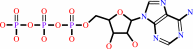 ATP
ATP
|
+
|
H2O
|
=
|
ADP
Bound ligand (Het Group name = )
matches with 81.25% similarity
|
+
|
 phosphate
|
+
|
H(+)
|
|
|
|
|
|
|
|
|
|
Enzyme class 3:
|
|
Chains C, D, T:
E.C.?
|
|
|
|
|
|
|
|
|
|
Note, where more than one E.C. class is given (as above), each may
correspond to a different protein domain or, in the case of polyprotein
precursors, to a different mature protein.
|
|
|
|
Molecule diagrams generated from .mol files obtained from the
KEGG ftp site
|
|
|
|
|
|
|
|
|
|
|
|
|
|
 |
|
|
|
|
|
|
| |
|
|
| |
|
DOI no:
|
Cell
126:713-725
(2006)
|
|
PubMed id:
|
|
|
|
|
|
| |
|
The crystal structure of the exon junction complex reveals how it maintains a stable grip on mRNA.
|
|
F.Bono,
J.Ebert,
E.Lorentzen,
E.Conti.
|
|
|
|
|
| |
ABSTRACT
|
|
|
|
| |
|
|
The exon junction complex (EJC) plays a major role in posttranscriptional
regulation of mRNA in metazoa. The EJC is deposited onto mRNA during splicing
and is transported to the cytoplasm where it influences translation,
surveillance, and localization of the spliced mRNA. The complex is formed by the
association of four proteins (eIF4AIII, Barentsz [Btz], Mago, and Y14), mRNA,
and ATP. The 2.2 A resolution structure of the EJC reveals how it stably locks
onto mRNA. The DEAD-box protein eIF4AIII encloses an ATP molecule and provides
the binding sites for six ribonucleotides. Btz wraps around eIF4AIII and stacks
against the 5' nucleotide. An intertwined network of interactions anchors
Mago-Y14 and Btz at the interface between the two domains of eIF4AIII,
effectively stabilizing the ATP bound state. Comparison with the structure of
the eIF4AIII-Btz subcomplex that we have also determined reveals that large
conformational changes are required upon EJC assembly and disassembly.
|
|
|
|
|
|
| |
Selected figure(s)
|
|
|
|
| |
|
|

|
|

|
|
Figure 2.
Figure 2. Structure of EJC
View of the human EJC in two
orientations related by a 180° rotation about a vertical
axis. In the complex, Btz (shown in red) stretches around the
DEAD-box helicase eIF4AIII (in yellow). Both proteins interact
with RNA (in black), which is bound at a cleft formed between
the two RecA-like domains of eIF4AIII. ATP (in gray) binds at an
interface between the two domains of eIF4AIII, distinct from the
RNA binding cleft. The other two protein components of the EJC,
Mago (blue), and Y14 (magenta), bind mainly to domain 2 of
eIF4AIII, but the interaction surface also extends over to the
interface with domain 1. The dotted line in red shows the
approximate path of a portion of Btz not present in the electron
density (residues 198–213; Figure 1). The helix at the
C-terminal stretch of Btz is present in the 3.2 Å
resolution structure (shown), while it is partially disordered
in the 2.2 Å structure. The two EJC structures are
otherwise virtually identical. All ribbon drawings were rendered
using PyMOL (DeLano, W.L., 2002, http://www.pymol.org).
|
|
Figure 4.
Figure 4. Interaction Networks between the Protein Components
of the EJC
(A) The C-terminal stretch of Btz (red) is
anchored to domain 1 of eIF4AIII (yellow). The close up is in a
similar orientation as Figure 2A. It shows a subset of Btz
residues contacting a region of the DEAD-box protein that is
conserved in eIF4AIII orthologs but not in paralogs such as
eIF4AI.
(B) Group of interactions between Mago (blue), Btz,
and eIF4AIII. Mago and Btz protrude into the cleft that is
formed between the two domains of eIF4AIII.
(C) The
C-terminal helix of eIF4AIII engages in a cluster of
interactions between Y14 (magenta) and Mago.
(D)
Interactions of Mago-Y14 with the eIF4AIII linker (residues
241–250, in yellow) connecting the two RecA-like domains (in
gray). The linker is wedged into Mago-Y14. It interacts on one
side with the loops of Mago shown in panel (B) and on the other
side with Y14 and with the C-terminal region of Mago (see Ile146
in Figure 3E).
|
|
|
|
|
|
| |
The above figures are
reprinted
by permission from Cell Press:
Cell
(2006,
126,
713-725)
copyright 2006.
|
|
| |
Figures were
selected
by an automated process.
|
|
|
|
|
|
|
|
|
|
|
|
|
|
|
|
 |
 |
 |
|
Literature references that cite this PDB file's key reference
|
|
|
| |
PubMed id
|
|
Reference
|
|
|
|
|
|
A.G.Murachelli,
J.Ebert,
C.Basquin,
H.Le Hir,
and
E.Conti
(2012).
The structure of the ASAP core complex reveals the existence of a Pinin-containing PSAP complex.
|
| |
Nat Struct Mol Biol,
19,
378-386.
|
|
|
PDB codes:
|
|
|
|
|
|
|
|
I.Barbosa,
N.Haque,
F.Fiorini,
C.Barrandon,
C.Tomasetto,
M.Blanchette,
and
H.Le Hir
(2012).
Human CWC22 escorts the helicase eIF4AIII to spliceosomes and promotes exon junction complex assembly.
|
| |
Nat Struct Mol Biol,
19,
983-990.
|
|
|
|
|
|
|
J.Saulière,
V.Murigneux,
Z.Wang,
E.Marquenet,
I.Barbosa,
O.Le Tonquèze,
Y.Audic,
L.Paillard,
H.Roest Crollius,
and
H.Le Hir
(2012).
CLIP-seq of eIF4AIII reveals transcriptome-wide mapping of the human exon junction complex.
|
| |
Nat Struct Mol Biol,
19,
1124-1131.
|
|
|
|
|
|
|
O.Mühlemann
(2012).
Intimate liaison with SR proteins brings exon junction complexes to unexpected places.
|
| |
Nat Struct Mol Biol,
19,
1209-1211.
|
|
|
|
|
|
|
R.Melero,
G.Buchwald,
R.Castaño,
M.Raabe,
D.Gil,
M.Lázaro,
H.Urlaub,
E.Conti,
and
O.Llorca
(2012).
The cryo-EM structure of the UPF-EJC complex shows UPF1 poised toward the RNA 3' end.
|
| |
Nat Struct Mol Biol,
19,
498.
|
|
|
|
|
|
|
D.Klostermeier
(2011).
Single-molecule FRET reveals nucleotide-driven conformational changes in molecular machines and their link to RNA unwinding and DNA supercoiling.
|
| |
Biochem Soc Trans,
39,
611-616.
|
|
|
|
|
|
|
E.Jankowsky
(2011).
RNA helicases at work: binding and rearranging.
|
| |
Trends Biochem Sci,
36,
19-29.
|
|
|
|
|
|
|
F.Li,
J.Herrera,
S.Zhou,
D.A.Maslov,
and
L.Simpson
(2011).
Trypanosome REH1 is an RNA helicase involved with the 3'-5' polarity of multiple gRNA-guided uridine insertion/deletion RNA editing.
|
| |
Proc Natl Acad Sci U S A,
108,
3542-3547.
|
|
|
|
|
|
|
J.Strohmeier,
I.Hertel,
U.Diederichsen,
M.G.Rudolph,
and
D.Klostermeier
(2011).
Changing nucleotide specificity of the DEAD-box helicase Hera abrogates communication between the Q-motif and the P-loop.
|
| |
Biol Chem,
392,
357-369.
|
|
|
PDB codes:
|
|
|
|
|
|
|
|
K.H.Nielsen,
M.A.Behrens,
Y.He,
C.L.Oliveira,
L.Sottrup Jensen,
S.V.Hoffmann,
J.S.Pedersen,
and
G.R.Andersen
(2011).
Synergistic activation of eIF4A by eIF4B and eIF4G.
|
| |
Nucleic Acids Res,
39,
2678-2689.
|
|
|
|
|
|
|
M.Doetsch,
R.Schroeder,
and
B.Fürtig
(2011).
Transient RNA-protein interactions in RNA folding.
|
| |
FEBS J,
278,
1634-1642.
|
|
|
|
|
|
|
M.Grünwald,
and
F.Bono
(2011).
Structure of Importin13-Ubc9 complex: nuclear import and release of a key regulator of sumoylation.
|
| |
EMBO J,
30,
427-438.
|
|
|
PDB code:
|
|
|
|
|
|
|
|
M.Hilbert,
F.Kebbel,
A.Gubaev,
and
D.Klostermeier
(2011).
eIF4G stimulates the activity of the DEAD box protein eIF4A by a conformational guidance mechanism.
|
| |
Nucleic Acids Res,
39,
2260-2270.
|
|
|
|
|
|
|
P.Linder,
and
E.Jankowsky
(2011).
From unwinding to clamping - the DEAD box RNA helicase family.
|
| |
Nat Rev Mol Cell Biol,
12,
505-516.
|
|
|
|
|
|
|
A.L.Bifano,
E.M.Turk,
and
M.G.Caprara
(2010).
Structure-guided mutational analysis of a yeast DEAD-box protein involved in mitochondrial RNA splicing.
|
| |
J Mol Biol,
398,
429-443.
|
|
|
|
|
|
|
G.Buchwald,
J.Ebert,
C.Basquin,
J.Sauliere,
U.Jayachandran,
F.Bono,
H.Le Hir,
and
E.Conti
(2010).
Insights into the recruitment of the NMD machinery from the crystal structure of a core EJC-UPF3b complex.
|
| |
Proc Natl Acad Sci U S A,
107,
10050-10055.
|
|
|
PDB code:
|
|
|
|
|
|
|
|
J.R.Weir,
F.Bonneau,
J.Hentschel,
and
E.Conti
(2010).
Structural analysis reveals the characteristic features of Mtr4, a DExH helicase involved in nuclear RNA processing and surveillance.
|
| |
Proc Natl Acad Sci U S A,
107,
12139-12144.
|
|
|
PDB code:
|
|
|
|
|
|
|
|
J.Y.Roignant,
and
J.E.Treisman
(2010).
Exon junction complex subunits are required to splice Drosophila MAP kinase, a large heterochromatic gene.
|
| |
Cell,
143,
238-250.
|
|
|
|
|
|
|
M.Gyimesi,
K.Sarlós,
and
M.Kovács
(2010).
Processive translocation mechanism of the human Bloom's syndrome helicase along single-stranded DNA.
|
| |
Nucleic Acids Res,
38,
4404-4414.
|
|
|
|
|
|
|
O.Fedorova,
A.Solem,
and
A.M.Pyle
(2010).
Protein-facilitated folding of group II intron ribozymes.
|
| |
J Mol Biol,
397,
799-813.
|
|
|
|
|
|
|
P.Nicholson,
H.Yepiskoposyan,
S.Metze,
R.Zamudio Orozco,
N.Kleinschmidt,
and
O.Mühlemann
(2010).
Nonsense-mediated mRNA decay in human cells: mechanistic insights, functions beyond quality control and the double-life of NMD factors.
|
| |
Cell Mol Life Sci,
67,
677-700.
|
|
|
|
|
|
|
P.Schütz,
T.Karlberg,
S.van den Berg,
R.Collins,
L.Lehtiö,
M.Högbom,
L.Holmberg-Schiavone,
W.Tempel,
H.W.Park,
M.Hammarström,
M.Moche,
A.G.Thorsell,
and
H.Schüler
(2010).
Comparative structural analysis of human DEAD-box RNA helicases.
|
| |
PLoS One,
5,
0.
|
|
|
PDB codes:
|
|
|
|
|
|
|
|
R.Tuteja,
and
J.Mehta
(2010).
A genomic glance at the components of the mRNA export machinery in Plasmodium falciparum.
|
| |
Commun Integr Biol,
3,
318-326.
|
|
|
|
|
|
|
S.A.Shiryaev,
and
A.Y.Strongin
(2010).
Structural and functional parameters of the flaviviral protease: a promising antiviral drug target.
|
| |
Future Virol,
5,
593-606.
|
|
|
|
|
|
|
W.Yang
(2010).
Lessons learned from UvrD helicase: mechanism for directional movement.
|
| |
Annu Rev Biophys,
39,
367-385.
|
|
|
|
|
|
|
A.R.Karow,
and
D.Klostermeier
(2009).
A conformational change in the helicase core is necessary but not sufficient for RNA unwinding by the DEAD box helicase YxiN.
|
| |
Nucleic Acids Res,
37,
4464-4471.
|
|
|
|
|
|
|
D.Klostermeier,
and
M.G.Rudolph
(2009).
A novel dimerization motif in the C-terminal domain of the Thermus thermophilus DEAD box helicase Hera confers substantial flexibility.
|
| |
Nucleic Acids Res,
37,
421-430.
|
|
|
PDB codes:
|
|
|
|
|
|
|
|
F.Tritschler,
J.E.Braun,
A.Eulalio,
V.Truffault,
E.Izaurralde,
and
O.Weichenrieder
(2009).
Structural basis for the mutually exclusive anchoring of P body components EDC3 and Tral to the DEAD box protein DDX6/Me31B.
|
| |
Mol Cell,
33,
661-668.
|
|
|
PDB codes:
|
|
|
|
|
|
|
|
H.Sato,
and
L.E.Maquat
(2009).
Remodeling of the pioneer translation initiation complex involves translation and the karyopherin importin beta.
|
| |
Genes Dev,
23,
2537-2550.
|
|
|
|
|
|
|
H.von Moeller,
C.Basquin,
and
E.Conti
(2009).
The mRNA export protein DBP5 binds RNA and the cytoplasmic nucleoporin NUP214 in a mutually exclusive manner.
|
| |
Nat Struct Mol Biol,
16,
247-254.
|
|
|
PDB codes:
|
|
|
|
|
|
|
|
K.H.Nielsen,
H.Chamieh,
C.B.Andersen,
F.Fredslund,
K.Hamborg,
H.Le Hir,
and
G.R.Andersen
(2009).
Mechanism of ATP turnover inhibition in the EJC.
|
| |
RNA,
15,
67-75.
|
|
|
PDB code:
|
|
|
|
|
|
|
|
M.Del Campo,
and
A.M.Lambowitz
(2009).
Crystallization and preliminary X-ray diffraction of the DEAD-box protein Mss116p complexed with an RNA oligonucleotide and AMP-PNP.
|
| |
Acta Crystallogr Sect F Struct Biol Cryst Commun,
65,
832-835.
|
|
|
|
|
|
|
M.Del Campo,
and
A.M.Lambowitz
(2009).
Structure of the Yeast DEAD box protein Mss116p reveals two wedges that crimp RNA.
|
| |
Mol Cell,
35,
598-609.
|
|
|
PDB codes:
|
|
|
|
|
|
|
|
M.G.Rudolph,
and
D.Klostermeier
(2009).
The Thermus thermophilus DEAD box helicase Hera contains a modified RNA recognition motif domain loosely connected to the helicase core.
|
| |
RNA,
15,
1993-2001.
|
|
|
PDB codes:
|
|
|
|
|
|
|
|
M.G.Rudolph,
J.G.Wittmann,
and
D.Klostermeier
(2009).
Crystallization and preliminary characterization of the Thermus thermophilus RNA helicase Hera C-terminal domain.
|
| |
Acta Crystallogr Sect F Struct Biol Cryst Commun,
65,
248-252.
|
|
|
|
|
|
|
M.Hilbert,
A.R.Karow,
and
D.Klostermeier
(2009).
The mechanism of ATP-dependent RNA unwinding by DEAD box proteins.
|
| |
Biol Chem,
390,
1237-1250.
|
|
|
|
|
|
|
M.N.Murphy,
P.Gong,
K.Ralto,
L.Manelyte,
N.J.Savery,
and
K.Theis
(2009).
An N-terminal clamp restrains the motor domains of the bacterial transcription-repair coupling factor Mfd.
|
| |
Nucleic Acids Res,
37,
6042-6053.
|
|
|
PDB code:
|
|
|
|
|
|
|
|
N.H.Gehring,
S.Lamprinaki,
A.E.Kulozik,
and
M.W.Hentze
(2009).
Disassembly of exon junction complexes by PYM.
|
| |
Cell,
137,
536-548.
|
|
|
|
|
|
|
N.H.Gehring,
S.Lamprinaki,
M.W.Hentze,
and
A.E.Kulozik
(2009).
The hierarchy of exon-junction complex assembly by the spliceosome explains key features of mammalian nonsense-mediated mRNA decay.
|
| |
PLoS Biol,
7,
e1000120.
|
|
|
|
|
|
|
P.G.Loh,
H.S.Yang,
M.A.Walsh,
Q.Wang,
X.Wang,
Z.Cheng,
D.Liu,
and
H.Song
(2009).
Structural basis for translational inhibition by the tumour suppressor Pdcd4.
|
| |
EMBO J,
28,
274-285.
|
|
|
PDB codes:
|
|
|
|
|
|
|
|
R.Collins,
T.Karlberg,
L.Lehtiö,
P.Schütz,
S.van den Berg,
L.G.Dahlgren,
M.Hammarström,
J.Weigelt,
and
H.Schüler
(2009).
The DEXD/H-box RNA Helicase DDX19 Is Regulated by an {alpha}-Helical Switch.
|
| |
J Biol Chem,
284,
10296-10300.
|
|
|
PDB codes:
|
|
|
|
|
|
|
|
S.Chimnaronk,
T.Suzuki,
T.Manita,
Y.Ikeuchi,
M.Yao,
T.Suzuki,
and
I.Tanaka
(2009).
RNA helicase module in an acetyltransferase that modifies a specific tRNA anticodon.
|
| |
EMBO J,
28,
1362-1373.
|
|
|
PDB code:
|
|
|
|
|
|
|
|
S.H.Ling,
Z.Cheng,
and
H.Song
(2009).
Structural aspects of RNA helicases in eukaryotic mRNA decay.
|
| |
Biosci Rep,
29,
339-349.
|
|
|
|
|
|
|
U.Schmidt,
K.B.Im,
C.Benzing,
S.Janjetovic,
K.Rippe,
P.Lichter,
and
M.Wachsmuth
(2009).
Assembly and mobility of exon-exon junction complexes in living cells.
|
| |
RNA,
15,
862-876.
|
|
|
|
|
|
|
Y.Dang,
W.K.Low,
J.Xu,
N.H.Gehring,
H.C.Dietz,
D.Romo,
and
J.O.Liu
(2009).
Inhibition of nonsense-mediated mRNA decay by the natural product pateamine A through eukaryotic initiation factor 4AIII.
|
| |
J Biol Chem,
284,
23613-23621.
|
|
|
|
|
|
|
A.M.Pyle
(2008).
Translocation and unwinding mechanisms of RNA and DNA helicases.
|
| |
Annu Rev Biophys,
37,
317-336.
|
|
|
|
|
|
|
A.Serganov,
and
D.J.Patel
(2008).
Towards deciphering the principles underlying an mRNA recognition code.
|
| |
Curr Opin Struct Biol,
18,
120-129.
|
|
|
|
|
|
|
B.Schwer
(2008).
A conformational rearrangement in the spliceosome sets the stage for Prp22-dependent mRNA release.
|
| |
Mol Cell,
30,
743-754.
|
|
|
|
|
|
|
B.Theissen,
A.R.Karow,
J.Köhler,
A.Gubaev,
and
D.Klostermeier
(2008).
Cooperative binding of ATP and RNA induces a closed conformation in a DEAD box RNA helicase.
|
| |
Proc Natl Acad Sci U S A,
105,
548-553.
|
|
|
|
|
|
|
D.Luo,
T.Xu,
R.P.Watson,
D.Scherer-Becker,
A.Sampath,
W.Jahnke,
S.S.Yeong,
C.H.Wang,
S.P.Lim,
A.Strongin,
S.G.Vasudevan,
and
J.Lescar
(2008).
Insights into RNA unwinding and ATP hydrolysis by the flavivirus NS3 protein.
|
| |
EMBO J,
27,
3209-3219.
|
|
|
PDB codes:
|
|
|
|
|
|
|
|
D.M.Mishler,
A.B.Christ,
and
J.A.Steitz
(2008).
Flexibility in the site of exon junction complex deposition revealed by functional group and RNA secondary structure alterations in the splicing substrate.
|
| |
RNA,
14,
2657-2670.
|
|
|
|
|
|
|
E.J.Enemark,
and
L.Joshua-Tor
(2008).
On helicases and other motor proteins.
|
| |
Curr Opin Struct Biol,
18,
243-257.
|
|
|
|
|
|
|
F.Liu,
A.Putnam,
and
E.Jankowsky
(2008).
ATP hydrolysis is required for DEAD-box protein recycling but not for duplex unwinding.
|
| |
Proc Natl Acad Sci U S A,
105,
20209-20214.
|
|
|
|
|
|
|
G.Langer,
S.X.Cohen,
V.S.Lamzin,
and
A.Perrakis
(2008).
Automated macromolecular model building for X-ray crystallography using ARP/wARP version 7.
|
| |
Nat Protoc,
3,
1171-1179.
|
|
|
|
|
|
|
H.Chamieh,
L.Ballut,
F.Bonneau,
and
H.Le Hir
(2008).
NMD factors UPF2 and UPF3 bridge UPF1 to the exon junction complex and stimulate its RNA helicase activity.
|
| |
Nat Struct Mol Biol,
15,
85-93.
|
|
|
|
|
|
|
H.Le Hir,
and
G.R.Andersen
(2008).
Structural insights into the exon junction complex.
|
| |
Curr Opin Struct Biol,
18,
112-119.
|
|
|
|
|
|
|
J.A.Worrall,
F.S.Howe,
A.R.McKay,
C.V.Robinson,
and
B.F.Luisi
(2008).
Allosteric activation of the ATPase activity of the Escherichia coli RhlB RNA helicase.
|
| |
J Biol Chem,
283,
5567-5576.
|
|
|
|
|
|
|
J.Banroques,
O.Cordin,
M.Doère,
P.Linder,
and
N.K.Tanner
(2008).
A conserved phenylalanine of motif IV in superfamily 2 helicases is required for cooperative, ATP-dependent binding of RNA substrates in DEAD-box proteins.
|
| |
Mol Cell Biol,
28,
3359-3371.
|
|
|
|
|
|
|
J.R.Boyne,
K.J.Colgan,
and
A.Whitehouse
(2008).
Recruitment of the complete hTREX complex is required for Kaposi's sarcoma-associated herpesvirus intronless mRNA nuclear export and virus replication.
|
| |
PLoS Pathog,
4,
e1000194.
|
|
|
|
|
|
|
L.Lindqvist,
M.Oberer,
M.Reibarkh,
R.Cencic,
M.E.Bordeleau,
E.Vogt,
A.Marintchev,
J.Tanaka,
F.Fagotto,
M.Altmann,
G.Wagner,
and
J.Pelletier
(2008).
Selective pharmacological targeting of a DEAD box RNA helicase.
|
| |
PLoS ONE,
3,
e1583.
|
|
|
|
|
|
|
M.H.Linden,
R.K.Hartmann,
and
D.Klostermeier
(2008).
The putative RNase P motif in the DEAD box helicase Hera is dispensable for efficient interaction with RNA and helicase activity.
|
| |
Nucleic Acids Res,
36,
5800-5811.
|
|
|
|
|
|
|
M.S.Jurica
(2008).
Detailed close-ups and the big picture of spliceosomes.
|
| |
Curr Opin Struct Biol,
18,
315-320.
|
|
|
|
|
|
|
N.Rozovsky,
A.C.Butterworth,
and
M.J.Moore
(2008).
Interactions between eIF4AI and its accessory factors eIF4B and eIF4H.
|
| |
RNA,
14,
2136-2148.
|
|
|
|
|
|
|
P.Schütz,
M.Bumann,
A.E.Oberholzer,
C.Bieniossek,
H.Trachsel,
M.Altmann,
and
U.Baumann
(2008).
Crystal structure of the yeast eIF4A-eIF4G complex: an RNA-helicase controlled by protein-protein interactions.
|
| |
Proc Natl Acad Sci U S A,
105,
9564-9569.
|
|
|
PDB codes:
|
|
|
|
|
|
|
|
P.V.Ivanov,
N.H.Gehring,
J.B.Kunz,
M.W.Hentze,
and
A.E.Kulozik
(2008).
Interactions between UPF1, eRFs, PABP and the exon junction complex suggest an integrated model for mammalian NMD pathways.
|
| |
EMBO J,
27,
736-747.
|
|
|
|
|
|
|
R.Lewis,
H.Dürr,
K.P.Hopfner,
and
J.Michaelis
(2008).
Conformational changes of a Swi2/Snf2 ATPase during its mechano-chemical cycle.
|
| |
Nucleic Acids Res,
36,
1881-1890.
|
|
|
|
|
|
|
Y.Chen,
J.P.Potratz,
P.Tijerina,
M.Del Campo,
A.M.Lambowitz,
and
R.Russell
(2008).
DEAD-box proteins can completely separate an RNA duplex using a single ATP.
|
| |
Proc Natl Acad Sci U S A,
105,
20203-20208.
|
|
|
|
|
|
|
Z.Kerényi,
Z.Mérai,
L.Hiripi,
A.Benkovics,
P.Gyula,
C.Lacomme,
E.Barta,
F.Nagy,
and
D.Silhavy
(2008).
Inter-kingdom conservation of mechanism of nonsense-mediated mRNA decay.
|
| |
EMBO J,
27,
1585-1595.
|
|
|
|
|
|
|
B.M.Lunde,
C.Moore,
and
G.Varani
(2007).
RNA-binding proteins: modular design for efficient function.
|
| |
Nat Rev Mol Cell Biol,
8,
479-490.
|
|
|
|
|
|
|
C.G.Noble,
and
H.Song
(2007).
MLN51 stimulates the RNA-helicase activity of eIF4AIII.
|
| |
PLoS ONE,
2,
e303.
|
|
|
|
|
|
|
D.H.Parma,
P.E.Bennett,
and
R.E.Boswell
(2007).
Mago Nashi and Tsunagi/Y14, respectively, regulate Drosophila germline stem cell differentiation and oocyte specification.
|
| |
Dev Biol,
308,
507-519.
|
|
|
|
|
|
|
E.Jankowsky,
and
M.E.Fairman
(2007).
RNA helicases--one fold for many functions.
|
| |
Curr Opin Struct Biol,
17,
316-324.
|
|
|
|
|
|
|
F.Bleichert,
and
S.J.Baserga
(2007).
The long unwinding road of RNA helicases.
|
| |
Mol Cell,
27,
339-352.
|
|
|
|
|
|
|
J.Shen,
L.Zhang,
and
R.Zhao
(2007).
Biochemical characterization of the ATPase and helicase activity of UAP56, an essential pre-mRNA splicing and mRNA export factor.
|
| |
J Biol Chem,
282,
22544-22550.
|
|
|
|
|
|
|
K.Büttner,
S.Nehring,
and
K.P.Hopfner
(2007).
Structural basis for DNA duplex separation by a superfamily-2 helicase.
|
| |
Nat Struct Mol Biol,
14,
647-652.
|
|
|
PDB codes:
|
|
|
|
|
|
|
|
K.P.Hopfner,
and
J.Michaelis
(2007).
Mechanisms of nucleic acid translocases: lessons from structural biology and single-molecule biophysics.
|
| |
Curr Opin Struct Biol,
17,
87-95.
|
|
|
|
|
|
|
M.H.Viegas,
N.H.Gehring,
S.Breit,
M.W.Hentze,
and
A.E.Kulozik
(2007).
The abundance of RNPS1, a protein component of the exon junction complex, can determine the variability in efficiency of the Nonsense Mediated Decay pathway.
|
| |
Nucleic Acids Res,
35,
4542-4551.
|
|
|
|
|
|
|
M.Stewart
(2007).
Ratcheting mRNA out of the nucleus.
|
| |
Mol Cell,
25,
327-330.
|
|
|
|
|
|
|
Q.Yang,
M.Del Campo,
A.M.Lambowitz,
and
E.Jankowsky
(2007).
DEAD-box proteins unwind duplexes by local strand separation.
|
| |
Mol Cell,
28,
253-263.
|
|
|
|
|
|
|
S.B.Patel,
N.Novikova,
and
M.Bellini
(2007).
Splicing-independent recruitment of spliceosomal small nuclear RNPs to nascent RNA polymerase II transcripts.
|
| |
J Cell Biol,
178,
937-949.
|
|
|
|
|
|
|
W.K.Low,
Y.Dang,
S.Bhat,
D.Romo,
and
J.O.Liu
(2007).
Substrate-dependent targeting of eukaryotic translation initiation factor 4A by pateamine A: negation of domain-linker regulation of activity.
|
| |
Chem Biol,
14,
715-727.
|
|
|
|
|
|
|
Z.Zhang,
and
A.R.Krainer
(2007).
Splicing remodels messenger ribonucleoprotein architecture via eIF4A3-dependent and -independent recruitment of exon junction complex components.
|
| |
Proc Natl Acad Sci U S A,
104,
11574-11579.
|
|
|
|
|
|
|
Q.Yang,
and
E.Jankowsky
(2006).
The DEAD-box protein Ded1 unwinds RNA duplexes by a mode distinct from translocating helicases.
|
| |
Nat Struct Mol Biol,
13,
981-986.
|
|
|
|
|
|
The most recent references are shown first.
Citation data come partly from CiteXplore and partly
from an automated harvesting procedure. Note that this is likely to be
only a partial list as not all journals are covered by
either method. However, we are continually building up the citation data
so more and more references will be included with time.
Where a reference describes a PDB structure, the PDB
codes are
shown on the right.
|

| |


 Links
Links


