 |
PDBsum entry 2hvq

|
|
|
|
|
 |
Contents |
 |
|
|
|
|
|
|
|
|
|
|
|
|
* Residue conservation analysis
|
|
|
|
|
|
|
|
|
|
|
Enzyme class:
|
|
E.C.6.5.1.3
- Rna ligase (ATP).
|
|
|
|
|
|
|
Reaction:
|
|
ATP + (ribonucleotide)n-3'-hydroxyl + 5'-phospho-(ribonucleotide)m = (ribonucleotide)n+m + AMP + diphosphate
|
|
|
|
|
|
 ATP
ATP
|
+
|
(ribonucleotide)n-3'-hydroxyl
|
+
|
5'-phospho-(ribonucleotide)m
|
=
|
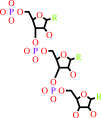 (ribonucleotide)n+m
|
+
|
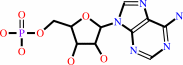 AMP
AMP
|
+
|
 diphosphate
|
|
|
|
|
|
|
|
|
|
|
|
|
Molecule diagrams generated from .mol files obtained from the
KEGG ftp site
|
|
|
|
|
|
|
|
|
|
|
|
|
|
 |
|
|
|
|
|
|
| |
|
|
| |
|
DOI no:
|
Cell
127:71-84
(2006)
|
|
PubMed id:
|
|
|
|
|
|
| |
|
RNA ligase structures reveal the basis for RNA specificity and conformational changes that drive ligation forward.
|
|
J.Nandakumar,
S.Shuman,
C.D.Lima.
|
|
|
|
|
| |
ABSTRACT
|
|
|
|
| |
|
|
T4 RNA ligase 2 (Rnl2) and kinetoplastid RNA editing ligases exemplify a family
of RNA repair enzymes that seal 3'OH/5'PO(4) nicks in duplex RNAs via ligase
adenylylation (step 1), AMP transfer to the nick 5'PO(4) (step 2), and attack by
the nick 3'OH on the 5'-adenylylated strand to form a phosphodiester (step 3).
Crystal structures are reported for Rnl2 at discrete steps along this pathway:
the covalent Rnl2-AMP intermediate; Rnl2 bound to an adenylylated nicked duplex,
captured immediately following step 2; and Rnl2 at an adenylylated nick in a
state poised for step 3. These structures illuminate the stereochemistry of
nucleotidyl transfer and reveal how remodeling of active-site contacts and
conformational changes propel the ligation reaction forward. Mutational analysis
and comparison of nick-bound structures of Rnl2 and human DNA ligase I highlight
common and divergent themes of substrate recognition that can explain their
specialization for RNA versus DNA repair.
|
|
|
|
|
|
| |
Selected figure(s)
|
|
|
|
| |
|
|

|
|

|
|
Figure 1.
Figure 1. Three-Step Pathway of Nick Sealing by
ATP-Dependent Polynucleotide Ligases
|
|
Figure 3.
Figure 3. Serial Remodeling of Contacts in the Rnl2 Active
Site in Synch with the Chemical Steps of Ligation
|
|
|
|
|
|
| |
The above figures are
reprinted
by permission from Cell Press:
Cell
(2006,
127,
71-84)
copyright 2006.
|
|
| |
Figures were
selected
by an automated process.
|
|
|
|
|
|
|
|
|
|
|
|
|
|
|
|
 |
 |
 |
|
Literature references that cite this PDB file's key reference
|
|
|
| |
PubMed id
|
|
Reference
|
|
|
|
|
|
A.Piserchio,
P.A.Nair,
S.Shuman,
and
R.Ghose
(2010).
Solution NMR studies of Chlorella virus DNA ligase-adenylate.
|
| |
J Mol Biol,
395,
291-308.
|
|
|
|
|
|
|
J.T.Perez,
A.Varble,
R.Sachidanandam,
I.Zlatev,
M.Manoharan,
A.García-Sastre,
and
B.R.tenOever
(2010).
Influenza A virus-generated small RNAs regulate the switch from transcription to replication.
|
| |
Proc Natl Acad Sci U S A,
107,
11525-11530.
|
|
|
|
|
|
|
L.K.Wang,
H.Zhu,
and
S.Shuman
(2009).
Structure-guided Mutational Analysis of the Nucleotidyltransferase Domain of Escherichia coli DNA Ligase (LigA).
|
| |
J Biol Chem,
284,
8486-8494.
|
|
|
|
|
|
|
N.Tanaka,
and
S.Shuman
(2009).
Structure-activity relationships in human RNA 3'-phosphate cyclase.
|
| |
RNA,
15,
1865-1874.
|
|
|
|
|
|
|
R.V.Swift,
J.Durrant,
R.E.Amaro,
and
J.A.McCammon
(2009).
Toward understanding the conformational dynamics of RNA ligation.
|
| |
Biochemistry,
48,
709-719.
|
|
|
|
|
|
|
R.V.Swift,
and
R.E.Amaro
(2009).
Discovery and design of DNA and RNA ligase inhibitors in infectious microorganisms.
|
| |
Expert Opin Drug Discov,
4,
1281-1294.
|
|
|
|
|
|
|
C.Torchia,
Y.Takagi,
and
C.K.Ho
(2008).
Archaeal RNA ligase is a homodimeric protein that catalyzes intramolecular ligation of single-stranded RNA and DNA.
|
| |
Nucleic Acids Res,
36,
6218-6227.
|
|
|
|
|
|
|
H.Zhu,
and
S.Shuman
(2008).
Bacterial nonhomologous end joining ligases preferentially seal breaks with a 3'-OH monoribonucleotide.
|
| |
J Biol Chem,
283,
8331-8339.
|
|
|
|
|
|
|
J.M.Pascal
(2008).
DNA and RNA ligases: structural variations and shared mechanisms.
|
| |
Curr Opin Struct Biol,
18,
96.
|
|
|
|
|
|
|
M.A.Brooks,
L.Meslet-Cladiére,
M.Graille,
J.Kuhn,
K.Blondeau,
H.Myllykallio,
and
H.van Tilbeurgh
(2008).
The structure of an archaeal homodimeric ligase which has RNA circularization activity.
|
| |
Protein Sci,
17,
1336-1345.
|
|
|
PDB code:
|
|
|
|
|
|
|
|
T.Ellenberger,
and
A.E.Tomkinson
(2008).
Eukaryotic DNA ligases: structural and functional insights.
|
| |
Annu Rev Biochem,
77,
313-338.
|
|
|
|
|
|
|
A.Raymond,
and
S.Shuman
(2007).
Deinococcus radiodurans RNA ligase exemplifies a novel ligase clade with a distinctive N-terminal module that is important for 5'-PO4 nick sealing and ligase adenylylation but dispensable for phosphodiester formation at an adenylylated nick.
|
| |
Nucleic Acids Res,
35,
839-849.
|
|
|
|
|
|
|
J.Nandakumar,
P.A.Nair,
and
S.Shuman
(2007).
Last stop on the road to repair: structure of E. coli DNA ligase bound to nicked DNA-adenylate.
|
| |
Mol Cell,
26,
257-271.
|
|
|
PDB code:
|
|
|
|
|
|
|
|
L.K.Wang,
J.Nandakumar,
B.Schwer,
and
S.Shuman
(2007).
The C-terminal domain of T4 RNA ligase 1 confers specificity for tRNA repair.
|
| |
RNA,
13,
1235-1244.
|
|
|
|
|
|
|
P.A.Nair,
J.Nandakumar,
P.Smith,
M.Odell,
C.D.Lima,
and
S.Shuman
(2007).
Structural basis for nick recognition by a minimal pluripotent DNA ligase.
|
| |
Nat Struct Mol Biol,
14,
770-778.
|
|
|
PDB codes:
|
|
|
|
|
|
|
|
J.M.Pascal,
and
T.Ellenberger
(2006).
RNA ligase does the AMP shuffle.
|
| |
Nat Struct Mol Biol,
13,
950-951.
|
|
|
|
|
|
|
L.K.Wang,
B.Schwer,
and
S.Shuman
(2006).
Structure-guided mutational analysis of T4 RNA ligase 1.
|
| |
RNA,
12,
2126-2134.
|
|
|
|
|
|
The most recent references are shown first.
Citation data come partly from CiteXplore and partly
from an automated harvesting procedure. Note that this is likely to be
only a partial list as not all journals are covered by
either method. However, we are continually building up the citation data
so more and more references will be included with time.
Where a reference describes a PDB structure, the PDB
code is
shown on the right.
|
|


 Links
Links


