 |
PDBsum entry 2h8h

|
|
|
|
|
 |
Contents |
 |
|
|
|
|
|
|
|
|
|
|
|
|
* Residue conservation analysis
|
|
|
|
|
|
PDB id:
|
|
|
|
| Name: |
|
Transferase
|
|
|
Title:
|
|
Src kinase in complex with a quinazoline inhibitor
|
|
Structure:
|
|
Proto-oncogene tyrosine-protein kinase src. Chain: a. Synonym: p60-src, c- src, pp60c-src. Engineered: yes
|
|
Source:
|
|
Homo sapiens. Human. Organism_taxid: 9606. Gene: src, src1. Expressed in: spodoptera frugiperda. Expression_system_taxid: 7108. Expression_system_cell_line: sf9 cells.
|
|
Resolution:
|
|
|
2.20Å
|
R-factor:
|
0.207
|
R-free:
|
0.272
|
|
|
Authors:
|
|
L.R.Otterbein,R.Norman,R.A.Pauptit,S.Rowsell,J.Breed
|
|
Key ref:
|
|
L.F.Hennequin
et al.
(2006).
N-(5-chloro-1,3-benzodioxol-4-yl)-7-[2-(4-methylpiperazin-1-yl)ethoxy]-5- (tetrahydro-2H-pyran-4-yloxy)quinazolin-4-amine, a novel, highly selective, orally available, dual-specific c-Src/Abl kinase inhibitor.
J Med Chem,
49,
6465-6488.
PubMed id:
DOI:
|
|
|
Date:
|
|
|
07-Jun-06
|
Release date:
|
21-Nov-06
|
|
|
|
|
|
|
PROCHECK
|

|
|
|
|
|
Headers
|
|
|
|
References
|
|
|
|
|
|

|
|
P12931
(SRC_HUMAN) -
Proto-oncogene tyrosine-protein kinase Src from Homo sapiens
|
|
|
|
Seq:
Struc:
|
|
|
|
536 a.a.
445 a.a.
|
|

|

|
|
|
|
|
|
|
|
|
|
|
|
Key: |
 |
PfamA domain |
|
|
 |
Secondary structure |
|
 |
CATH domain |
|
|
|
|
|
|
|
|
|
|
|
|
|
Enzyme class:
|
|
E.C.2.7.10.2
- non-specific protein-tyrosine kinase.
|
|
|
|
|
|
|
Reaction:
|
|
L-tyrosyl-[protein] + ATP = O-phospho-L-tyrosyl-[protein] + ADP + H+
|
|
|
|
|
|
L-tyrosyl-[protein]
|
+
|
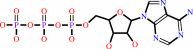 ATP
ATP
|
=
|
O-phospho-L-tyrosyl-[protein]
|
+
|
 ADP
ADP
|
+
|
H(+)
|
|
|
|
|
|
|
|
|
|
|
|
|
Molecule diagrams generated from .mol files obtained from the
KEGG ftp site
|
|
|
|
|
|
|
|
|
|
|
|
|
|
 |
|
|
|
|
|
|
| |
|
|
| |
|
DOI no:
|
J Med Chem
49:6465-6488
(2006)
|
|
PubMed id:
|
|
|
|
|
|
| |
|
N-(5-chloro-1,3-benzodioxol-4-yl)-7-[2-(4-methylpiperazin-1-yl)ethoxy]-5- (tetrahydro-2H-pyran-4-yloxy)quinazolin-4-amine, a novel, highly selective, orally available, dual-specific c-Src/Abl kinase inhibitor.
|
|
L.F.Hennequin,
J.Allen,
J.Breed,
J.Curwen,
M.Fennell,
T.P.Green,
C.Lambert-van der Brempt,
R.Morgentin,
R.A.Norman,
A.Olivier,
L.Otterbein,
P.A.Plé,
N.Warin,
G.Costello.
|
|
|
|
|
| |
ABSTRACT
|
|
|
|
| |
|
|
Src family kinases (SFKs) are nonreceptor tyrosine kinases that are reported to
be critical for cancer progression. We report here a novel subseries of
C-5-substituted anilinoquinazolines that display high affinity and specificity
for the tyrosine kinase domain of the c-Src and Abl enzymes. These compounds
exhibit high selectivity for SFKs over a panel of recombinant protein kinases,
excellent pharmacokinetics, and in vivo activity following oral dosing.
N-(5-Chloro-1,3-benzodioxol-4-yl)-7-[2-(4-methylpiperazin-1-yl)ethoxy]-5-(tetrahydro-2H-pyran-4-yloxy)quinazolin-4-amine
(AZD0530) inhibits c-Src and Abl enzymes at low nanomolar concentrations and is
highly selective over a range of kinases. AZD0530 displays excellent
pharmacokinetic parameters in animal preclinically and in man (t(1/2) = 40 h).
AZD0530 is a potent inhibitor of tumor growth in a c-Src-transfected
3T3-fibroblast xenograft model in vivo and led to a significant increase in
survival in a highly aggressive, orthotopic model of human pancreatic cancer
when dosed orally once daily. AZD0530 is currently undergoing clinical
evaluation in man.
|
|
|
|
|
|
|
|
|
|
|
|
|
|
|
|
|
|
 |
 |
 |
|
Literature references that cite this PDB file's key reference
|
|
|
| |
PubMed id
|
|
Reference
|
|
|
|
|
|
S.Schenone,
O.Bruno,
M.Radi,
and
M.Botta
(2011).
New insights into small-molecule inhibitors of Bcr-Abl.
|
| |
Med Res Rev,
31,
1.
|
|
|
|
|
|
|
A.Aleshin,
and
R.S.Finn
(2010).
SRC: a century of science brought to the clinic.
|
| |
Neoplasia,
12,
599-607.
|
|
|
|
|
|
|
C.J.Morrow,
M.Ghattas,
C.Smith,
H.Bönisch,
R.A.Bryce,
D.M.Hickinson,
T.P.Green,
and
C.Dive
(2010).
Src family kinase inhibitor Saracatinib (AZD0530) impairs oxaliplatin uptake in colorectal cancer cells and blocks organic cation transporters.
|
| |
Cancer Res,
70,
5931-5941.
|
|
|
|
|
|
|
F.Saad,
and
A.Lipton
(2010).
SRC kinase inhibition: targeting bone metastases and tumor growth in prostate and breast cancer.
|
| |
Cancer Treat Rev,
36,
177-184.
|
|
|
|
|
|
|
K.P.Ravindranathan,
V.Mandiyan,
A.R.Ekkati,
J.H.Bae,
J.Schlessinger,
and
W.L.Jorgensen
(2010).
Discovery of novel fibroblast growth factor receptor 1 kinase inhibitors by structure-based virtual screening.
|
| |
J Med Chem,
53,
1662-1672.
|
|
|
PDB code:
|
|
|
|
|
|
|
|
R.Cao,
N.Mi,
and
H.Zhang
(2010).
3D-QSAR study of c-Src kinase inhibitors based on docking.
|
| |
J Mol Model,
16,
361-375.
|
|
|
|
|
|
|
S.Di Cosimo,
and
J.Baselga
(2010).
Management of breast cancer with targeted agents: importance of heterogenicity.
|
| |
Nat Rev Clin Oncol,
7,
139-147.
|
|
|
|
|
|
|
A.G.Ammer,
L.C.Kelley,
K.E.Hayes,
J.V.Evans,
L.A.Lopez-Skinner,
K.H.Martin,
B.Frederick,
B.L.Rothschild,
D.Raben,
P.Elvin,
T.P.Green,
and
S.A.Weed
(2009).
Saracatinib Impairs Head and Neck Squamous Cell Carcinoma Invasion by Disrupting Invadopodia Function.
|
| |
J Cancer Sci Ther,
1,
52-61.
|
|
|
|
|
|
|
A.M.Egloff,
and
J.R.Grandis
(2009).
Improving Response Rates to EGFR-Targeted Therapies for Head and Neck Squamous Cell Carcinoma: Candidate Predictive Biomarkers and Combination Treatment with Src Inhibitors.
|
| |
J Oncol,
2009,
896407.
|
|
|
|
|
|
|
E.Ciccimaro,
S.K.Hanks,
and
I.A.Blair
(2009).
Quantification of focal adhesion kinase activation loop phosphorylation as a biomarker of Src activity.
|
| |
Mol Pharmacol,
75,
658-666.
|
|
|
|
|
|
|
E.Ciccimaro,
S.K.Hanks,
K.H.Yu,
and
I.A.Blair
(2009).
Absolute quantification of phosphorylation on the kinase activation loop of cellular focal adhesion kinase by stable isotope dilution liquid chromatography/mass spectrometry.
|
| |
Anal Chem,
81,
3304-3313.
|
|
|
|
|
|
|
J.Zhang,
P.L.Yang,
and
N.S.Gray
(2009).
Targeting cancer with small molecule kinase inhibitors.
|
| |
Nat Rev Cancer,
9,
28-39.
|
|
|
|
|
|
|
N.K.Banavali,
and
B.Roux
(2009).
Flexibility and charge asymmetry in the activation loop of Src tyrosine kinases.
|
| |
Proteins,
74,
378-389.
|
|
|
|
|
|
|
S.Barchéchath,
C.Williams,
K.Saade,
S.Lauwagie,
and
B.Jean-Claude
(2009).
Rational design of multitargeted tyrosine kinase inhibitors: a novel approach.
|
| |
Chem Biol Drug Des,
73,
380-387.
|
|
|
|
|
|
|
S.Hiscox,
N.J.Jordan,
C.Smith,
M.James,
L.Morgan,
K.M.Taylor,
T.P.Green,
and
R.I.Nicholson
(2009).
Dual targeting of Src and ER prevents acquired antihormone resistance in breast cancer cells.
|
| |
Breast Cancer Res Treat,
115,
57-67.
|
|
|
|
|
|
|
S.K.Bairy,
B.V.Suneel Kumar,
J.U.Bhalla,
A.B.Pramod,
and
M.Ravikumar
(2009).
Three-dimensional quantitative structure-activity relationship studies on c-Src inhibitors based on different docking methods.
|
| |
Chem Biol Drug Des,
73,
416-427.
|
|
|
|
|
|
|
S.S.Constancio-Lund,
J.Brabek,
and
S.K.Hanks
(2009).
Src transformation of colonic epithelial cells: enhanced anchorage-independent growth in an Apc(+/min) background.
|
| |
Mol Carcinog,
48,
156-166.
|
|
|
|
|
|
|
V.S.Hawthorne,
W.C.Huang,
C.L.Neal,
L.M.Tseng,
M.C.Hung,
and
D.Yu
(2009).
ErbB2-mediated Src and signal transducer and activator of transcription 3 activation leads to transcriptional up-regulation of p21Cip1 and chemoresistance in breast cancer cells.
|
| |
Mol Cancer Res,
7,
592-600.
|
|
|
|
|
|
|
A.Strimpakos,
M.W.Saif,
and
K.N.Syrigos
(2008).
Pancreatic cancer: from molecular pathogenesis to targeted therapy.
|
| |
Cancer Metastasis Rev,
27,
495-522.
|
|
|
|
|
|
|
B.G.Perera,
and
D.J.Maly
(2008).
Design, synthesis and characterization of "clickable" 4-anilinoquinazoline kinase inhibitors.
|
| |
Mol Biosyst,
4,
542-550.
|
|
|
|
|
|
|
D.H.Boschelli,
B.Wu,
F.Ye,
H.Durutlic,
J.M.Golas,
J.Lucas,
and
F.Boschelli
(2008).
Facile preparation of new 4-phenylamino-3-quinolinecarbonitrile Src kinase inhibitors via 7-fluoro intermediates: identification of potent 7-amino analogs.
|
| |
Bioorg Med Chem,
16,
405-412.
|
|
|
|
|
|
|
G.Giaccone,
and
P.A.Zucali
(2008).
Src as a potential therapeutic target in non-small-cell lung cancer.
|
| |
Ann Oncol,
19,
1219-1223.
|
|
|
|
|
|
|
G.Middleton,
P.Ghaneh,
E.Costello,
W.Greenhalf,
and
J.P.Neoptolemos
(2008).
New treatment options for advanced pancreatic cancer.
|
| |
Expert Rev Gastroenterol Hepatol,
2,
673-696.
|
|
|
|
|
|
|
P.M.Siesser,
L.M.Meenderink,
L.Ryzhova,
K.E.Michael,
D.W.Dumbauld,
A.J.García,
I.Kaverina,
and
S.K.Hanks
(2008).
A FAK/Src chimera with gain-of-function properties promotes formation of large peripheral adhesions associated with dynamic actin assembly.
|
| |
Cell Motil Cytoskeleton,
65,
25-39.
|
|
|
|
|
|
|
R.S.Finn
(2008).
Targeting Src in breast cancer.
|
| |
Ann Oncol,
19,
1379-1386.
|
|
|
|
|
|
|
Y.M.Chang,
L.Bai,
S.Liu,
J.C.Yang,
H.J.Kung,
and
C.P.Evans
(2008).
Src family kinase oncogenic potential and pathways in prostate cancer as revealed by AZD0530.
|
| |
Oncogene,
27,
6365-6375.
|
|
|
|
|
|
|
A.Quintás-Cardama,
H.Kantarjian,
and
J.Cortes
(2007).
Flying under the radar: the new wave of BCR-ABL inhibitors.
|
| |
Nat Rev Drug Discov,
6,
834-848.
|
|
|
|
|
|
|
D.Nowak,
S.Boehrer,
S.Hochmuth,
B.Trepohl,
W.Hofmann,
D.Hoelzer,
W.K.Hofmann,
P.S.Mitrou,
M.Ruthardt,
and
K.U.Chow
(2007).
Src kinase inhibitors induce apoptosis and mediate cell cycle arrest in lymphoma cells.
|
| |
Anticancer Drugs,
18,
981-995.
|
|
|
|
|
|
|
E.Weisberg,
P.W.Manley,
S.W.Cowan-Jacob,
A.Hochhaus,
and
J.D.Griffin
(2007).
Second generation inhibitors of BCR-ABL for the treatment of imatinib-resistant chronic myeloid leukaemia.
|
| |
Nat Rev Cancer,
7,
345-356.
|
|
|
|
|
|
|
J.A.Blair,
D.Rauh,
C.Kung,
C.H.Yun,
Q.W.Fan,
H.Rode,
C.Zhang,
M.J.Eck,
W.A.Weiss,
and
K.M.Shokat
(2007).
Structure-guided development of affinity probes for tyrosine kinases using chemical genetics.
|
| |
Nat Chem Biol,
3,
229-238.
|
|
|
PDB codes:
|
|
|
|
|
|
|
|
J.Baranda,
and
S.Williamson
(2007).
The new paradigm in the treatment of colorectal cancer: are we hitting the right target?
|
| |
Expert Opin Investig Drugs,
16,
311-324.
|
|
|
|
|
|
|
J.J.Chu,
and
P.L.Yang
(2007).
c-Src protein kinase inhibitors block assembly and maturation of dengue virus.
|
| |
Proc Natl Acad Sci U S A,
104,
3520-3525.
|
|
|
|
|
|
|
S.Hiscox,
N.J.Jordan,
L.Morgan,
T.P.Green,
and
R.I.Nicholson
(2007).
Src kinase promotes adhesion-independent activation of FAK and enhances cellular migration in tamoxifen-resistant breast cancer cells.
|
| |
Clin Exp Metastasis,
24,
157-167.
|
|
|
|
|
|
The most recent references are shown first.
Citation data come partly from CiteXplore and partly
from an automated harvesting procedure. Note that this is likely to be
only a partial list as not all journals are covered by
either method. However, we are continually building up the citation data
so more and more references will be included with time.
Where a reference describes a PDB structure, the PDB
code is
shown on the right.
|
|


 Links
Links


