 |
PDBsum entry 2gcd

|
|
|
|
|
 |
Contents |
 |
|
|
|
|
|
|
|
|
|
|
|
|
* Residue conservation analysis
|
|
|
|
|
|
|
|
|
|
|
Enzyme class:
|
|
E.C.2.7.11.1
- non-specific serine/threonine protein kinase.
|
|
|
|
|
|
|
Reaction:
|
|
|
1.
|
L-seryl-[protein] + ATP = O-phospho-L-seryl-[protein] + ADP + H+
|
|
2.
|
L-threonyl-[protein] + ATP = O-phospho-L-threonyl-[protein] + ADP + H+
|
|
|
|
|
|
|
L-seryl-[protein]
|
+
|
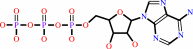 ATP
ATP
|
=
|
O-phospho-L-seryl-[protein]
|
+
|
 ADP
ADP
|
+
|
H(+)
|
|
|
|
|
|
|
L-threonyl-[protein]
|
+
|
ATP
|
=
|
O-phospho-L-threonyl-[protein]
|
+
|
ADP
|
+
|
H(+)
|
|
|
|
|
|
|
|
|
|
|
|
|
Molecule diagrams generated from .mol files obtained from the
KEGG ftp site
|
|
|
|
|
|
|
|
|
|
|
|
|
|
 |
|
|
|
|
|
|
| |
|
|
| |
|
|
Acta Biochim Biophys Sin (shanghai)
38:385-392
(2006)
|
|
PubMed id:
|
|
|
|
|
|
| |
|
Crystal structure of the MAP3K TAO2 kinase domain bound by an inhibitor staurosporine.
|
|
T.J.Zhou,
L.G.Sun,
Y.Gao,
E.J.Goldsmith.
|
|
|
|
|
| |
ABSTRACT
|
|
|
|
| |
|
|
Mitogen-activated protein kinase (MAPK) signal transduction pathways are
ubiquitous in eukaryotic cells, which transfer signals from the cell surface to
the nucleus, controlling multiple cellular programs. MAPKs are activated by MAPK
kinases [MAP2Ks or MAP/extracellular signal-regulated kinase (ERK) kinases
(MEK)], which in turn are activated by MAPK kinase kinases (MAP3Ks). TAO2 is a
MAP3K level kinase that activates the MAP2Ks MEK3 and MEK6 to activate p38
MAPKs. Because p38 MAPKs are key regulators of expression of inflammatory
cytokines, they appear to be involved in human diseases such as asthma and
autoimmunity. As an upstream activator of p38s, TAO2 represents a potential drug
target. Here we report the crystal structure of active TAO2 kinase domain in
complex with staurosporine, a broad-range protein kinase inhibitor that inhibits
TAO2 with an IC50 of 3 mM. The structure reveals that staurosporine occupies the
position where the adenosine of ATP binds in TAO2, and the binding of the
inhibitor mimics many features of ATP binding. Both polar and nonpolar
interactions contribute to the enzyme-inhibitor recognition. Staurosporine
induces conformational changes in TAO2 residues that surround the inhibitor
molecule, but causes very limited global changes in the kinase. The structure
provides atomic details for TAO2-staurosporine interactions, and explains the
relatively low potency of staurosporine against TAO2. The structure presented
here should aid in the design of inhibitors specific to TAO2 and related kinases.
|
|
|
|
|
|
|
|
|
|
|
|
|
|
|
|
|
|
 |
 |
 |
|


 Links
Links


