 |
PDBsum entry 2g0c

|
|
|
|
|
 |
Contents |
 |
|
|
|
|
|
|
|
|
|
|
|
|
* Residue conservation analysis
|
|
|
|
|
|
|
|
|
|
|
Enzyme class:
|
|
E.C.3.6.4.13
- Rna helicase.
|
|
|
|
|
|
|
Reaction:
|
|
ATP + H2O = ADP + phosphate + H+
|
|
|
|
|
|
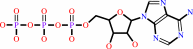 ATP
ATP
|
+
|
H2O
|
=
|
 ADP
ADP
|
+
|
 phosphate
|
+
|
H(+)
|
|
|
|
|
|
|
|
|
|
|
|
|
Molecule diagrams generated from .mol files obtained from the
KEGG ftp site
|
|
|
|
|
|
|
|
|
|
|
|
|
|
 |
|
|
|
|
|
|
| |
|
|
| |
|
|
Rna
12:959-967
(2006)
|
|
PubMed id:
|
|
|
|
|
|
| |
|
The domain of the Bacillus subtilis DEAD-box helicase YxiN that is responsible for specific binding of 23S rRNA has an RNA recognition motif fold.
|
|
S.Wang,
Y.Hu,
M.T.Overgaard,
F.V.Karginov,
O.C.Uhlenbeck,
D.B.McKay.
|
|
|
|
|
| |
ABSTRACT
|
|
|
|
| |
|
|
The YxiN protein of Bacillus subtilis is a member of the DbpA subfamily of
prokaryotic DEAD-box RNA helicases. Like DbpA, it binds with high affinity and
specificity to segments of 23S ribosomal RNA as short as 32 nucleotides (nt)
that include hairpin 92. Several experiments have shown that the 76-residue
carboxy-terminal domain of YxiN is responsible for the high-affinity RNA
binding. The domain has been crystallized and its structure has been solved to
1.7 Angstroms resolution. The structure reveals an RNA recognition motif (RRM)
fold that is found in many eukaryotic RNA binding proteins; the RRM fold was not
apparent from the amino acid sequence. The domain has two solvent exposed
aromatic residues at sites that correspond to the aromatic residues of the
ribonucleoprotein (RNP) motifs RNP1 and RNP2 that are essential for RNA binding
in many RRMs. However, mutagenesis of these residues (Tyr404 and Tyr447) to
alanine has little effect on RNA affinity, suggesting that the YxiN domain binds
target RNAs in a manner that differs from the binding mode commonly found in
many eukaryotic RRMs.
|
|
|
|
|
|
|
|
|
|
|
|
|
|
|
|
|
|
 |
 |
 |
|
Literature references that cite this PDB file's key reference
|
|
|
| |
PubMed id
|
|
Reference
|
|
|
|
|
|
D.Klostermeier
(2011).
Single-molecule FRET reveals nucleotide-driven conformational changes in molecular machines and their link to RNA unwinding and DNA supercoiling.
|
| |
Biochem Soc Trans,
39,
611-616.
|
|
|
|
|
|
|
V.López-Ramírez,
L.D.Alcaraz,
G.Moreno-Hagelsieb,
and
G.Olmedo-Álvarez
(2011).
Phylogenetic Distribution and Evolutionary History of Bacterial DEAD-Box Proteins.
|
| |
J Mol Evol,
72,
413-431.
|
|
|
|
|
|
|
D.Klostermeier,
and
M.G.Rudolph
(2009).
A novel dimerization motif in the C-terminal domain of the Thermus thermophilus DEAD box helicase Hera confers substantial flexibility.
|
| |
Nucleic Acids Res,
37,
421-430.
|
|
|
PDB codes:
|
|
|
|
|
|
|
|
L.M.Sharpe Elles,
M.T.Sykes,
J.R.Williamson,
and
O.C.Uhlenbeck
(2009).
A dominant negative mutant of the E. coli RNA helicase DbpA blocks assembly of the 50S ribosomal subunit.
|
| |
Nucleic Acids Res,
37,
6503-6514.
|
|
|
|
|
|
|
M.G.Rudolph,
and
D.Klostermeier
(2009).
The Thermus thermophilus DEAD box helicase Hera contains a modified RNA recognition motif domain loosely connected to the helicase core.
|
| |
RNA,
15,
1993-2001.
|
|
|
PDB codes:
|
|
|
|
|
|
|
|
M.G.Rudolph,
J.G.Wittmann,
and
D.Klostermeier
(2009).
Crystallization and preliminary characterization of the Thermus thermophilus RNA helicase Hera C-terminal domain.
|
| |
Acta Crystallogr Sect F Struct Biol Cryst Commun,
65,
248-252.
|
|
|
|
|
|
|
M.Hilbert,
A.R.Karow,
and
D.Klostermeier
(2009).
The mechanism of ATP-dependent RNA unwinding by DEAD box proteins.
|
| |
Biol Chem,
390,
1237-1250.
|
|
|
|
|
|
|
K.N.Rao,
S.K.Burley,
and
S.Swaminathan
(2008).
UPF201 archaeal specific family members reveal structural similarity to RNA-binding proteins but low likelihood for RNA-binding function.
|
| |
PLoS ONE,
3,
e3903.
|
|
|
PDB codes:
|
|
|
|
|
|
|
|
L.M.Elles,
and
O.C.Uhlenbeck
(2008).
Mutation of the arginine finger in the active site of Escherichia coli DbpA abolishes ATPase and helicase activity and confers a dominant slow growth phenotype.
|
| |
Nucleic Acids Res,
36,
41-50.
|
|
|
|
|
|
|
V.B.Chu,
and
D.Herschlag
(2008).
Unwinding RNA's secrets: advances in the biology, physics, and modeling of complex RNAs.
|
| |
Curr Opin Struct Biol,
18,
305-314.
|
|
|
|
|
|
|
J.K.Grohman,
M.Del Campo,
H.Bhaskaran,
P.Tijerina,
A.M.Lambowitz,
and
R.Russell
(2007).
Probing the mechanisms of DEAD-box proteins as general RNA chaperones: the C-terminal domain of CYT-19 mediates general recognition of RNA.
|
| |
Biochemistry,
46,
3013-3022.
|
|
|
|
|
|
|
L.E.Hoelzle,
K.Hoelzle,
A.Harder,
M.Ritzmann,
H.Aupperle,
H.A.Schoon,
K.Heinritzi,
and
M.M.Wittenbrink
(2007).
First identification and functional characterization of an immunogenic protein in unculturable haemotrophic Mycoplasmas (Mycoplasma suis HspA1).
|
| |
FEMS Immunol Med Microbiol,
49,
215-223.
|
|
|
|
|
|
|
I.Iost,
and
M.Dreyfus
(2006).
DEAD-box RNA helicases in Escherichia coli.
|
| |
Nucleic Acids Res,
34,
4189-4197.
|
|
|
|
|
|
|
J.M.Caruthers,
Y.Hu,
and
D.B.McKay
(2006).
Structure of the second domain of the Bacillus subtilis DEAD-box RNA helicase YxiN.
|
| |
Acta Crystallogr Sect F Struct Biol Cryst Commun,
62,
1191-1195.
|
|
|
PDB code:
|
|
|
|
|
|
|
|
P.Linder
(2006).
Dead-box proteins: a family affair--active and passive players in RNP-remodeling.
|
| |
Nucleic Acids Res,
34,
4168-4180.
|
|
|
|
|
|
The most recent references are shown first.
Citation data come partly from CiteXplore and partly
from an automated harvesting procedure. Note that this is likely to be
only a partial list as not all journals are covered by
either method. However, we are continually building up the citation data
so more and more references will be included with time.
Where a reference describes a PDB structure, the PDB
codes are
shown on the right.
|
|


 Links
Links


