|
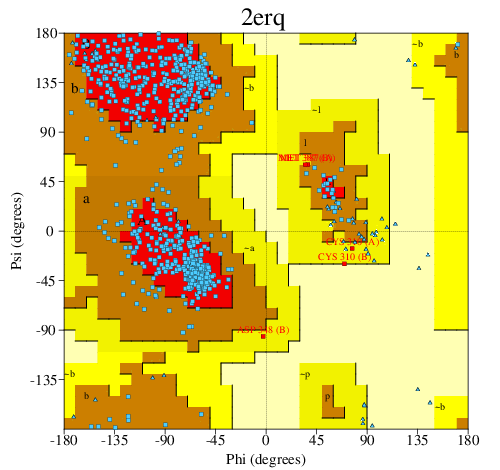
PDBsum entry 2erq

|
|
|
|
|
 |
Contents |
 |
|
|
|
|
|
|
|
|
|
|
|
|
|
|
* Residue conservation analysis
|
|
|
|
|
|
|
|
|
|
|
|
|
|
|
 |
|
|
|
|
|
|
| |
|
DOI no:
|
EMBO J
25:2388-2396
(2006)
|
|
PubMed id:
|
|
|
|
|
|
| |
|
Crystal structures of VAP1 reveal ADAMs' MDC domain architecture and its unique C-shaped scaffold.
|
|
S.Takeda,
T.Igarashi,
H.Mori,
S.Araki.
|
|
|
|
|
| |
ABSTRACT
|
|
|
|
| |
|
|
ADAMs (a disintegrin and metalloproteinase) are sheddases possessing
extracellular metalloproteinase/disintegrin/cysteine-rich (MDC) domains. ADAMs
uniquely display both proteolytic and adhesive activities on the cell surface,
however, most of their physiological targets and adhesion mechanisms remain
unclear. Here for the first time, we reveal the ADAMs' MDC architecture and a
potential target-binding site by solving crystal structures of VAP1, a snake
venom homolog of mammalian ADAMs. The D-domain protrudes from the M-domain
opposing the catalytic site and constituting a C-shaped arm with cores of Ca2+
ions. The disintegrin-loop, supposed to interact with integrins, is packed by
the C-domain and inaccessible for protein binding. Instead, the hyper-variable
region (HVR) in the C-domain, which has a novel fold stabilized by the strictly
conserved disulfide bridges, constitutes a potential protein-protein adhesive
interface. The HVR is located at the distal end of the arm and faces toward the
catalytic site. The C-shaped structure implies interplay between the ADAMs'
proteolytic and adhesive domains and suggests a molecular mechanism for ADAMs'
target recognition for shedding.
|
|
|
|
|
|
| |
Selected figure(s)
|
|
|
|
| |
|
|

|
|

|
|
Figure 1.
Figure 1 MDC architecture. (A) VAP1 dimer viewed from the NCS
axis. The H0-helix, M-domain, linker, D[s]-, D[a]-, C[w]-, and
C[h]-domains and HVRs belonging to the one monomer are shown in
red, yellow, gray, cyan, pink, gray, green and blue,
respectively. The disulfide-linked counterpart is shown in gray.
Zinc and calcium ions are represented as red and black spheres,
respectively. The NAG (N-acetyl-glucosamine, in orange) moieties
linked to Asn218, the calcium-mimetic Lys202 and the bound
inhibitor GM6001 (GM, in green) are in ball-stick
representations. (B) Stereo view of VAP1 monomer from the
direction nearly perpendicular to (A). The helix numbers are
labelled. (C) Superposition of the M-domains of ADAM33 (blue)
and VAP1 (yellow). The calcium ion bound to site I and the zinc
ion in ADAM33 are represented by black and red spheres,
respectively. The disulfide bridges are indicated in black and
blue letters for VAP1 and ADAM33, respectively. The QDHSK
sequence for the dimer interface in VAP1 (residues 320–324) is
in red. (D) Comparison of the calcium-binding site I structures
of ADAM33 (blue) and VAP1 (yellow) in stereo. The residues in
ADAM33 and in VAP1 are labelled in blue and black, respectively.
A calcium ion and a water molecule bound to ADAM33 are
represented as green and red spheres, respectively. The ammonium
group of Lys202 in VAP1 occupies the position of the calcium ion
in ADAM33. In ADAM33 (Orth et al, 2004), side-chain oxygen atoms
of Glu213, Asp296 and Asn407, the carbonyl oxygen of Cys404 and
a water molecule form the corners of a pentagonal bipyramid and
ligand to the calcium ion.
|
|
Figure 4.
Figure 4 C-domain architecture and HVR. (A) The C-domain
architecture in stereo. The C[w]- and C[h]-domains are in gray
and light green, respectively. The disulfide bridges and the
residues forming the hydrophobic ridges are indicated. The HVR
and its NCS counterpart are shown in red and blue, respectively.
The variable loop (residues 539–549), flanked by two adjacent
cysteine residues, is in green. (B) Crystal packing in the
orthorhombic crystal. The crystallographically equivalent
molecules (HVRs) are in cyan (blue) and pink (red),
respectively. The arrows indicate the directions of the HVR
chains. Zinc and calcium ions are represented as red and black
spheres, respectively. (C) Interactions between the HVRs (cyan
and pink) in stereo. The molecular surface of the cyan molecule
is shown with the electrochemical surface potential (red to
blue). The residues constituting the hydrophobic ridges are in
yellow. The residues are labelled in blue and red for cyan and
pink, respectively. (D) Water-mediated hydrogen-bond network in
the HVR. The HVR residues are in pink and cyan; non-HVR residues
in the pink molecule are in gray.
|
|
|
|
|
|
| |
The above figures are
reprinted
by permission from Macmillan Publishers Ltd:
EMBO J
(2006,
25,
2388-2396)
copyright 2006.
|
|
| |
Figures were
selected
by an automated process.
|
|
|
|
|
|
|
|
|
|
|
|
|
|
|
|
 |
 |
 |
|
Literature references that cite this PDB file's key reference
|
|
|
| |
PubMed id
|
|
Reference
|
|
|
|
|
|
A.Pinyachat,
P.Rojnuckarin,
C.Muanpasitporn,
P.Singhamatr,
and
S.Nuchprayoon
(2011).
Albocollagenase, a novel recombinant P-III snake venom metalloproteinase from green pit viper (Cryptelytrops albolabris), digests collagen and inhibits platelet aggregation.
|
| |
Toxicon,
57,
772-780.
|
|
|
|
|
|
|
C.J.Tape,
S.H.Willems,
S.L.Dombernowsky,
P.L.Stanley,
M.Fogarasi,
W.Ouwehand,
J.McCafferty,
and
G.Murphy
(2011).
Cross-domain inhibition of TACE ectodomain.
|
| |
Proc Natl Acad Sci U S A,
108,
5578-5583.
|
|
|
|
|
|
|
T.Teklemariam,
A.I.Seoane,
C.J.Ramos,
E.E.Sanchez,
S.E.Lucena,
J.C.Perez,
S.A.Mandal,
and
J.G.Soto
(2011).
Functional analysis of a recombinant PIII-SVMP, GST-acocostatin; an apoptotic inducer of HUVEC and HeLa, but not SK-Mel-28 cells.
|
| |
Toxicon,
57,
646-656.
|
|
|
|
|
|
|
G.A.Wilke,
and
J.Bubeck Wardenburg
(2010).
Role of a disintegrin and metalloprotease 10 in Staphylococcus aureus alpha-hemolysin-mediated cellular injury.
|
| |
Proc Natl Acad Sci U S A,
107,
13473-13478.
|
|
|
|
|
|
|
R.Bass,
and
D.R.Edwards
(2010).
ADAMs and protein disulfide isomerase: the key to regulated cell-surface protein ectodomain shedding?
|
| |
Biochem J,
428,
e3-e5.
|
|
|
|
|
|
|
G.Murphy
(2009).
Regulation of the proteolytic disintegrin metalloproteinases, the 'Sheddases'.
|
| |
Semin Cell Dev Biol,
20,
138-145.
|
|
|
|
|
|
|
H.Liu,
A.H.Shim,
and
X.He
(2009).
Structural characterization of the ectodomain of a disintegrin and metalloproteinase-22 (ADAM22), a neural adhesion receptor instead of metalloproteinase: insights on ADAM function.
|
| |
J Biol Chem,
284,
29077-29086.
|
|
|
|
|
|
|
M.Akiyama,
S.Takeda,
K.Kokame,
J.Takagi,
and
T.Miyata
(2009).
Crystal structures of the noncatalytic domains of ADAMTS13 reveal multiple discontinuous exosites for von Willebrand factor.
|
| |
Proc Natl Acad Sci U S A,
106,
19274-19279.
|
|
|
PDB codes:
|
|
|
|
|
|
|
|
R.Doley,
S.P.Mackessy,
and
R.M.Kini
(2009).
Role of accelerated segment switch in exons to alter targeting (ASSET) in the molecular evolution of snake venom proteins.
|
| |
BMC Evol Biol,
9,
146.
|
|
|
|
|
|
|
S.Takeda
(2009).
Three-dimensional domain architecture of the ADAM family proteinases.
|
| |
Semin Cell Dev Biol,
20,
146-152.
|
|
|
|
|
|
|
S.Wakatsuki,
N.Yumoto,
K.Komatsu,
T.Araki,
and
A.Sehara-Fujisawa
(2009).
Roles of Meltrin-{beta}/ADAM19 in Progression of Schwann Cell Differentiation and Myelination during Sciatic Nerve Regeneration.
|
| |
J Biol Chem,
284,
2957-2966.
|
|
|
|
|
|
|
Y.Wang,
A.H.Herrera,
Y.Li,
K.K.Belani,
and
B.Walcheck
(2009).
Regulation of mature ADAM17 by redox agents for L-selectin shedding.
|
| |
J Immunol,
182,
2449-2457.
|
|
|
|
|
|
|
A.Zolkiewska
(2008).
ADAM proteases: ligand processing and modulation of the Notch pathway.
|
| |
Cell Mol Life Sci,
65,
2056-2068.
|
|
|
|
|
|
|
C.K.Joo,
H.S.Kim,
J.Y.Park,
Y.Seomun,
M.J.Son,
and
J.T.Kim
(2008).
Ligand release-independent transactivation of epidermal growth factor receptor by transforming growth factor-beta involves multiple signaling pathways.
|
| |
Oncogene,
27,
614-628.
|
|
|
|
|
|
|
G.Murphy
(2008).
The ADAMs: signalling scissors in the tumour microenvironment.
|
| |
Nat Rev Cancer,
8,
929-941.
|
|
|
|
|
|
|
H.S.Chen,
J.M.Chen,
C.W.Lin,
K.H.Khoo,
and
I.H.Tsai
(2008).
New insights into the functions and N-glycan structures of factor X activator from Russell's viper venom.
|
| |
FEBS J,
275,
3944-3958.
|
|
|
|
|
|
|
J.W.Fox,
and
S.M.Serrano
(2008).
Insights into and speculations about snake venom metalloproteinase (SVMP) synthesis, folding and disulfide bond formation and their contribution to venom complexity.
|
| |
FEBS J,
275,
3016-3030.
|
|
|
|
|
|
|
M.Kveiborg,
R.Albrechtsen,
J.R.Couchman,
and
U.M.Wewer
(2008).
Cellular roles of ADAM12 in health and disease.
|
| |
Int J Biochem Cell Biol,
40,
1685-1702.
|
|
|
|
|
|
|
P.Juárez,
I.Comas,
F.González-Candelas,
and
J.J.Calvete
(2008).
Evolution of snake venom disintegrins by positive darwinian selection.
|
| |
Mol Biol Evol,
25,
2391-2407.
|
|
|
|
|
|
|
J.P.Himanen,
N.Saha,
and
D.B.Nikolov
(2007).
Cell-cell signaling via Eph receptors and ephrins.
|
| |
Curr Opin Cell Biol,
19,
534-542.
|
|
|
|
|
|
|
M.C.Berndt,
D.Karunakaran,
E.E.Gardiner,
and
R.K.Andrews
(2007).
Programmed autologous cleavage of platelet receptors.
|
| |
J Thromb Haemost,
5,
212-219.
|
|
|
|
|
|
|
M.Shimoda,
G.Hashimoto,
S.Mochizuki,
E.Ikeda,
N.Nagai,
S.Ishida,
and
Y.Okada
(2007).
Binding of ADAM28 to P-selectin glycoprotein ligand-1 enhances P-selectin-mediated leukocyte adhesion to endothelial cells.
|
| |
J Biol Chem,
282,
25864-25874.
|
|
|
|
|
|
|
P.Zigrino,
J.Steiger,
J.W.Fox,
S.Löffek,
A.Schild,
R.Nischt,
and
C.Mauch
(2007).
Role of ADAM-9 disintegrin-cysteine-rich domains in human keratinocyte migration.
|
| |
J Biol Chem,
282,
30785-30793.
|
|
|
|
|
|
|
S.M.Serrano,
J.Kim,
D.Wang,
B.Dragulev,
J.D.Shannon,
H.H.Mann,
G.Veit,
R.Wagener,
M.Koch,
and
J.W.Fox
(2006).
The cysteine-rich domain of snake venom metalloproteinases is a ligand for von Willebrand factor A domains: role in substrate targeting.
|
| |
J Biol Chem,
281,
39746-39756.
|
|
|
|
|
|
|
T.Igarashi,
Y.Oishi,
S.Araki,
H.Mori,
and
S.Takeda
(2006).
Crystallization and preliminary X-ray crystallographic analysis of two vascular apoptosis-inducing proteins (VAPs) from Crotalus atrox venom.
|
| |
Acta Crystallogr Sect F Struct Biol Cryst Commun,
62,
688-691.
|
|
|
|
|
|
The most recent references are shown first.
Citation data come partly from CiteXplore and partly
from an automated harvesting procedure. Note that this is likely to be
only a partial list as not all journals are covered by
either method. However, we are continually building up the citation data
so more and more references will be included with time.
Where a reference describes a PDB structure, the PDB
codes are
shown on the right.
|
|


 Links
Links