 |
PDBsum entry 2d4l

|
|
|
|
|
 |
Contents |
 |
|
|
|
|
|
|
|
|
|
|
* Residue conservation analysis
|
|
|
|
|
|
|
|
|
|
|
Enzyme class 1:
|
|
E.C.3.4.23.-
- ?????
|
|
|
|
|
|
|
Enzyme class 2:
|
|
E.C.3.6.1.23
- dUTP diphosphatase.
|
|
|
|
|
|
|
Reaction:
|
|
dUTP + H2O = dUMP + diphosphate + H+
|
|
|
|
|
|
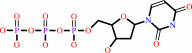 dUTP
dUTP
|
+
|
H2O
|
=
|
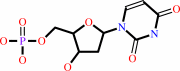 dUMP
dUMP
|
+
|
 diphosphate
|
+
|
H(+)
|
|
|
|
|
|
|
|
|
|
|
|
|
Note, where more than one E.C. class is given (as above), each may
correspond to a different protein domain or, in the case of polyprotein
precursors, to a different mature protein.
|
|
|
|
Molecule diagrams generated from .mol files obtained from the
KEGG ftp site
|
|
|
|
|
|
|
|
|
|
|
|
|
|
 |
|
|
|
|
|
|
| |
|
|
| |
|
|
Nucleic Acids Res
35:495-505
(2007)
|
|
PubMed id:
|
|
|
|
|
|
| |
|
Flexible segments modulate co-folding of dUTPase and nucleocapsid proteins.
|
|
V.Németh-Pongrácz,
O.Barabás,
M.Fuxreiter,
I.Simon,
I.Pichová,
M.Rumlová,
H.Zábranská,
D.Svergun,
M.Petoukhov,
V.Harmat,
E.Klement,
E.Hunyadi-Gulyás,
K.F.Medzihradszky,
E.Kónya,
B.G.Vértessy.
|
|
|
|
|
| |
ABSTRACT
|
|
|
|
| |
|
|
The homotrimeric fusion protein nucleocapsid (NC)-dUTPase combines domains that
participate in RNA/DNA folding, reverse transcription, and DNA repair in
Mason-Pfizer monkey betaretrovirus infected cells. The structural organization
of the fusion protein remained obscured by the N- and C-terminal flexible
segments of dUTPase and the linker region connecting the two domains that are
invisible in electron density maps. Small-angle X-ray scattering reveals that
upon oligonucleotide binding the NC domains adopt the trimeric symmetry of
dUTPase. High-resolution X-ray structures together with molecular modeling
indicate that fusion with NC domains dramatically alters the conformation of the
flexible C-terminus by perturbing the orientation of a critical beta-strand.
Consequently, the C-terminal segment is capable of double backing upon the
active site of its own monomer and stabilized by non-covalent interactions
formed with the N-terminal segment. This co-folding of the dUTPase terminal
segments, not observable in other homologous enzymes, is due to the presence of
the fused NC domain. Structural and genomic advantages of fusing the NC domain
to a shortened dUTPase in betaretroviruses and the possible physiological
consequences are envisaged.
|
|
|
|
|
|
|
|
|
|
|
|
|
|
|
|
|
|
 |
 |
 |
|


 Links
Links


