 |
PDBsum entry 2d3b

|
|
|
|
|
 |
Contents |
 |
|
|
|
|
|
|
|
|
|
|
|
|
|
|
* Residue conservation analysis
|
|
|
|
|
|
PDB id:
|
|
|
|
| Name: |
|
Ligase
|
|
|
Title:
|
|
Crystal structure of the maize glutamine synthetase complexed with amppnp and methionine sulfoximine
|
|
Structure:
|
|
Glutamine synthetase. Chain: a, b, c, d, e, f, g, h, i, j. Engineered: yes
|
|
Source:
|
|
Zea mays. Organism_taxid: 4577. Gene: gs1a. Expressed in: escherichia coli. Expression_system_taxid: 562.
|
|
Biol. unit:
|
|
 Decamer (from
)
Decamer (from
)
|
|
Resolution:
|
|
|
3.50Å
|
R-factor:
|
0.168
|
R-free:
|
0.209
|
|
|
Authors:
|
|
H.Unno,T.Uchida,H.Sugawara,G.Kurisu,T.Sugiyama,T.Yamaya,H.Sakakibara, T.Hase,M.Kusunoki
|
Key ref:

|
|
H.Unno
et al.
(2006).
Atomic structure of plant glutamine synthetase: a key enzyme for plant productivity.
J Biol Chem,
281,
29287-29296.
PubMed id:
DOI:

|
|
|
Date:
|
|
|
26-Sep-05
|
Release date:
|
18-Jul-06
|
|
|
|
|
|
|
PROCHECK
|

|
|
|
|
|
Headers
|
|
|
|
References
|
|
|
|
|
|

|
|
P38561
(GLNA3_MAIZE) -
Glutamine synthetase root isozyme 3 from Zea mays
|
|
|
|
Seq:
Struc:
|
|
|
|
356 a.a.
353 a.a.*
|
|

|

|

|
|
|
|
|
|
|
|
|
|
|
Key: |
 |
PfamA domain |
|
|
 |
Secondary structure |
|
 |
CATH domain |
|
|
*
PDB and UniProt seqs differ
at 6 residue positions (black
crosses)
|
|
|
|
|
|
|
|
|
|
|
|
|
Enzyme class:
|
|
E.C.6.3.1.2
- glutamine synthetase.
|
|
|
|
|
|
|
Reaction:
|
|
L-glutamate + NH4+ + ATP = L-glutamine + ADP + phosphate + H+
|
|
|
|
|
|
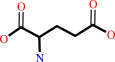 L-glutamate
|
+
|
NH4(+)
Bound ligand (Het Group name = )
matches with 50.00% similarity
|
+
|
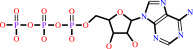 ATP
ATP
|
=
|
L-glutamine
Bound ligand (Het Group name = )
matches with 81.25% similarity
|
+
|
 ADP
ADP
|
+
|
 phosphate
|
+
|
H(+)
|
|
|
|
|
|
|
|
|
|
|
|
|
Molecule diagrams generated from .mol files obtained from the
KEGG ftp site
|
|
|
|
|
|
|
|
|
|
|
|
|
|
 |
|
|
|
|
|
|
| |
|
|
| |
|
DOI no:
|
J Biol Chem
281:29287-29296
(2006)
|
|
PubMed id:
|
|
|
|
|
|
| |
|
Atomic structure of plant glutamine synthetase: a key enzyme for plant productivity.
|
|
H.Unno,
T.Uchida,
H.Sugawara,
G.Kurisu,
T.Sugiyama,
T.Yamaya,
H.Sakakibara,
T.Hase,
M.Kusunoki.
|
|
|
|
|
| |
ABSTRACT
|
|
|
|
| |
|
|
Plants provide nourishment for animals and other heterotrophs as the sole
primary producer in the food chain. Glutamine synthetase (GS), one of the
essential enzymes for plant autotrophy catalyzes the incorporation of ammonia
into glutamate to generate glutamine with concomitant hydrolysis of ATP, and
plays a crucial role in the assimilation and re-assimilation of ammonia derived
from a wide variety of metabolic processes during plant growth and development.
Elucidation of the atomic structure of higher plant GS is important to
understand its detailed reaction mechanism and to obtain further insight into
plant productivity and agronomical utility. Here we report the first crystal
structures of maize (Zea mays L.) GS. The structure reveals a unique decameric
structure that differs significantly from the bacterial GS structure. Higher
plants have several isoenzymes of GS differing in heat stability and catalytic
properties for efficient responses to variation in the environment and
nutrition. A key residue responsible for the heat stability was found to be
Ile-161 in GS1a. The three structures in complex with substrate analogues,
including phosphinothricin, a widely used herbicide, lead us to propose a
mechanism for the transfer of phosphate from ATP to glutamate and to interpret
the inhibitory action of phosphinothricin as a guide for the development of new
potential herbicides.
|
|
|
|
|
|
| |
Selected figure(s)
|
|
|
|
| |
|
|

|
|

|
|
Figure 4.
FIGURE 4. Representation of the interactions between enzyme
and substrate analogues. a, stick models for the interaction of
the enzyme with AMPPNP and MetSox. Carbon, oxygen, nitrogen,
phosphorus, and sulfur atoms are colored gray, red, blue,
salmon, and yellow, respectively. Three Mn^2+ are indicated in
pink spheres. Dotted lines designate hydrogen bonds and
coordination bonds to Mn^2+ ions. Residues without dotted lines
have hydrophobic interactions with the substrate. b, stick
models for the interaction of the enzyme with ADP and MetSox. c,
stick models for the interaction of the enzyme with ADP and
PPT-P.
|
|
Figure 7.
FIGURE 7. Active site structure formed by Asp-56 and
Glu-297 of maize GS1a. a, stereo view of the side chain
structures of Asp-56' and Glu-297 together with ADP, MetSox-P,
and three Mn^2+ ions. b, alignments of short stretches of amino
acid sequences containing Asp-56 and Glu-297 in GSs from M.
tuberculosis (MtGS), S. typhimurium (StGS), maize (GS1 isozymes
GS1a, GS1d, andGS2), Arabidopsis, human, and chicken.
|
|
|
|
|
|
| |
The above figures are
reprinted
by permission from the ASBMB:
J Biol Chem
(2006,
281,
29287-29296)
copyright 2006.
|
|
| |
Figures were
selected
by an automated process.
|
|
|
|
|
|
|
|
|
|
|
|
|
|
|
|
 |
 |
 |
|
Literature references that cite this PDB file's key reference
|
|
|
| |
PubMed id
|
|
Reference
|
|
|
|
|
|
J.M.van Rooyen,
V.R.Abratt,
H.Belrhali,
and
T.Sewell
(2011).
Crystal Structure of Type III Glutamine Synthetase: Surprising Reversal of the Inter-Ring Interface.
|
| |
Structure,
19,
471-483.
|
|
|
PDB code:
|
|
|
|
|
|
|
|
S.M.Swarbreck,
M.Defoin-Platel,
M.Hindle,
M.Saqi,
and
D.Z.Habash
(2011).
New perspectives on glutamine synthetase in grasses.
|
| |
J Exp Bot,
62,
1511-1522.
|
|
|
|
|
|
|
B.Simon,
and
C.Sengupta-Gopalan
(2010).
The 3' untranslated region of the two cytosolic glutamine synthetase (GS(1)) genes in alfalfa (Medicago sativa) regulates transcript stability in response to glutamine.
|
| |
Planta,
232,
1151-1162.
|
|
|
|
|
|
|
C.Masclaux-Daubresse,
F.Daniel-Vedele,
J.Dechorgnat,
F.Chardon,
L.Gaufichon,
and
A.Suzuki
(2010).
Nitrogen uptake, assimilation and remobilization in plants: challenges for sustainable and productive agriculture.
|
| |
Ann Bot,
105,
1141-1157.
|
|
|
|
|
|
|
G.Estivill,
P.Guardado,
R.Buser,
M.Betti,
and
A.J.Márquez
(2010).
Identification of an essential cysteinyl residue for the structure of glutamine synthetase alpha from Phaseolus vulgaris.
|
| |
Planta,
231,
1101-1111.
|
|
|
|
|
|
|
F.Striebel,
F.Imkamp,
M.Sutter,
M.Steiner,
A.Mamedov,
and
E.Weber-Ban
(2009).
Bacterial ubiquitin-like modifier Pup is deamidated and conjugated to substrates by distinct but homologous enzymes.
|
| |
Nat Struct Mol Biol,
16,
647-651.
|
|
|
|
|
|
|
S.M.Bernard,
and
D.Z.Habash
(2009).
The importance of cytosolic glutamine synthetase in nitrogen assimilation and recycling.
|
| |
New Phytol,
182,
608-620.
|
|
|
|
|
|
|
T.Pornprom,
N.Prodmatee,
and
O.Chatchawankanphanich
(2009).
Glutamine synthetase mutation conferring target-site-based resistance to glufosinate in soybean cell selections.
|
| |
Pest Manag Sci,
65,
216-222.
|
|
|
|
|
|
|
Y.X.He,
L.Gui,
Y.Z.Liu,
Y.Du,
Y.Zhou,
P.Li,
and
C.Z.Zhou
(2009).
Crystal structure of Saccharomyces cerevisiae glutamine synthetase Gln1 suggests a nanotube-like supramolecular assembly.
|
| |
Proteins,
76,
249-254.
|
|
|
PDB code:
|
|
|
|
|
|
|
|
S.M.Bernard,
A.L.Møller,
G.Dionisio,
T.Kichey,
T.P.Jahn,
F.Dubois,
M.Baudo,
M.S.Lopes,
T.Tercé-Laforgue,
C.H.Foyer,
M.A.Parry,
B.G.Forde,
J.L.Araus,
B.Hirel,
J.K.Schjoerring,
and
D.Z.Habash
(2008).
Gene expression, cellular localisation and function of glutamine synthetase isozymes in wheat (Triticum aestivum L.).
|
| |
Plant Mol Biol,
67,
89.
|
|
|
|
|
|
|
K.Wyatt,
H.E.White,
L.Wang,
O.A.Bateman,
C.Slingsby,
E.V.Orlova,
and
G.Wistow
(2006).
Lengsin is a survivor of an ancient family of class I glutamine synthetases re-engineered by evolution for a role in the vertebrate lens.
|
| |
Structure,
14,
1823-1834.
|
|
|
PDB code:
|
|
|
|
|
|
|
The most recent references are shown first.
Citation data come partly from CiteXplore and partly
from an automated harvesting procedure. Note that this is likely to be
only a partial list as not all journals are covered by
either method. However, we are continually building up the citation data
so more and more references will be included with time.
Where a reference describes a PDB structure, the PDB
code is
shown on the right.
|
|


 Links
Links


