 |
PDBsum entry 2bjh

|
|
|
|
|
 |
Contents |
 |
|
|
|
|
|
|
|
|
|
|
|
|
* Residue conservation analysis
|
|
|
|
|
|
PDB id:
|
|
|
|
| Name: |
|
Hydrolase
|
|
|
Title:
|
|
Crystal structure of s133a anfaea-ferulic acid complex
|
|
Structure:
|
|
Feruloyl esterase a. Chain: a, b, c. Synonym: ferulic acid esterase a, fae-iii, cinnamoyl esterase. Engineered: yes. Mutation: yes
|
|
Source:
|
|
Aspergillus niger. Organism_taxid: 5061. Strain: cbs 120.49/n400. Expressed in: pichia pastoris. Expression_system_taxid: 4922
|
|
Resolution:
|
|
|
2.54Å
|
R-factor:
|
0.216
|
R-free:
|
0.277
|
|
|
Authors:
|
|
C.B.Faulds,R.Molina,R.Gonzalez,F.Husband,N.Juge,J.Sanz-Aparicio, J.A.Hermoso
|
Key ref:

|
|
C.B.Faulds
et al.
(2005).
Probing the determinants of substrate specificity of a feruloyl esterase, AnFaeA, from Aspergillus niger.
FEBS J,
272,
4362-4371.
PubMed id:
DOI:

|
|
|
Date:
|
|
|
02-Feb-05
|
Release date:
|
07-Sep-05
|
|
|
|
|
|
|
PROCHECK
|

|
|
|
|
|
Headers
|
|
|
|
References
|
|
|
|
|
|

|
|
O42807
(FAEA_ASPNG) -
Feruloyl esterase A from Aspergillus niger
|
|
|
|
Seq:
Struc:
|
|
|
|
281 a.a.
260 a.a.*
|
|

|

|

|
|
|
|
|
|
|
|
|
|
|
Key: |
 |
PfamA domain |
|
|
 |
Secondary structure |
|
 |
CATH domain |
|
|
*
PDB and UniProt seqs differ
at 1 residue position (black
cross)
|
|
|
|
|
|
|
|
|
|
|
|
|
Enzyme class:
|
|
E.C.3.1.1.73
- feruloyl esterase.
|
|
|
|
|
|
|
Reaction:
|
|
feruloyl-polysaccharide + H2O = ferulate + polysaccharide
|
|
|
|
|
|
feruloyl-polysaccharide
|
+
|
H2O
|
=
|
ferulate
Bound ligand (Het Group name = )
corresponds exactly
|
+
|
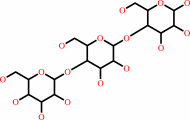 polysaccharide
|
|
|
|
|
|
|
|
|
|
|
|
|
Molecule diagrams generated from .mol files obtained from the
KEGG ftp site
|
|
|
|
|
|
|
|
|
|
|
|
|
|
 |
|
|
|
|
|
|
| |
|
|
| |
|
DOI no:
|
FEBS J
272:4362-4371
(2005)
|
|
PubMed id:
|
|
|
|
|
|
| |
|
Probing the determinants of substrate specificity of a feruloyl esterase, AnFaeA, from Aspergillus niger.
|
|
C.B.Faulds,
R.Molina,
R.Gonzalez,
F.Husband,
N.Juge,
J.Sanz-Aparicio,
J.A.Hermoso.
|
|
|
|
|
| |
ABSTRACT
|
|
|
|
| |
|
|
Feruloyl esterases hydrolyse phenolic groups involved in the cross-linking of
arabinoxylan to other polymeric structures. This is important for opening the
cell wall structure making material more accessible to glycoside hydrolases.
Here we describe the crystal structure of inactive S133A mutant of type-A
feruloyl esterase from Aspergillus niger (AnFaeA) in complex with a feruloylated
trisaccharide substrate. Only the ferulic acid moiety of the substrate is
visible in the electron density map, showing interactions through its OH and
OCH(3) groups with the hydroxyl groups of Tyr80. The importance of aromatic and
polar residues in the activity of AnFaeA was also evaluated using site-directed
mutagenesis. Four mutant proteins were heterologously expressed in Pichia
pastoris, and their kinetic properties determined against methyl esters of
ferulic, sinapic, caffeic and p-coumaric acid. The k(cat) of Y80S, Y80V, W260S
and W260V was drastically reduced compared to that of the wild-type enzyme.
However, the replacement of Tyr80 and Trp260 with smaller residues broadened the
substrate specificity of the enzyme, allowing the hydrolysis of methyl caffeate.
The role of Tyr80 and Trp260 in AnFaeA are discussed in light of the
three-dimensional structure.
|
|
|
|
|
|
| |
Selected figure(s)
|
|
|
|
| |
|
|

|
|

|
|
Figure 2.
Fig. 2. Crystal structure of the S133A AnFaeA mutant in
complex with FAXX. (A) Molecular surface of S133A AnFaeA mutant.
The catalytic triad and the Y80 and W260 residues are labelled.
Ferulic acid molecule is coloured in cyan. (B) Environment of FA
(green) in the active site of S133A. The flap region of AnFaeA
is highlighted in dark blue. (C) Proposed interactions of FA
with residues at the substrate cavity of AnFaeA.
|
|
Figure 4.
Fig. 4. Local environment of Tyr80 and Trp260. (A)
Arrangement of the Tyr80 residue. Ferulic acid is shown in blue,
Tyr80 is shown in red and the residues that participate in the
substrate cavity are shown in green. (B) Arrangement of Trp260
residue (red). The residues that bury Tpr260 are shown in blue.
|
|
|
|
|
|
| |
The above figures are
reprinted
by permission from the Federation of European Biochemical Societies:
FEBS J
(2005,
272,
4362-4371)
copyright 2005.
|
|
| |
Figures were
selected
by an automated process.
|
|
|
|
|
|
|
|
|
|
|
|
|
|
|
|
 |
 |
 |
|
Literature references that cite this PDB file's key reference
|
|
|
| |
PubMed id
|
|
Reference
|
|
|
|
|
|
H.Rakotoarivonina,
B.Hermant,
B.Chabbert,
J.P.Touzel,
and
C.Remond
(2011).
A thermostable feruloyl-esterase from the hemicellulolytic bacterium Thermobacillus xylanilyticus releases phenolic acids from non-pretreated plant cell walls.
|
| |
Appl Microbiol Biotechnol,
90,
541-552.
|
|
|
|
|
|
|
M.M.Buanafina,
T.Langdon,
B.Hauck,
S.Dalton,
E.Timms-Taravella,
and
P.Morris
(2010).
Targeting expression of a fungal ferulic acid esterase to the apoplast, endoplasmic reticulum or golgi can disrupt feruloylation of the growing cell wall and increase the biodegradability of tall fescue (Festuca arundinacea).
|
| |
Plant Biotechnol J,
8,
316-331.
|
|
|
|
|
|
|
M.Moukouli,
E.Topakas,
and
P.Christakopoulos
(2008).
Cloning, characterization and functional expression of an alkalitolerant type C feruloyl esterase from Fusarium oxysporum.
|
| |
Appl Microbiol Biotechnol,
79,
245-254.
|
|
|
|
|
|
|
A.E.Fazary,
and
Y.H.Ju
(2007).
Feruloyl esterases as biotechnological tools: current and future perspectives.
|
| |
Acta Biochim Biophys Sin (Shanghai),
39,
811-828.
|
|
|
|
|
|
|
A.Levasseur,
P.Gouret,
L.Lesage-Meessen,
M.Asther,
M.Asther,
E.Record,
and
P.Pontarotti
(2006).
Tracking the connection between evolutionary and functional shifts using the fungal lipase/feruloyl esterase A family.
|
| |
BMC Evol Biol,
6,
92.
|
|
|
|
|
|
|
T.Koseki,
K.Takahashi,
T.Handa,
Y.Yamane,
S.Fushinobu,
and
K.Hashizume
(2006).
N-linked oligosaccharides of Aspergillus awamori feruloyl esterase are important for thermostability and catalysis.
|
| |
Biosci Biotechnol Biochem,
70,
2476-2480.
|
|
|
|
|
|
The most recent references are shown first.
Citation data come partly from CiteXplore and partly
from an automated harvesting procedure. Note that this is likely to be
only a partial list as not all journals are covered by
either method. However, we are continually building up the citation data
so more and more references will be included with time.
|
|


 Links
Links


