
|
|
|
|
|
 |
Contents |
 |
|
|
|
|
|
|
|
|
|
|
|
|
|
|
* Residue conservation analysis
|
|
|
|
|
|
|
|
|
|
Enzyme class:
|
|
Chain A:
E.C.2.7.11.24
- mitogen-activated protein kinase.
|
|
|
|
|
|
|
Reaction:
|
|
|
1.
|
L-seryl-[protein] + ATP = O-phospho-L-seryl-[protein] + ADP + H+
|
|
2.
|
L-threonyl-[protein] + ATP = O-phospho-L-threonyl-[protein] + ADP + H+
|
|
|
|
|
|
|
L-seryl-[protein]
|
+
|
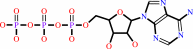 ATP
ATP
|
=
|
O-phospho-L-seryl-[protein]
Bound ligand (Het Group name = )
corresponds exactly
|
+
|
 ADP
ADP
|
+
|
H(+)
|
|
|
|
|
|
|
L-threonyl-[protein]
|
+
|
ATP
|
=
|
O-phospho-L-threonyl-[protein]
Bound ligand (Het Group name = )
corresponds exactly
|
+
|
ADP
|
+
|
H(+)
|
|
|
|
|
|
|
|
|
|
|
|
|
Molecule diagrams generated from .mol files obtained from the
KEGG ftp site
|
|
|
|
|
|
|
|
|
|
|
|
|
|
 |
|
|
|
|
|
|
| |
|
|
| |
|
DOI no:
|
Mol Cell
20:951-962
(2005)
|
|
PubMed id:
|
|
|
|
|
|
| |
|
The role of docking interactions in mediating signaling input, output, and discrimination in the yeast MAPK network.
|
|
A.Reményi,
M.C.Good,
R.P.Bhattacharyya,
W.A.Lim.
|
|
|
|
|
| |
ABSTRACT
|
|
|
|
| |
|
|
Cells use a network of mitogen-activated protein kinases (MAPKs) to coordinate
responses to diverse extracellular signals. Here, we examine the role of docking
interactions in determining connectivity of the yeast MAPKs Fus3 and Kss1. These
closely related kinases are activated by the common upstream MAPK kinase Ste7
yet generate distinct output responses, mating and filamentous growth,
respectively. We find that docking interactions are necessary for communication
with the kinases and that they can encode subtle differences in pathway-specific
input and output. The cell cycle arrest mediator Far1, a mating-specific
substrate, has a docking motif that selectively binds Fus3. In contrast, the
shared partner Ste7 has a promiscuous motif that binds both Fus3 and Kss1.
Structural analysis reveals that Fus3 interacts with specific and promiscuous
peptides in conformationally distinct modes. Induced fit recognition may allow
docking peptides to achieve discrimination by exploiting subtle differences in
kinase flexibility.
|
|
|
|
|
|
| |
Selected figure(s)
|
|
|
|
| |
|
|

|
|

|
|
Figure 1.
Figure 1. Docking Motifs Found in Interaction Partners of
the Saccharomyces cerevisiae MAPKs Fus3 and Kss1
|
|
Figure 3.
Figure 3. Structure of the Fus3 MAPK
|
|
|
|
|
|
| |
The above figures are
reprinted
by permission from Cell Press:
Mol Cell
(2005,
20,
951-962)
copyright 2005.
|
|
| |
Figures were
selected
by an automated process.
|
|
|
|
|
|
|
|
|
|
|
|
|
|
|
|
 |
 |
 |
|
Literature references that cite this PDB file's key reference
|
|
|
| |
PubMed id
|
|
Reference
|
|
|
|
|
|
C.F.Tiger,
F.Krause,
G.Cedersund,
R.Palmér,
E.Klipp,
S.Hohmann,
H.Kitano,
and
M.Krantz
(2012).
A framework for mapping, visualisation and automatic model creation of signal-transduction networks.
|
| |
Mol Syst Biol,
8,
578.
|
|
|
|
|
|
|
M.C.Good,
J.G.Zalatan,
and
W.A.Lim
(2011).
Scaffold proteins: hubs for controlling the flow of cellular information.
|
| |
Science,
332,
680-686.
|
|
|
|
|
|
|
B.Raisley,
H.N.Nguyen,
and
J.A.Hadwiger
(2010).
G{alpha}5 subunit-mediated signalling requires a D-motif and the MAPK ERK1 in Dictyostelium.
|
| |
Microbiology,
156,
789-797.
|
|
|
|
|
|
|
C.W.Li,
and
B.S.Chen
(2010).
Identifying functional mechanisms of gene and protein regulatory networks in response to a broader range of environmental stresses.
|
| |
Comp Funct Genomics,
(),
408705.
|
|
|
|
|
|
|
H.Saito
(2010).
Regulation of cross-talk in yeast MAPK signaling pathways.
|
| |
Curr Opin Microbiol,
13,
677-683.
|
|
|
|
|
|
|
R.Akella,
X.Min,
Q.Wu,
K.H.Gardner,
and
E.J.Goldsmith
(2010).
The third conformation of p38α MAP kinase observed in phosphorylated p38α and in solution.
|
| |
Structure,
18,
1571-1578.
|
|
|
PDB code:
|
|
|
|
|
|
|
|
W.Ma,
Y.Shang,
Z.Wei,
W.Wen,
W.Wang,
and
M.Zhang
(2010).
Phosphorylation of DCC by ERK2 is facilitated by direct docking of the receptor P1 domain to the kinase.
|
| |
Structure,
18,
1502-1511.
|
|
|
PDB code:
|
|
|
|
|
|
|
|
A.J.Bardwell,
E.Frankson,
and
L.Bardwell
(2009).
Selectivity of docking sites in MAPK kinases.
|
| |
J Biol Chem,
284,
13165-13173.
|
|
|
|
|
|
|
A.Mody,
J.Weiner,
and
S.Ramanathan
(2009).
Modularity of MAP kinases allows deformation of their signalling pathways.
|
| |
Nat Cell Biol,
11,
484-491.
|
|
|
|
|
|
|
F.Xu,
P.Du,
H.Shen,
H.Hu,
Q.Wu,
J.Xie,
and
L.Yu
(2009).
Correlated mutation analysis on the catalytic domains of serine/threonine protein kinases.
|
| |
PLoS One,
4,
e5913.
|
|
|
|
|
|
|
G.L.Johnson,
and
S.M.Gomez
(2009).
Sequence patches on MAPK surfaces define protein-protein interactions.
|
| |
Genome Biol,
10,
222.
|
|
|
|
|
|
|
H.N.Nguyen,
and
J.A.Hadwiger
(2009).
The Galpha4 G protein subunit interacts with the MAP kinase ERK2 using a D-motif that regulates developmental morphogenesis in Dictyostelium.
|
| |
Dev Biol,
335,
385-395.
|
|
|
|
|
|
|
M.C.Balasu,
L.N.Spiridon,
S.Miron,
C.T.Craescu,
A.J.Scheidig,
A.J.Petrescu,
and
S.E.Szedlacsek
(2009).
Interface analysis of the complex between ERK2 and PTP-SL.
|
| |
PLoS ONE,
4,
e5432.
|
|
|
|
|
|
|
M.Good,
G.Tang,
J.Singleton,
A.Reményi,
and
W.A.Lim
(2009).
The Ste5 scaffold directs mating signaling by catalytically unlocking the Fus3 MAP kinase for activation.
|
| |
Cell,
136,
1085-1097.
|
|
|
PDB code:
|
|
|
|
|
|
|
|
M.J.Marín,
M.Flández,
C.Bermejo,
J.Arroyo,
H.Martín,
and
M.Molina
(2009).
Different modulation of the outputs of yeast MAPK-mediated pathways by distinct stimuli and isoforms of the dual-specificity phosphatase Msg5.
|
| |
Mol Genet Genomics,
281,
345-359.
|
|
|
|
|
|
|
R.B.Annan,
A.Y.Lee,
I.D.Reid,
A.Sayad,
M.Whiteway,
M.Hallett,
and
D.Y.Thomas
(2009).
A biochemical genomics screen for substrates of Ste20p kinase enables the in silico prediction of novel substrates.
|
| |
PLoS One,
4,
e8279.
|
|
|
|
|
|
|
X.Min,
R.Akella,
H.He,
J.M.Humphreys,
S.E.Tsutakawa,
S.J.Lee,
J.A.Tainer,
M.H.Cobb,
and
E.J.Goldsmith
(2009).
The structure of the MAP2K MEK6 reveals an autoinhibitory dimer.
|
| |
Structure,
17,
96.
|
|
|
PDB code:
|
|
|
|
|
|
|
|
M.S.Cortese,
V.N.Uversky,
and
A.K.Dunker
(2008).
Intrinsic disorder in scaffold proteins: getting more from less.
|
| |
Prog Biophys Mol Biol,
98,
85.
|
|
|
|
|
|
|
P.Côte,
and
M.Whiteway
(2008).
The role of Candida albicans FAR1 in regulation of pheromone-mediated mating, gene expression and cell cycle arrest.
|
| |
Mol Microbiol,
68,
392-404.
|
|
|
|
|
|
|
R.Akella,
T.M.Moon,
and
E.J.Goldsmith
(2008).
Unique MAP Kinase binding sites.
|
| |
Biochim Biophys Acta,
1784,
48-55.
|
|
|
|
|
|
|
Y.Murakami,
K.Tatebayashi,
and
H.Saito
(2008).
Two adjacent docking sites in the yeast Hog1 mitogen-activated protein (MAP) kinase differentially interact with the Pbs2 MAP kinase kinase and the Ptp2 protein tyrosine phosphatase.
|
| |
Mol Cell Biol,
28,
2481-2494.
|
|
|
|
|
|
|
C.I.Maeder,
M.A.Hink,
A.Kinkhabwala,
R.Mayr,
P.I.Bastiaens,
and
M.Knop
(2007).
Spatial regulation of Fus3 MAP kinase activity through a reaction-diffusion mechanism in yeast pheromone signalling.
|
| |
Nat Cell Biol,
9,
1319-1326.
|
|
|
|
|
|
|
J.A.Ubersax,
and
J.E.Ferrell
(2007).
Mechanisms of specificity in protein phosphorylation.
|
| |
Nat Rev Mol Cell Biol,
8,
530-541.
|
|
|
|
|
|
|
M.Jiménez-Sánchez,
V.J.Cid,
and
M.Molina
(2007).
Retrophosphorylation of Mkk1 and Mkk2 MAPKKs by the Slt2 MAPK in the yeast cell integrity pathway.
|
| |
J Biol Chem,
282,
31174-31185.
|
|
|
|
|
|
|
R.E.Chen,
and
J.Thorner
(2007).
Function and regulation in MAPK signaling pathways: lessons learned from the yeast Saccharomyces cerevisiae.
|
| |
Biochim Biophys Acta,
1773,
1311-1340.
|
|
|
|
|
|
|
R.Linding,
L.J.Jensen,
G.J.Ostheimer,
M.A.van Vugt,
C.Jørgensen,
I.M.Miron,
F.Diella,
K.Colwill,
L.Taylor,
K.Elder,
P.Metalnikov,
V.Nguyen,
A.Pasculescu,
J.Jin,
J.G.Park,
L.D.Samson,
J.R.Woodgett,
R.B.Russell,
P.Bork,
M.B.Yaffe,
and
T.Pawson
(2007).
Systematic discovery of in vivo phosphorylation networks.
|
| |
Cell,
129,
1415-1426.
|
|
|
|
|
|
|
A.Breitkreutz,
and
M.Tyers
(2006).
Cell signaling. A sophisticated scaffold wields a new trick.
|
| |
Science,
311,
789-790.
|
|
|
PDB codes:
|
|
|
|
|
|
|
|
A.Reményi,
M.C.Good,
and
W.A.Lim
(2006).
Docking interactions in protein kinase and phosphatase networks.
|
| |
Curr Opin Struct Biol,
16,
676-685.
|
|
|
|
|
|
|
B.Zhou,
J.Zhang,
S.Liu,
S.Reddy,
F.Wang,
and
Z.Y.Zhang
(2006).
Mapping ERK2-MKP3 binding interfaces by hydrogen/deuterium exchange mass spectrometry.
|
| |
J Biol Chem,
281,
38834-38844.
|
|
|
|
|
|
|
L.Bardwell,
and
K.Shah
(2006).
Analysis of mitogen-activated protein kinase activation and interactions with regulators and substrates.
|
| |
Methods,
40,
213-223.
|
|
|
|
|
|
|
L.Bardwell
(2006).
Mechanisms of MAPK signalling specificity.
|
| |
Biochem Soc Trans,
34,
837-841.
|
|
|
|
|
|
|
R.P.Bhattacharyya,
A.Reményi,
B.J.Yeh,
and
W.A.Lim
(2006).
Domains, motifs, and scaffolds: the role of modular interactions in the evolution and wiring of cell signaling circuits.
|
| |
Annu Rev Biochem,
75,
655-680.
|
|
|
|
|
|
|
R.P.Bhattacharyya,
A.Reményi,
M.C.Good,
C.J.Bashor,
A.M.Falick,
and
W.A.Lim
(2006).
The Ste5 scaffold allosterically modulates signaling output of the yeast mating pathway.
|
| |
Science,
311,
822-826.
|
|
|
PDB codes:
|
|
|
|
|
|
|
|
T.Zhou,
L.Sun,
J.Humphreys,
and
E.J.Goldsmith
(2006).
Docking interactions induce exposure of activation loop in the MAP kinase ERK2.
|
| |
Structure,
14,
1011-1019.
|
|
|
PDB code:
|
|
|
|
|
|
|
The most recent references are shown first.
Citation data come partly from CiteXplore and partly
from an automated harvesting procedure. Note that this is likely to be
only a partial list as not all journals are covered by
either method. However, we are continually building up the citation data
so more and more references will be included with time.
Where a reference describes a PDB structure, the PDB
code is
shown on the right.
|
 |


 Links
Links


