 |
PDBsum entry 2as3

|
|
|
|
|
|

|

|

|

|
|

|
|

|
|

|
|

|
|

|
|
|
 |

|

|
|
|
|
|
|
|
|
|
|
|
|
|
|
|
|
|
|
|
|
|
|
|
|
|
|
|
|
|
|
|
|
|
|
Oxidoreductase
|
PDB id
|
|
|
|
2as3
|
|
|
|
|
|
|
|
|
|
|
|
|
|
|

|

|

|
|
|
|
|
|
|
|
 |
Contents |
 |
|
|
|
|
|
|
|
|
|
|
|
|
|
|
* Residue conservation analysis
|
|
|
|
|
|
PDB id:
|
|
|
|
| Name: |
|
Oxidoreductase
|
|
|
Title:
|
|
CytochromE C peroxidase in complex with phenol
|
|
Structure:
|
|
CytochromE C peroxidase, mitochondrial. Chain: a. Fragment: cytochromE C peroxidase. Synonym: ccp. Engineered: yes. Mutation: yes
|
|
Source:
|
|
Saccharomyces cerevisiae. Baker's yeast. Organism_taxid: 4932. Gene: ccp1, ccp, cpo. Expressed in: escherichia coli bl21(de3). Expression_system_taxid: 469008.
|
|
Resolution:
|
|
|
1.40Å
|
R-factor:
|
0.144
|
R-free:
|
0.188
|
|
|
Authors:
|
|
R.Brenk,S.W.Vetter,S.E.Boyce,D.B.Goodin,B.K.Shoichet
|
Key ref:

|
|
R.Brenk
et al.
(2006).
Probing molecular docking in a charged model binding site.
J Mol Biol,
357,
1449-1470.
PubMed id:
DOI:

|
|
|
Date:
|
|
|
22-Aug-05
|
Release date:
|
11-Apr-06
|
|
|
|
|
|
|
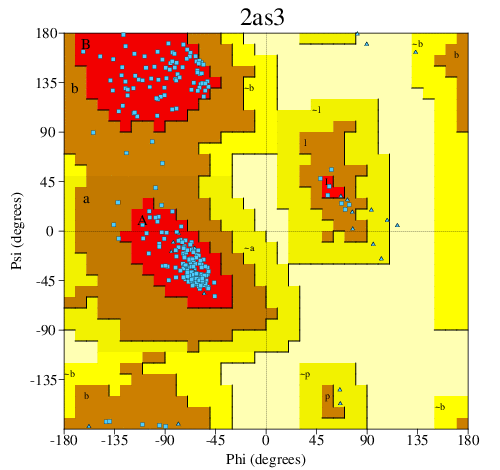
PROCHECK
|
|
|
|
|
|
Headers
|
|
|
|
References
|
|
|
|
|
|
|
|
P00431
(CCPR_YEAST) -
Cytochrome c peroxidase, mitochondrial from Saccharomyces cerevisiae (strain ATCC 204508 / S288c)
|
|
|
|
Seq:
Struc:
|
|
|
|
361 a.a.
291 a.a.*
|
|

|

|
|
|
|
|
|
|
|
|
|
|
|
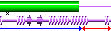
Key: |
 |
PfamA domain |
|
|
 |
Secondary structure |
|
 |
CATH domain |
|
|
*
PDB and UniProt seqs differ
at 3 residue positions (black
crosses)
|
|
|
|
|
|
|
|
|
|
|
|
|
Enzyme class:
|
|
E.C.1.11.1.5
- cytochrome-c peroxidase.
|
|
|
|
|
|
|
Reaction:
|
|
2 Fe(II)-[cytochrome c] + H2O2 + 2 H+ = 2 Fe(III)-[cytochrome c] + 2 H2O
|
|
|
|
|
|
2
×
Fe(II)-[cytochrome c]
|
+
|
 H2O2
H2O2
|
+
|
2
×
H(+)
|
=
|
2
×
Fe(III)-[cytochrome c]
|
+
|
2
×
H2O
|
|
|
|
|
|
|
|
|
|
Cofactor:
|
|
Heme
|
|
|
|
|
|
Heme
Bound ligand (Het Group name =
HEM)
matches with 95.45% similarity
|
|
|
|
|
|
|
Molecule diagrams generated from .mol files obtained from the
KEGG ftp site
|
|
|
|
|
|
|
|
|
|
|
|
|
|
 |
|
|
|
|
|
|
| |
|
|
| |
|
DOI no:
|
J Mol Biol
357:1449-1470
(2006)
|
|
PubMed id:
|
|
|
|
|
|
| |
|
Probing molecular docking in a charged model binding site.
|
|
R.Brenk,
S.W.Vetter,
S.E.Boyce,
D.B.Goodin,
B.K.Shoichet.
|
|
|
|
|
| |
ABSTRACT
|
|
|
|
| |
|
|
A model binding site was used to investigate charge-charge interactions in
molecular docking. This simple site, a small (180A(3)) engineered cavity in
cyctochrome c peroxidase (CCP), is negatively charged and completely buried from
solvent, allowing us to explore the balance between electrostatic energy and
ligand desolvation energy in a system where many of the common approximations in
docking do not apply. A database with about 5300 molecules was docked into this
cavity. Retrospective testing with known ligands and decoys showed that overall
the balance between electrostatic interaction and desolvation energy was
captured. More interesting were prospective docking scre"ens that looked
for novel ligands, especially those that might reveal problems with the docking
and energy methods. Based on screens of the 5300 compound database, both
high-scoring and low-scoring molecules were acquired and tested for binding. Out
of 16 new, high-scoring compounds tested, 15 were observed to bind. All of these
were small heterocyclic cations. Binding constants were measured for a few of
these, they ranged between 20microM and 60microM. Crystal structures were
determined for ten of these ligands in complex with the protein. The observed
ligand geometry corresponded closely to that predicted by docking. Several
low-scoring alkyl amino cations were also tested and found to bind. The low
docking score of these molecules owed to the relatively high charge density of
the charged amino group and the corresponding high desolvation penalty. When the
complex structures of those ligands were determined, a bound water molecule was
observed interacting with the amino group and a backbone carbonyl group of the
cavity. This water molecule mitigates the desolvation penalty and improves the
interaction energy relative to that of the "naked" site used in the
docking screen. Finally, six low-scoring neutral molecules were also tested,
with a view to looking for false negative predictions. Whereas most of these did
not bind, two did (phenol and 3-fluorocatechol). Crystal structures for these
two ligands in complex with the cavity site suggest reasons for their binding.
That these neutral molecules do, in fact bind, contradicts previous results in
this site and, along with the alkyl amines, provides instructive false negatives
that help identify weaknesses in our scoring functions. Several improvements of
these are considered.
|
|
|
|
|
|
| |
Selected figure(s)
|
|
|
|
| |
|
|

|
|

|
|
Figure 1.
Figure 1. The cavity in CCP W191G. A transparent surface is
displayed showing four ordered water molecules (red) and one
potassium ion (green) in the cavity of the apo-structure. Water
molecule 308 is conserved in all structures. (This Figure was
made using PyMOL (www.pymol.org, as were Figure 4 and Figure 5).)
|
|
Figure 7.
Figure 7. Ranks of the CCP W191G cavity ligands (test set
ligands and the new ligands in Table 2) scored using Gaussian
charges and desolvation energies plotted against the ranks
obtained using AMSOL charges and desolvation energies.
|
|
|
|
|
|
| |
The above figures are
reprinted
by permission from Elsevier:
J Mol Biol
(2006,
357,
1449-1470)
copyright 2006.
|
|
| |
Figures were
selected
by an automated process.
|
|
|
|
|
|
|
|
|
|
|
|
|
|
|
|
 |
 |
 |
|
Literature references that cite this PDB file's key reference
|
|
|
| |
PubMed id
|
|
Reference
|
|
|
|
|
|
P.Daldrop,
F.E.Reyes,
D.A.Robinson,
C.M.Hammond,
D.M.Lilley,
R.T.Batey,
and
R.Brenk
(2011).
Novel ligands for a purine riboswitch discovered by RNA-ligand docking.
|
| |
Chem Biol,
18,
324-335.
|
|
|
PDB codes:
|
|
|
|
|
|
|
|
C.P.Mpamhanga,
D.Spinks,
L.B.Tulloch,
E.J.Shanks,
D.A.Robinson,
I.T.Collie,
A.H.Fairlamb,
P.G.Wyatt,
J.A.Frearson,
W.N.Hunter,
I.H.Gilbert,
and
R.Brenk
(2009).
One scaffold, three binding modes: novel and selective pteridine reductase 1 inhibitors derived from fragment hits discovered by virtual screening.
|
| |
J Med Chem,
52,
4454-4465.
|
|
|
PDB codes:
|
|
|
|
|
|
|
|
D.J.Huggins,
M.D.Altman,
and
B.Tidor
(2009).
Evaluation of an inverse molecular design algorithm in a model binding site.
|
| |
Proteins,
75,
168-186.
|
|
|
|
|
|
|
D.L.Mobley,
and
K.A.Dill
(2009).
Binding of small-molecule ligands to proteins: "what you see" is not always "what you get".
|
| |
Structure,
17,
489-498.
|
|
|
|
|
|
|
A.P.Graves,
D.M.Shivakumar,
S.E.Boyce,
M.P.Jacobson,
D.A.Case,
and
B.K.Shoichet
(2008).
Rescoring docking hit lists for model cavity sites: predictions and experimental testing.
|
| |
J Mol Biol,
377,
914-934.
|
|
|
PDB codes:
|
|
|
|
|
|
|
|
R.Baron,
and
J.A.McCammon
(2008).
(Thermo)dynamic role of receptor flexibility, entropy, and motional correlation in protein-ligand binding.
|
| |
Chemphyschem,
9,
983-988.
|
|
|
|
|
|
|
W.Deng,
and
C.L.Verlinde
(2008).
Evaluation of different virtual screening programs for docking in a charged binding pocket.
|
| |
J Chem Inf Model,
48,
2010-2020.
|
|
|
|
|
|
|
K.H.Kim
(2007).
Outliers in SAR and QSAR: is unusual binding mode a possible source of outliers?
|
| |
J Comput Aided Mol Des,
21,
63-86.
|
|
|
|
|
|
The most recent references are shown first.
Citation data come partly from CiteXplore and partly
from an automated harvesting procedure. Note that this is likely to be
only a partial list as not all journals are covered by
either method. However, we are continually building up the citation data
so more and more references will be included with time.
Where a reference describes a PDB structure, the PDB
codes are
shown on the right.
|
|


 Links
Links


