 |
PDBsum entry 2a2s

|
|
|
|
|
 |
Contents |
 |
|
|
|
|
|
|
|
|
|
|
|
|
|
|
* Residue conservation analysis
|
|
|
|
|
|
|
|
|
|
|
Enzyme class:
|
|
E.C.2.5.1.18
- glutathione transferase.
|
|
|
|
|
|
|
Reaction:
|
|
RX + glutathione = an S-substituted glutathione + a halide anion + H+
|
|
|
|
|
|
RX
Bound ligand (Het Group name = )
matches with 90.91% similarity
|
+
|
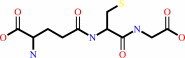 glutathione
|
=
|
S-substituted glutathione
|
+
|
halide anion
|
+
|
H(+)
|
|
|
|
|
|
|
|
|
|
|
|
|
Molecule diagrams generated from .mol files obtained from the
KEGG ftp site
|
|
|
|
|
|
|
|
|
|
|
|
|
|
 |
|
|
|
|
|
|
| |
|
|
| |
|
DOI no:
|
Protein Sci
15:1093-1105
(2006)
|
|
PubMed id:
|
|
|
|
|
|
| |
|
Calorimetric and structural studies of the nitric oxide carrier S-nitrosoglutathione bound to human glutathione transferase P1-1.
|
|
R.Téllez-Sanz,
E.Cesareo,
M.Nuccetelli,
A.M.Aguilera,
C.Barón,
L.J.Parker,
J.J.Adams,
C.J.Morton,
M.Lo Bello,
M.W.Parker,
L.García-Fuentes.
|
|
|
|
|
| |
ABSTRACT
|
|
|
|
| |
|
|
The nitric oxide molecule (NO) is involved in many important physiological
processes and seems to be stabilized by reduced thiol species, such as
S-nitrosoglutathione (GSNO). GSNO binds strongly to glutathione transferases, a
major superfamily of detoxifying enzymes. We have determined the crystal
structure of GSNO bound to dimeric human glutathione transferase P1-1 (hGSTP1-1)
at 1.4 A resolution. The GSNO ligand binds in the active site with the nitrosyl
moiety involved in multiple interactions with the protein. Isothermal titration
calorimetry and differential scanning calorimetry (DSC) have been used to
characterize the interaction of GSNO with the enzyme. The binding of GSNO to
wild-type hGSTP1-1 induces a negative cooperativity with a kinetic process
concomitant to the binding process occurring at more physiological temperatures.
GSNO inhibits wild-type enzyme competitively at lower temperatures but
covalently at higher temperatures, presumably by S-nitrosylation of a sulfhydryl
group. The C47S mutation removes the covalent modification potential of the
enzyme by GSNO. These results are consistent with a model in which the flexible
helix alpha2 of hGST P1-1 must move sufficiently to allow chemical modification
of Cys47. In contrast to wild-type enzyme, the C47S mutation induces a positive
cooperativity toward GSNO binding. The DSC results show that the thermal
stability of the mutant is slightly higher than wild type, consistent with helix
alpha2 forming new interactions with the other subunit. All these results
suggest that Cys47 plays a key role in intersubunit cooperativity and that under
certain pathological conditions S-nitrosylation of Cys47 by GSNO is a likely
physiological scenario.
|
|
|
|
|
|
| |
Selected figure(s)
|
|
|
|
| |
|
|

|
|

|
|
Figure 1.
Stereo diagram of the 2F[o] -- F[c] electron density map of
the hGSTP1-1 --GSNO complex at 1.4 A resolution (contoured at
the 1[sigma] level). Only one conformer of the nitroso moiety is
shown for clarity.
|
|
Figure 3.
ITC data for the binding of GSNO to wt-hGSTP1-1 at
35.1[deg]C. Titrations were performed in 20 mM sodium phosphate
(pH 7.0), 5 mM NaCl, and 0.1 mM EDTA buffer. Raw data for the
titration of enzyme (39.46 [mu]M) with 29 8-[mu]L injections of
GSNO (13.95 mM). A preinjection of 1 [mu]L was performed at the
beginning. (a) GSNO dilution experiment.
|
|
|
|
|
|
| |
The above figures are
reprinted
from an Open Access publication published by the Protein Society:
Protein Sci
(2006,
15,
1093-1105)
copyright 2006.
|
|
| |
Figures were
selected
by the author.
|
|
|
|
|
|
|
|
|
|
|
|
|
|
|
|
 |
 |
 |
|
Literature references that cite this PDB file's key reference
|
|
|
| |
PubMed id
|
|
Reference
|
|
|
|
|
|
I.Quesada-Soriano,
L.J.Parker,
A.Primavera,
J.Wielens,
J.K.Holien,
J.M.Casas-Solvas,
A.Vargas-Berenguel,
A.M.Aguilera,
M.Nuccetelli,
A.P.Mazzetti,
M.L.Bello,
M.W.Parker,
and
L.García-Fuentes
(2011).
Diuretic drug binding to human glutathione transferase P1-1: potential role of Cys-101 revealed in the double mutant C47S/Y108V.
|
| |
J Mol Recognit,
24,
220-234.
|
|
|
PDB codes:
|
|
|
|
|
|
|
|
I.Quesada-Soriano,
L.J.Parker,
A.Primavera,
J.M.Casas-Solvas,
A.Vargas-Berenguel,
C.Barón,
C.J.Morton,
A.Paola Mazzetti,
M.Lo Bello,
M.W.Parker,
and
L.García-Fuentes
(2009).
Influence of the H-site residue 108 on human glutathione transferase P1-1 ligand binding: Structure-thermodynamic relationships and thermal stability.
|
| |
Protein Sci,
18,
2454-2470.
|
|
|
PDB codes:
|
|
|
|
|
|
|
|
H.Cui,
J.Shen,
D.Lu,
T.Zhang,
W.Zhang,
D.Sun,
and
P.G.Wang
(2008).
4-Aryl-1,3,2-oxathiazolylium-5-olate: a novel GST inhibitor to release JNK and activate c-Jun for cancer therapy.
|
| |
Cancer Chemother Pharmacol,
62,
509-515.
|
|
|
|
|
|
|
O.Okhrimenko,
and
I.Jelesarov
(2008).
A survey of the year 2006 literature on applications of isothermal titration calorimetry.
|
| |
J Mol Recognit,
21,
1.
|
|
|
|
|
|
|
Y.M.Go,
and
D.P.Jones
(2008).
Redox compartmentalization in eukaryotic cells.
|
| |
Biochim Biophys Acta,
1780,
1273-1290.
|
|
|
|
|
|
The most recent references are shown first.
Citation data come partly from CiteXplore and partly
from an automated harvesting procedure. Note that this is likely to be
only a partial list as not all journals are covered by
either method. However, we are continually building up the citation data
so more and more references will be included with time.
Where a reference describes a PDB structure, the PDB
codes are
shown on the right.
|
|


 Links
Links


