 |
PDBsum entry 2a2c

|
|
|
|
|
 |
Contents |
 |
|
|
|
|
|
|
|
|
|
|
|
|
|
|
* Residue conservation analysis
|
|
|
|
|
|
|
|
|
|
|
Enzyme class:
|
|
E.C.2.7.1.157
- N-acetylgalactosamine kinase.
|
|
|
|
|
|
|
Reaction:
|
|
N-acetyl-alpha-D-galactosamine + ATP = N-acetyl-alpha-D-galactosamine 1-phosphate + ADP + H+
|
|
|
|
|
|
N-acetyl-alpha-D-galactosamine
|
+
|
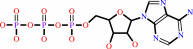 ATP
ATP
|
=
|
N-acetyl-alpha-D-galactosamine 1-phosphate
Bound ligand (Het Group name = )
corresponds exactly
|
+
|
 ADP
ADP
|
+
|
H(+)
Bound ligand (Het Group name = )
corresponds exactly
|
|
|
|
|
|
|
|
|
|
Cofactor:
|
|
Mg(2+)
|
|
|
|
|
|
|
|
|
Molecule diagrams generated from .mol files obtained from the
KEGG ftp site
|
|
|
|
|
|
|
|
|
|
|
|
|
|
 |
|
|
|
|
|
|
| |
|
|
| |
|
DOI no:
|
J Biol Chem
280:32784-32791
(2005)
|
|
PubMed id:
|
|
|
|
|
|
| |
|
The molecular architecture of human N-acetylgalactosamine kinase.
|
|
J.B.Thoden,
H.M.Holden.
|
|
|
|
|
| |
ABSTRACT
|
|
|
|
| |
|
|
Galactokinase plays a key role in normal galactose metabolism by catalyzing the
conversion of alpha-d-galactose to galactose 1-phosphate. Within recent years,
the three-dimensional structures of human galactokinase and two bacterial forms
of the enzyme have been determined. Originally, the gene encoding galactokinase
in humans was mapped to chromosome 17. An additional gene, encoding a protein
with sequence similarity to galactokinase, was subsequently mapped to chromosome
15. Recent reports have shown that this second gene (GALK2) encodes an enzyme
with greater activity against GalNAc than galactose. This enzyme, GalNAc kinase,
has been implicated in a salvage pathway for the reutilization of free GalNAc
derived from the degradation of complex carbohydrates. Here we report the first
structural analysis of a GalNAc kinase. The structure of the human enzyme was
solved in the presence of MnAMPPNP and GalNAc or MgATP and GalNAc (which
resulted in bound products in the active site). The enzyme displays a distinctly
bilobal appearance with its active site wedged between the two domains. The
N-terminal region is dominated by a seven-stranded mixed beta-sheet, whereas the
C-terminal motif contains two layers of anti-parallel beta-sheet. The overall
topology displayed by GalNAc kinase places it into the GHMP superfamily of
enzymes, which generally function as small molecule kinases. From this
investigation, the geometry of the GalNAc kinase active site before and after
catalysis has been revealed, and the determinants of substrate specificity have
been defined on a molecular level.
|
|
|
|
|
|
| |
Selected figure(s)
|
|
|
|
| |
|
|

|
|

|
|
Figure 1.
FIGURE 1. Ribbon representation of human GalNAc kinase.
Human GalNAc kinase folds into two motifs referred to as the N-
and C-terminal domains. As indicated in a, the N-terminal domain
is dominated by a seven-stranded mixed  -sheet highlighted in
magenta. Two layers of antiparallel -sheet, colored in
yellow and blue, characterize the C-terminal domain. The
location of the active site is indicated by the ball-and-stick
representations for GalNAc-1-phosphate and MgADP, with the Mg2+
ion highlighted in green. Electron density corresponding to
GalNAc 1-phosphate and MgADP is displayed in b. While the
protein was crystallized in the presence of GalNAc and MgATP,
the electron density clearly reveals that the enzyme is active
in the crystalline lattice. The map, contoured at 2 -sheet highlighted in
magenta. Two layers of antiparallel -sheet, colored in
yellow and blue, characterize the C-terminal domain. The
location of the active site is indicated by the ball-and-stick
representations for GalNAc-1-phosphate and MgADP, with the Mg2+
ion highlighted in green. Electron density corresponding to
GalNAc 1-phosphate and MgADP is displayed in b. While the
protein was crystallized in the presence of GalNAc and MgATP,
the electron density clearly reveals that the enzyme is active
in the crystalline lattice. The map, contoured at 2  , was
calculated with coefficients of the form F[o] - F[c], where F[o]
was the native structure factor amplitude, and F[c] was the
calculated structure factor amplitude from the model lacking
coordinates for the ligands. A close-up view of the active site
with bound products is depicted in c. Only those residues
located within , was
calculated with coefficients of the form F[o] - F[c], where F[o]
was the native structure factor amplitude, and F[c] was the
calculated structure factor amplitude from the model lacking
coordinates for the ligands. A close-up view of the active site
with bound products is depicted in c. Only those residues
located within  3.2 Å of the
ligands are shown. The green dashed lines indicate coordinate
covalent bonds between the magnesium ion and its ligands. The
black dashed lines indicate potential hydrogen bonding
interactions. For clarity, Ser141 and Gly143 were omitted from
the figure. 3.2 Å of the
ligands are shown. The green dashed lines indicate coordinate
covalent bonds between the magnesium ion and its ligands. The
black dashed lines indicate potential hydrogen bonding
interactions. For clarity, Ser141 and Gly143 were omitted from
the figure.
|
|
Figure 3.
FIGURE 3. A comparison of human galactokinase versus GalNAc
kinase. The human forms of galactokinase and GalNAc kinase
differ in three specific regions labeled A, B, and C and
indicated by the blue ribbons in a. A superposition of the sugar
binding regions for these enzymes is given in b. The yellow
bonds correspond to GalNAc kinase, with the sugar ligand
depicted in aquamarine. The white bonds correspond to
galactokinase, with the sugar ligand highlighted in magenta. The
red and black labels correspond to residues in galactokinase and
GalNAc kinase, respectively. Coordinates for the human
galactokinase were from this laboratory (Protein Data Bank
accession number 1WUU [PDB]
).
|
|
|
|
|
|
| |
The above figures are
reprinted
by permission from the ASBMB:
J Biol Chem
(2005,
280,
32784-32791)
copyright 2005.
|
|
| |
Figures were
selected
by an automated process.
|
|
|
|
|
|
|
|
|
|
|
|
|
|
|
|
 |
 |
 |
|
Literature references that cite this PDB file's key reference
|
|
|
| |
PubMed id
|
|
Reference
|
|
|
|
|
|
Z.Zhang,
J.Akutsu,
and
Y.Kawarabayasi
(2010).
Identification of novel acetyltransferase activity on the thermostable protein ST0452 from Sulfolobus tokodaii strain 7.
|
| |
J Bacteriol,
192,
3287-3293.
|
|
|
|
|
|
|
C.Fan,
H.J.Fromm,
and
T.A.Bobik
(2009).
Kinetic and functional analysis of L-threonine kinase, the PduX enzyme of Salmonella enterica.
|
| |
J Biol Chem,
284,
20240-20248.
|
|
|
|
|
|
|
J.Du,
M.A.Meledeo,
Z.Wang,
H.S.Khanna,
V.D.Paruchuri,
and
K.J.Yarema
(2009).
Metabolic glycoengineering: sialic acid and beyond.
|
| |
Glycobiology,
19,
1382-1401.
|
|
|
|
|
|
|
J.L.Andreassi,
M.W.Vetting,
P.W.Bilder,
S.L.Roderick,
and
T.S.Leyh
(2009).
Structure of the ternary complex of phosphomevalonate kinase: the enzyme and its family.
|
| |
Biochemistry,
48,
6461-6468.
|
|
|
PDB code:
|
|
|
|
|
|
|
|
L.Cai,
W.Guan,
M.Kitaoka,
J.Shen,
C.Xia,
W.Chen,
and
P.G.Wang
(2009).
A chemoenzymatic route to N-acetylglucosamine-1-phosphate analogues: substrate specificity investigations of N-acetylhexosamine 1-kinase.
|
| |
Chem Commun (Camb),
(),
2944-2946.
|
|
|
|
|
|
|
R.B.Stockbridge,
and
R.Wolfenden
(2009).
The intrinsic reactivity of ATP and the catalytic proficiencies of kinases acting on glucose, N-acetylgalactosamine, and homoserine: a thermodynamic analysis.
|
| |
J Biol Chem,
284,
22747-22757.
|
|
|
|
|
|
|
E.S.Burgie,
J.B.Thoden,
and
H.M.Holden
(2007).
Molecular architecture of DesV from Streptomyces venezuelae: a PLP-dependent transaminase involved in the biosynthesis of the unusual sugar desosamine.
|
| |
Protein Sci,
16,
887-896.
|
|
|
PDB codes:
|
|
|
|
|
|
|
|
M.Nishimoto,
and
M.Kitaoka
(2007).
Identification of N-acetylhexosamine 1-kinase in the complete lacto-N-biose I/galacto-N-biose metabolic pathway in Bifidobacterium longum.
|
| |
Appl Environ Microbiol,
73,
6444-6449.
|
|
|
|
|
|
The most recent references are shown first.
Citation data come partly from CiteXplore and partly
from an automated harvesting procedure. Note that this is likely to be
only a partial list as not all journals are covered by
either method. However, we are continually building up the citation data
so more and more references will be included with time.
Where a reference describes a PDB structure, the PDB
code is
shown on the right.
|
|


 Links
Links


