 |
PDBsum entry 2wi3

|
|
|
|
|
 |
Contents |
 |
|
|
|
|
|
|
|
|
|
|
|
|
|
|
* Residue conservation analysis
|
|
|
|
|
|
PDB id:
|
|
|
|
| Name: |
|
Chaperone
|
|
|
Title:
|
|
Orally active 2-amino thienopyrimidine inhibitors of the hsp90 chaperone
|
|
Structure:
|
|
Heat shock protein, hsp 90-alpha. Chain: a. Fragment: n-terminal atp-binding domain, residues 1-236. Synonym: hsp 86, renal carcinoma antigen ny-ren-38. Engineered: yes
|
|
Source:
|
|
Homo sapiens. Human. Organism_taxid: 9606. Organ: skin. Tissue: melanoma. Expressed in: escherichia coli. Expression_system_taxid: 469008. Other_details: cloned from image\:4026275
|
|
Resolution:
|
|
|
1.90Å
|
R-factor:
|
0.200
|
R-free:
|
0.242
|
|
|
Authors:
|
|
P.A.Brough,X.Barril,J.Borgognoni,P.Chene,N.G.M.Davies,B.Davis, M.J.Drysdale,B.Dymock,S.A.Eccles,C.Garcia-Echeverria,C.Fromont, A.Hayes,R.E.Hubbard,A.M.Jordan,M.Rugaard-Jensen,A.Massey,A.Merret, A.Padfield,R.Parsons,T.Radimerski,F.I.Raynaud,A.Robertson, S.D.Roughley,J.Schoepfer,H.Simmonite,A.Surgenor,M.Valenti,S.Walls, P.Webb,M.Wood,P.Workman,L.M.Wright
|
|
Key ref:
|
|
P.A.Brough
et al.
(2009).
Combining hit identification strategies: fragment-based and in silico approaches to orally active 2-aminothieno[2,3-d]pyrimidine inhibitors of the Hsp90 molecular chaperone.
J Med Chem,
52,
4794-4809.
PubMed id:
|
|
|
Date:
|
|
|
08-May-09
|
Release date:
|
28-Jul-09
|
|
|
|
|
|
|
PROCHECK
|

|
|
|
|
|
Headers
|
|
|
|
References
|
|
|
|
|
|

|
|
P07900
(HS90A_HUMAN) -
Heat shock protein HSP 90-alpha from Homo sapiens
|
|
|
|
Seq:
Struc:
|
|
|
|
732 a.a.
209 a.a.
|
|

|

|
|
|
|
|
|
|
|
|
|
|
|
Key: |
 |
PfamA domain |
|
|
 |
Secondary structure |
|
 |
CATH domain |
|
|
|
|
|
|
|
|
|
|
|
|
|
Enzyme class:
|
|
E.C.3.6.4.10
- non-chaperonin molecular chaperone ATPase.
|
|
|
|
|
|
|
Reaction:
|
|
ATP + H2O = ADP + phosphate + H+
|
|
|
|
|
|
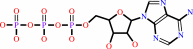 ATP
ATP
|
+
|
H2O
|
=
|
 ADP
ADP
|
+
|
 phosphate
|
+
|
H(+)
|
|
|
|
|
|
|
|
|
|
|
|
|
Molecule diagrams generated from .mol files obtained from the
KEGG ftp site
|
|
|
|
|
|
|
|
|
|
|
|
|
|
 |
|
|
|
|
|
|
| |
|
|
| |
|
|
J Med Chem
52:4794-4809
(2009)
|
|
PubMed id:
|
|
|
|
|
|
| |
|
Combining hit identification strategies: fragment-based and in silico approaches to orally active 2-aminothieno[2,3-d]pyrimidine inhibitors of the Hsp90 molecular chaperone.
|
|
P.A.Brough,
X.Barril,
J.Borgognoni,
P.Chene,
N.G.Davies,
B.Davis,
M.J.Drysdale,
B.Dymock,
S.A.Eccles,
C.Garcia-Echeverria,
C.Fromont,
A.Hayes,
R.E.Hubbard,
A.M.Jordan,
M.R.Jensen,
A.Massey,
A.Merrett,
A.Padfield,
R.Parsons,
T.Radimerski,
F.I.Raynaud,
A.Robertson,
S.D.Roughley,
J.Schoepfer,
H.Simmonite,
S.Y.Sharp,
A.Surgenor,
M.Valenti,
S.Walls,
P.Webb,
M.Wood,
P.Workman,
L.Wright.
|
|
|
|
|
| |
ABSTRACT
|
|
|
|
| |
|
|
Inhibitors of the Hsp90 molecular chaperone are showing considerable promise as
potential molecular therapeutic agents for the treatment of cancer. Here we
describe novel 2-aminothieno[2,3-d]pyrimidine ATP competitive Hsp90 inhibitors,
which were designed by combining structural elements of distinct low affinity
hits generated from fragment-based and in silico screening exercises in concert
with structural information from X-ray protein crystallography. Examples from
this series have high affinity (IC50 = 50-100 nM) for Hsp90 as measured in a
fluorescence polarization (FP) competitive binding assay and are active in human
cancer cell lines where they inhibit cell proliferation and exhibit a
characteristic profile of depletion of oncogenic proteins and concomitant
elevation of Hsp72. Several examples (34a, 34d and 34i) caused tumor growth
regression at well tolerated doses when administered orally in a human BT474
human breast cancer xenograft model.
|
|
|
|
|
|
|
|
|
|
|
|
|
|
|
|
|
|
 |
 |
 |
|
Literature references that cite this PDB file's key reference
|
|
|
| |
PubMed id
|
|
Reference
|
|
|
|
|
|
R.E.Hubbard
(2011).
Structure-based drug discovery and protein targets in the CNS.
|
| |
Neuropharmacology,
60,
7.
|
|
|
|
|
|
|
A.G.Coyne,
D.E.Scott,
and
C.Abell
(2010).
Drugging challenging targets using fragment-based approaches.
|
| |
Curr Opin Chem Biol,
14,
299-307.
|
|
|
|
|
|
|
A.J.Massey,
D.S.Williamson,
H.Browne,
J.B.Murray,
P.Dokurno,
T.Shaw,
A.T.Macias,
Z.Daniels,
S.Geoffroy,
M.Dopson,
P.Lavan,
N.Matassova,
G.L.Francis,
C.J.Graham,
R.Parsons,
Y.Wang,
A.Padfield,
M.Comer,
M.J.Drysdale,
and
M.Wood
(2010).
A novel, small molecule inhibitor of Hsc70/Hsp70 potentiates Hsp90 inhibitor induced apoptosis in HCT116 colon carcinoma cells.
|
| |
Cancer Chemother Pharmacol,
66,
535-545.
|
|
|
|
|
|
|
C.W.Murray,
and
T.L.Blundell
(2010).
Structural biology in fragment-based drug design.
|
| |
Curr Opin Struct Biol,
20,
497-507.
|
|
|
|
|
|
|
J.R.Porter,
C.C.Fritz,
and
K.M.Depew
(2010).
Discovery and development of Hsp90 inhibitors: a promising pathway for cancer therapy.
|
| |
Curr Opin Chem Biol,
14,
412-420.
|
|
|
|
|
|
|
L.Stingl,
T.Stühmer,
M.Chatterjee,
M.R.Jensen,
M.Flentje,
and
C.S.Djuzenova
(2010).
Novel HSP90 inhibitors, NVP-AUY922 and NVP-BEP800, radiosensitise tumour cells through cell-cycle impairment, increased DNA damage and repair protraction.
|
| |
Br J Cancer,
102,
1578-1591.
|
|
|
|
|
|
|
T.Stühmer,
M.Chatterjee,
E.Grella,
R.Seggewiss,
C.Langer,
S.Müller,
J.Schoepfer,
C.Garcia-Echeverria,
C.Quadt,
M.R.Jensen,
H.Einsele,
and
R.C.Bargou
(2009).
Anti-myeloma activity of the novel 2-aminothienopyrimidine Hsp90 inhibitor NVP-BEP800.
|
| |
Br J Haematol,
147,
319-327.
|
|
|
|
|
|
The most recent references are shown first.
Citation data come partly from CiteXplore and partly
from an automated harvesting procedure. Note that this is likely to be
only a partial list as not all journals are covered by
either method. However, we are continually building up the citation data
so more and more references will be included with time.
|
|


 Links
Links


