|
PDBsum entry 1zoh

|
|
|
|
|
 |
Contents |
 |
|
|
|
|
|
|
|
|
|
|
|
|
|
|
* Residue conservation analysis
|
|
|
|
|
|
|
|
|
|
|
Enzyme class:
|
|
E.C.2.7.11.1
- non-specific serine/threonine protein kinase.
|
|
|
|
|
|
|
Reaction:
|
|
|
1.
|
L-seryl-[protein] + ATP = O-phospho-L-seryl-[protein] + ADP + H+
|
|
2.
|
L-threonyl-[protein] + ATP = O-phospho-L-threonyl-[protein] + ADP + H+
|
|
|
|
|
|
|
L-seryl-[protein]
|
+
|
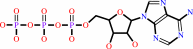 ATP
ATP
|
=
|
O-phospho-L-seryl-[protein]
|
+
|
 ADP
ADP
|
+
|
H(+)
|
|
|
|
|
|
|
L-threonyl-[protein]
|
+
|
ATP
|
=
|
O-phospho-L-threonyl-[protein]
|
+
|
ADP
|
+
|
H(+)
|
|
|
|
|
|
|
|
|
|
|
|
|
Molecule diagrams generated from .mol files obtained from the
KEGG ftp site
|
|
|
|
|
|
|
|
|
|
|
|
|
|
 |
|
|
|
|
|
|
| |
|
|
| |
|
DOI no:
|
Chem Biol
12:1211-1219
(2005)
|
|
PubMed id:
|
|
|
|
|
|
| |
|
Inspecting the structure-activity relationship of protein kinase CK2 inhibitors derived from tetrabromo-benzimidazole.
|
|
R.Battistutta,
M.Mazzorana,
S.Sarno,
Z.Kazimierczuk,
G.Zanotti,
L.A.Pinna.
|
|
|
|
|
| |
ABSTRACT
|
|
|
|
| |
|
|
CK2 is a very pleiotropic protein kinase whose high constitutive activity is
suspected to cooperate to neoplasia. Here, the crystal structure of the
complexes between CK2 and three selective tetrabromo-benzimidazole derivatives
inhibiting CK2 with Ki values between 40 and 400 nM are presented. The ligands
bind to the CK2 active site in a different way with respect to the parent
compound TBB. They enter more deeply into the cavity, establishing halogen bonds
with the backbone of Glu114 and Val116 in the hinge region. A detailed analysis
of the interactions highlights a major role of the hydrophobic effect in
establishing the rank of potency within this class of inhibitors and shows that
polar interactions are responsible for the different orientation of the
molecules in the active site.
|
|
|
|
|
|
| |
Selected figure(s)
|
|
|
|
| |
|
|

|
|

|
|
Figure 4.
Figure 4. K44 Interactions
|
|
Figure 5.
Figure 5. Stereo Representation of the Main Hydrophobic
Residues Surrounding the Inhibitors in the ATP Binding Pocket
|
|
|
|
|
|
| |
The above figures are
reprinted
by permission from Cell Press:
Chem Biol
(2005,
12,
1211-1219)
copyright 2005.
|
|
| |
Figures were
selected
by an automated process.
|
|
|
|
|
|
|
|
|
|
|
|
|
|
|
|
 |
 |
 |
|
Literature references that cite this PDB file's key reference
|
|
|
| |
PubMed id
|
|
Reference
|
|
|
|
|
|
O.Fedorov,
K.Huber,
A.Eisenreich,
P.Filippakopoulos,
O.King,
A.N.Bullock,
D.Szklarczyk,
L.J.Jensen,
D.Fabbro,
J.Trappe,
U.Rauch,
F.Bracher,
and
S.Knapp
(2011).
Specific CLK inhibitors from a novel chemotype for regulation of alternative splicing.
|
| |
Chem Biol,
18,
67-76.
|
|
|
PDB codes:
|
|
|
|
|
|
|
|
W.Zierkiewicz,
R.Wieczorek,
P.Hobza,
and
D.Michalska
(2011).
Halogen bonded complexes between volatile anaesthetics (chloroform, halothane, enflurane, isoflurane) and formaldehyde: a theoretical study.
|
| |
Phys Chem Chem Phys,
13,
5105-5113.
|
|
|
|
|
|
|
G.Cozza,
A.Bortolato,
and
S.Moro
(2010).
How druggable is protein kinase CK2?
|
| |
Med Res Rev,
30,
419-462.
|
|
|
|
|
|
|
H.D.Arman,
R.L.Gieseking,
T.W.Hanks,
and
W.T.Pennington
(2010).
Complementary halogen and hydrogen bonding: sulfur...iodine interactions and thioamide ribbons.
|
| |
Chem Commun (Camb),
46,
1854-1856.
|
|
|
|
|
|
|
N.Zhang,
and
R.Zhong
(2010).
Structural basis for decreased affinity of Emodin binding to Val66-mutated human CK2 alpha as determined by molecular dynamics.
|
| |
J Mol Model,
16,
771-780.
|
|
|
|
|
|
|
S.Baumli,
J.A.Endicott,
and
L.N.Johnson
(2010).
Halogen bonds form the basis for selective P-TEFb inhibition by DRB.
|
| |
Chem Biol,
17,
931-936.
|
|
|
PDB codes:
|
|
|
|
|
|
|
|
Y.Lu,
Y.Wang,
and
W.Zhu
(2010).
Nonbonding interactions of organic halogens in biological systems: implications for drug discovery and biomolecular design.
|
| |
Phys Chem Chem Phys,
12,
4543-4551.
|
|
|
|
|
|
|
R.Prudent,
V.Moucadel,
M.López-Ramos,
S.Aci,
B.Laudet,
L.Mouawad,
C.Barette,
J.Einhorn,
C.Einhorn,
J.N.Denis,
G.Bisson,
F.Schmidt,
S.Roy,
L.Lafanechere,
J.C.Florent,
and
C.Cochet
(2008).
Expanding the chemical diversity of CK2 inhibitors.
|
| |
Mol Cell Biochem,
316,
71-85.
|
|
|
|
|
|
|
S.Sarno,
and
L.A.Pinna
(2008).
Protein kinase CK2 as a druggable target.
|
| |
Mol Biosyst,
4,
889-894.
|
|
|
|
|
|
|
M.A.Pagano,
G.Poletto,
G.Di Maira,
G.Cozza,
M.Ruzzene,
S.Sarno,
J.Bain,
M.Elliott,
S.Moro,
G.Zagotto,
F.Meggio,
and
L.A.Pinna
(2007).
Tetrabromocinnamic acid (TBCA) and related compounds represent a new class of specific protein kinase CK2 inhibitors.
|
| |
Chembiochem,
8,
129-139.
|
|
|
|
|
|
|
R.Battistutta,
M.Mazzorana,
L.Cendron,
A.Bortolato,
S.Sarno,
Z.Kazimierczuk,
G.Zanotti,
S.Moro,
and
L.A.Pinna
(2007).
The ATP-binding site of protein kinase CK2 holds a positive electrostatic area and conserved water molecules.
|
| |
Chembiochem,
8,
1804-1809.
|
|
|
PDB codes:
|
|
|
|
|
|
|
The most recent references are shown first.
Citation data come partly from CiteXplore and partly
from an automated harvesting procedure. Note that this is likely to be
only a partial list as not all journals are covered by
either method. However, we are continually building up the citation data
so more and more references will be included with time.
Where a reference describes a PDB structure, the PDB
codes are
shown on the right.
|
|


 Links
Links