
|
|
|
|
|
 |
Contents |
 |
|
|
|
|
|
|
|
|
|
|
|
 64 a.a.
|
|
|
|
|
|
|
|
|
|
|
 142 a.a.
|
|
|
|
|
|
|
|
|
|
|
 152 a.a.
|
|
|
|
|
|
|
|
|
|
|
* Residue conservation analysis
|
|
|
|
|
|
PDB id:
|
|
|
|
| Name: |
|
Muscle protein
|
|
|
Title:
|
|
Scallop myosin regulatory domain
|
|
Structure:
|
|
Scallop myosin. Chain: a. Fragment: proteolytic fragment, regulatory domain. Other_details: ph 7.0. Scallop myosin. Chain: b. Fragment: proteolytic fragment, regulatory domain. Other_details: ph 7.0. Scallop myosin.
|
|
Source:
|
|
Argopecten irradians. Organism_taxid: 31199. Organ: skeletal. Tissue: skeletal muscle. Tissue: skeletal muscle
|
|
Biol. unit:
|
|
 Not given
|
|
Resolution:
|
|
|
2.00Å
|
R-factor:
|
0.194
|
R-free:
|
0.281
|
|
|
Authors:
|
|
A.Houdusse,C.Cohen
|
Key ref:

|
|
A.Houdusse
and
C.Cohen
(1996).
Structure of the regulatory domain of scallop myosin at 2 A resolution: implications for regulation.
Structure,
4,
21-32.
PubMed id:
DOI:

|
|
|
Date:
|
|
|
19-Jan-96
|
Release date:
|
11-Jul-96
|
|
|
|
|
|
|
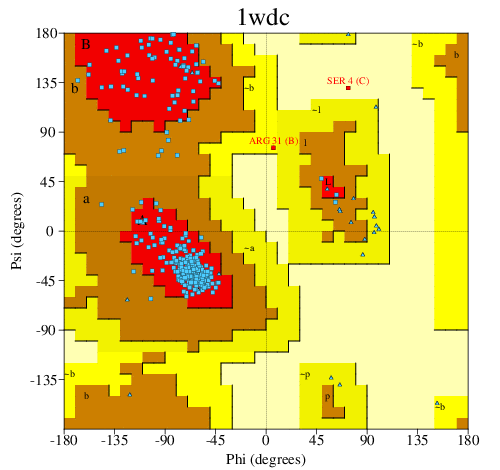
PROCHECK
|
|
|
|
|
|
Headers
|
|
|
|
References
|
|
|
|
|
|

|
|
P24733
(MYS_ARGIR) -
Myosin heavy chain, striated muscle from Argopecten irradians
|
|
|
|
Seq:
Struc:
|
|
|
|
1938 a.a.
64 a.a.
|
|

|

|

|
|
|
|
|
|
|
|
|
|
|
|
|
|
|
|
|
Enzyme class:
|
|
Chains A, B, C:
E.C.?
|
|
|
|
|
|
|
|
|
|
|
|
|
|
|
|
|
|
|
 |
|
|
|
|
|
|
| |
|
DOI no:
|
Structure
4:21-32
(1996)
|
|
PubMed id:
|
|
|
|
|
|
| |
|
Structure of the regulatory domain of scallop myosin at 2 A resolution: implications for regulation.
|
|
A.Houdusse,
C.Cohen.
|
|
|
|
|
| |
ABSTRACT
|
|
|
|
| |
|
|
BACKGROUND: In contrast to the myosins of vertebrate skeletal muscle, molluscan
myosins are regulated molecules whose enzymatic activity is switched on by the
direct binding of Ca2+. The head portion (S1) of the molecule consists of a
motor domain and a regulatory domain (RD) containing a 'regulatory' and an
'essential' light chain (RLC and ELC, respectively). The structures of scallop
myosin RD with bound Ca2+, as well as the S1 fragment of chicken skeletal muscle
myosin, have been determined previously to 2.8 A resolution. RESULTS: We have
determined the structure at 2.0 A resolution of scallop myosin RD with bound
Ca2+. The unusual coordination at the specific Ca(2+)-binding site in the ELC
has now been clarified, as has the structural basis for Mg2+ binding to the RLC.
A comparison of the scallop RD structure with that in the chicken S1 structure
shows differences in the bending of the two RDs in two different places.
CONCLUSIONS: Based on these structural results, a model for regulation is
proposed in which the Ca(2+)-bound RD is a rigid structure, and transient
flexibility of the Ca(2+)-free RD allows the myosin heads to make stabilizing
intramolecular linkage which shut off the motor.
|
|
|
|
|
|
| |
Selected figure(s)
|
|
|
|
| |
|
|

|
|
Figure 4.
Figure 4. Stereo diagram of the complex between apo-CaM and
an IQ motif peptide. Two views are shown which are related by a
90° rotation about the horizontal axis. The helical IQ motif
peptide (black, residues Arg654-Ser686) is bent around residue
Tyr675. The N-terminal lobe of CaM (domain I in red, domain II
in yellow) adopts a closed conformation. The C-terminal lobe of
CaM (domain III in cyan, domain IV in blue) adopts a semi-open
conformation. The complex has a rather elongated shape; apo-CaM
forms a channel which surrounds the middle portion of the
peptide. On the other side of the interlobe linker (green),
interactions occur between the two lobes of CaM. Among these
linkages two hydrogen bonds are made across the peptide helix
between the sidechain of residue Glu114 (in ball-and-stick
representation) in linker 3 (purple) and backbone nitrogens of
Glu45 and Ala46 (blue balls) of linker 1.
|
|
|
|
|
|
| |
The above figure is
reprinted
by permission from Cell Press:
Structure
(1996,
4,
21-32)
copyright 1996.
|
|
| |
Figure was
selected
by an automated process.
|
|
|
|
|
|
|
|
|
|
|
|
|
|
|
|
 |
 |
 |
|
Literature references that cite this PDB file's key reference
|
|
|
| |
PubMed id
|
|
Reference
|
|
|
|
|
|
Z.Grabarek
(2011).
Insights into modulation of calcium signaling by magnesium in calmodulin, troponin C and related EF-hand proteins.
|
| |
Biochim Biophys Acta,
1813,
913-921.
|
|
|
|
|
|
|
T.P.Burghardt,
K.L.Neff,
E.D.Wieben,
and
K.Ajtai
(2010).
Myosin individualized: single nucleotide polymorphisms in energy transduction.
|
| |
BMC Genomics,
11,
172.
|
|
|
|
|
|
|
D.M.Himmel,
S.Mui,
E.O'Neall-Hennessey,
A.G.Szent-Györgyi,
and
C.Cohen
(2009).
The on-off switch in regulated myosins: different triggers but related mechanisms.
|
| |
J Mol Biol,
394,
496-505.
|
|
|
PDB codes:
|
|
|
|
|
|
|
|
G.Bajaj,
Y.Zhang,
M.I.Schimerlik,
A.M.Hau,
J.Yang,
T.M.Filtz,
C.Kioussi,
and
J.E.Ishmael
(2009).
N-Methyl-D-aspartate Receptor Subunits Are Non-myosin Targets of Myosin Regulatory Light Chain.
|
| |
J Biol Chem,
284,
1252-1266.
|
|
|
|
|
|
|
K.Ajtai,
M.F.Halstead,
M.Nyitrai,
A.R.Penheiter,
Y.Zheng,
and
T.P.Burghardt
(2009).
The myosin C-loop is an allosteric actin contact sensor in actomyosin.
|
| |
Biochemistry,
48,
5263-5275.
|
|
|
|
|
|
|
K.Kazmierczak,
Y.Xu,
M.Jones,
G.Guzman,
O.M.Hernandez,
W.G.Kerrick,
and
D.Szczesna-Cordary
(2009).
The role of the N-terminus of the myosin essential light chain in cardiac muscle contraction.
|
| |
J Mol Biol,
387,
706-725.
|
|
|
|
|
|
|
V.Z.Miloushev,
J.A.Levine,
M.A.Arbing,
J.F.Hunt,
G.S.Pitt,
and
A.G.Palmer
(2009).
Solution Structure of the NaV1.2 C-terminal EF-hand Domain.
|
| |
J Biol Chem,
284,
6446-6454.
|
|
|
PDB code:
|
|
|
|
|
|
|
|
A.C.Knowles,
R.E.Ferguson,
B.D.Brandmeier,
Y.B.Sun,
D.R.Trentham,
and
M.Irving
(2008).
Orientation of the essential light chain region of myosin in relaxed, active, and rigor muscle.
|
| |
Biophys J,
95,
3882-3891.
|
|
|
|
|
|
|
J.H.Brown,
Y.Yang,
L.Reshetnikova,
S.Gourinath,
D.Süveges,
J.Kardos,
F.Hóbor,
R.Reutzel,
L.Nyitray,
and
C.Cohen
(2008).
An unstable head-rod junction may promote folding into the compact off-state conformation of regulated myosins.
|
| |
J Mol Biol,
375,
1434-1443.
|
|
|
PDB codes:
|
|
|
|
|
|
|
|
Q.Xiao,
A.Prussia,
K.Yu,
Y.Y.Cui,
and
H.C.Hartzell
(2008).
Regulation of bestrophin Cl channels by calcium: role of the C terminus.
|
| |
J Gen Physiol,
132,
681-692.
|
|
|
|
|
|
|
S.L.Hooper,
K.H.Hobbs,
and
J.B.Thuma
(2008).
Invertebrate muscles: thin and thick filament structure; molecular basis of contraction and its regulation, catch and asynchronous muscle.
|
| |
Prog Neurobiol,
86,
72.
|
|
|
|
|
|
|
J.Bosch,
S.Turley,
C.M.Roach,
T.M.Daly,
L.W.Bergman,
and
W.G.Hol
(2007).
The closed MTIP-myosin A-tail complex from the malaria parasite invasion machinery.
|
| |
J Mol Biol,
372,
77-88.
|
|
|
PDB code:
|
|
|
|
|
|
|
|
T.P.Burghardt,
K.Ajtai,
D.K.Chan,
M.F.Halstead,
J.Li,
and
Y.Zheng
(2007).
GFP-tagged regulatory light chain monitors single myosin lever-arm orientation in a muscle fiber.
|
| |
Biophys J,
93,
2226-2239.
|
|
|
|
|
|
|
Y.Yang,
S.Gourinath,
M.Kovács,
L.Nyitray,
R.Reutzel,
D.M.Himmel,
E.O'Neall-Hennessey,
L.Reshetnikova,
A.G.Szent-Györgyi,
J.H.Brown,
and
C.Cohen
(2007).
Rigor-like structures from muscle myosins reveal key mechanical elements in the transduction pathways of this allosteric motor.
|
| |
Structure,
15,
553-564.
|
|
|
PDB codes:
|
|
|
|
|
|
|
|
S.Li,
A.M.Sandercock,
P.Conduit,
C.V.Robinson,
R.L.Williams,
and
J.V.Kilmartin
(2006).
Structural role of Sfi1p-centrin filaments in budding yeast spindle pole body duplication.
|
| |
J Cell Biol,
173,
867-877.
|
|
|
PDB codes:
|
|
|
|
|
|
|
|
J.E.Debreczeni,
L.Farkas,
V.Harmat,
C.Hetényi,
I.Hajdú,
P.Závodszky,
K.Kohama,
and
L.Nyitray
(2005).
Structural evidence for non-canonical binding of Ca2+ to a canonical EF-hand of a conventional myosin.
|
| |
J Biol Chem,
280,
41458-41464.
|
|
|
PDB code:
|
|
|
|
|
|
|
|
S.Brunet,
T.Scheuer,
R.Klevit,
and
W.A.Catterall
(2005).
Modulation of CaV1.2 channels by Mg2+ acting at an EF-hand motif in the COOH-terminal domain.
|
| |
J Gen Physiol,
126,
311-323.
|
|
|
|
|
|
|
B.A.Baumann,
H.Liang,
K.Sale,
B.D.Hambly,
and
P.G.Fajer
(2004).
Myosin regulatory domain orientation in skeletal muscle fibers: application of novel electron paramagnetic resonance spectral decomposition and molecular modeling methods.
|
| |
Biophys J,
86,
3030-3041.
|
|
|
|
|
|
|
E.S.Shih,
and
M.J.Hwang
(2004).
Alternative alignments from comparison of protein structures.
|
| |
Proteins,
56,
519-527.
|
|
|
|
|
|
|
J.L.Wahlstrom,
M.A.Randall,
J.D.Lawson,
D.E.Lyons,
W.F.Siems,
G.J.Crouch,
R.Barr,
K.C.Facemyer,
and
C.R.Cremo
(2003).
Structural model of the regulatory domain of smooth muscle heavy meromyosin.
|
| |
J Biol Chem,
278,
5123-5131.
|
|
|
|
|
|
|
J.V.Kilmartin
(2003).
Sfi1p has conserved centrin-binding sites and an essential function in budding yeast spindle pole body duplication.
|
| |
J Cell Biol,
162,
1211-1221.
|
|
|
|
|
|
|
L.Farkas,
A.Malnasi-Csizmadia,
A.Nakamura,
K.Kohama,
and
L.Nyitray
(2003).
Localization and characterization of the inhibitory Ca2+-binding site of Physarum polycephalum myosin II.
|
| |
J Biol Chem,
278,
27399-27405.
|
|
|
|
|
|
|
M.Terrak,
G.Wu,
W.F.Stafford,
R.C.Lu,
and
R.Dominguez
(2003).
Two distinct myosin light chain structures are induced by specific variations within the bound IQ motifs-functional implications.
|
| |
EMBO J,
22,
362-371.
|
|
|
PDB codes:
|
|
|
|
|
|
|
|
N.Gamper,
and
M.S.Shapiro
(2003).
Calmodulin mediates Ca2+-dependent modulation of M-type K+ channels.
|
| |
J Gen Physiol,
122,
17-31.
|
|
|
|
|
|
|
S.Gourinath,
D.M.Himmel,
J.H.Brown,
L.Reshetnikova,
A.G.Szent-Györgyi,
and
C.Cohen
(2003).
Crystal structure of scallop Myosin s1 in the pre-power stroke state to 2.6 a resolution: flexibility and function in the head.
|
| |
Structure,
11,
1621-1627.
|
|
|
PDB code:
|
|
|
|
|
|
|
|
S.Sheng,
Y.Gao,
A.S.Khromov,
A.V.Somlyo,
A.P.Somlyo,
and
Z.Shao
(2003).
Cryo-atomic force microscopy of unphosphorylated and thiophosphorylated single smooth muscle myosin molecules.
|
| |
J Biol Chem,
278,
39892-39896.
|
|
|
|
|
|
|
J.Köhler,
G.Winkler,
I.Schulte,
T.Scholz,
W.McKenna,
B.Brenner,
and
T.Kraft
(2002).
Mutation of the myosin converter domain alters cross-bridge elasticity.
|
| |
Proc Natl Acad Sci U S A,
99,
3557-3562.
|
|
|
|
|
|
|
L.E.LaConte,
V.Voelz,
W.Nelson,
M.Enz,
and
D.D.Thomas
(2002).
Molecular dynamics simulation of site-directed spin labeling: experimental validation in muscle fibers.
|
| |
Biophys J,
83,
1854-1866.
|
|
|
|
|
|
|
M.S.Cates,
M.L.Teodoro,
and
G.N.Phillips
(2002).
Molecular mechanisms of calcium and magnesium binding to parvalbumin.
|
| |
Biophys J,
82,
1133-1146.
|
|
|
|
|
|
|
S.Burgess,
M.Walker,
F.Wang,
J.R.Sellers,
H.D.White,
P.J.Knight,
and
J.Trinick
(2002).
The prepower stroke conformation of myosin V.
|
| |
J Cell Biol,
159,
983-991.
|
|
|
|
|
|
|
S.R.Martin,
and
P.M.Bayley
(2002).
Regulatory implications of a novel mode of interaction of calmodulin with a double IQ-motif target sequence from murine dilute myosin V.
|
| |
Protein Sci,
11,
2909-2923.
|
|
|
|
|
|
|
F.Yumoto,
M.Nara,
H.Kagi,
W.Iwasaki,
T.Ojima,
K.Nishita,
K.Nagata,
and
M.Tanokura
(2001).
Coordination structures of Ca2+ and Mg2+ in Akazara scallop troponin C in solution. FTIR spectroscopy of side-chain COO- groups.
|
| |
Eur J Biochem,
268,
6284-6290.
|
|
|
|
|
|
|
J.J.Chou,
S.Li,
C.B.Klee,
and
A.Bax
(2001).
Solution structure of Ca(2+)-calmodulin reveals flexible hand-like properties of its domains.
|
| |
Nat Struct Biol,
8,
990-997.
|
|
|
PDB codes:
|
|
|
|
|
|
|
|
R.A.Atkinson,
C.Joseph,
G.Kelly,
F.W.Muskett,
T.A.Frenkiel,
D.Nietlispach,
and
A.Pastore
(2001).
Ca2+-independent binding of an EF-hand domain to a novel motif in the alpha-actinin-titin complex.
|
| |
Nat Struct Biol,
8,
853-857.
|
|
|
PDB code:
|
|
|
|
|
|
|
|
T.Wendt,
D.Taylor,
K.M.Trybus,
and
K.Taylor
(2001).
Three-dimensional image reconstruction of dephosphorylated smooth muscle heavy meromyosin reveals asymmetry in the interaction between myosin heads and placement of subfragment 2.
|
| |
Proc Natl Acad Sci U S A,
98,
4361-4366.
|
|
|
PDB code:
|
|
|
|
|
|
|
|
A.Houdusse,
A.G.Szent-Gyorgyi,
and
C.Cohen
(2000).
Three conformational states of scallop myosin S1.
|
| |
Proc Natl Acad Sci U S A,
97,
11238-11243.
|
|
|
PDB codes:
|
|
|
|
|
|
|
|
A.Lewit-Bentley,
and
S.Réty
(2000).
EF-hand calcium-binding proteins.
|
| |
Curr Opin Struct Biol,
10,
637-643.
|
|
|
|
|
|
|
B.Pliszka,
E.Karczewska,
and
B.Wawro
(2000).
Nucleotide-induced movements in the myosin head near the converter region.
|
| |
Biochim Biophys Acta,
1481,
55-62.
|
|
|
|
|
|
|
D.J.Black,
S.B.Tikunova,
J.D.Johnson,
and
J.P.Davis
(2000).
Acid pairs increase the N-terminal Ca2+ affinity of CaM by increasing the rate of Ca2+ association.
|
| |
Biochemistry,
39,
13831-13837.
|
|
|
|
|
|
|
E.W.Becker
(2000).
Kinetic equilibrium of forces and molecular events in muscle contraction.
|
| |
Proc Natl Acad Sci U S A,
97,
157-161.
|
|
|
|
|
|
|
H.Patel,
S.S.Margossian,
and
P.D.Chantler
(2000).
Locking regulatory myosin in the off-state with trifluoperazine.
|
| |
J Biol Chem,
275,
4880-4888.
|
|
|
|
|
|
|
K.C.Holmes,
and
M.A.Geeves
(2000).
The structural basis of muscle contraction.
|
| |
Philos Trans R Soc Lond B Biol Sci,
355,
419-431.
|
|
|
|
|
|
|
M.A.Titus
(2000).
Getting to the point with myosin VI.
|
| |
Curr Biol,
10,
R294-R297.
|
|
|
|
|
|
|
R.D.Vale,
and
R.A.Milligan
(2000).
The way things move: looking under the hood of molecular motor proteins.
|
| |
Science,
288,
88-95.
|
|
|
|
|
|
|
S.Quevillon-Chéruel,
C.Janmot,
M.Nozais,
A.M.Lompré,
and
J.J.Béchet
(2000).
Functional regions in the essential light chain of smooth muscle myosin as revealed by the mutagenesis approach.
|
| |
Eur J Biochem,
267,
6151-6157.
|
|
|
|
|
|
|
T.M.Blumenschein,
and
F.C.Reinach
(2000).
Analysis of affinity and specificity in an EF-hand site using double mutant cycles.
|
| |
Biochemistry,
39,
3603-3610.
|
|
|
|
|
|
|
T.Ozawa,
M.Fukuda,
M.Nara,
A.Nakamura,
Y.Komine,
K.Kohama,
and
Y.Umezawa
(2000).
How can Ca2+ selectively activate recoverin in the presence of Mg2+? Surface plasmon resonance and FT-IR spectroscopic studies.
|
| |
Biochemistry,
39,
14495-14503.
|
|
|
|
|
|
|
A.Houdusse,
V.N.Kalabokis,
D.Himmel,
A.G.Szent-Györgyi,
and
C.Cohen
(1999).
Atomic structure of scallop myosin subfragment S1 complexed with MgADP: a novel conformation of the myosin head.
|
| |
Cell,
97,
459-470.
|
|
|
PDB code:
|
|
|
|
|
|
|
|
A.Málnási-Csizmadia,
G.Hegyi,
F.Tölgyesi,
A.G.Szent-Györgyi,
and
L.Nyitray
(1999).
Fluorescence measurements detect changes in scallop myosin regulatory domain.
|
| |
Eur J Biochem,
261,
452-458.
|
|
|
|
|
|
|
B.B.Adhikari,
J.Somerset,
J.T.Stull,
and
P.G.Fajer
(1999).
Dynamic modulation of the regulatory domain of myosin heads by pH, ionic strength, and RLC phosphorylation in synthetic myosin filaments.
|
| |
Biochemistry,
38,
3127-3132.
|
|
|
|
|
|
|
B.Z.Peterson,
C.D.DeMaria,
J.P.Adelman,
and
D.T.Yue
(1999).
Calmodulin is the Ca2+ sensor for Ca2+ -dependent inactivation of L-type calcium channels.
|
| |
Neuron,
22,
549-558.
|
|
|
|
|
|
|
M.A.Geeves,
and
K.C.Holmes
(1999).
Structural mechanism of muscle contraction.
|
| |
Annu Rev Biochem,
68,
687-728.
|
|
|
|
|
|
|
M.S.Cates,
M.B.Berry,
E.L.Ho,
Q.Li,
J.D.Potter,
and
G.N.Phillips
(1999).
Metal-ion affinity and specificity in EF-hand proteins: coordination geometry and domain plasticity in parvalbumin.
|
| |
Structure,
7,
1269-1278.
|
|
|
PDB codes:
|
|
|
|
|
|
|
|
R.Vemuri,
E.B.Lankford,
K.Poetter,
S.Hassanzadeh,
K.Takeda,
Z.X.Yu,
V.J.Ferrans,
and
N.D.Epstein
(1999).
The stretch-activation response may be critical to the proper functioning of the mammalian heart.
|
| |
Proc Natl Acad Sci U S A,
96,
1048-1053.
|
|
|
|
|
|
|
S.Ramachandran,
and
D.D.Thomas
(1999).
Rotational dynamics of the regulatory light chain in scallop muscle detected by time-resolved phosphorescence anisotropy.
|
| |
Biochemistry,
38,
9097-9104.
|
|
|
|
|
|
|
A.Malmendal,
J.Evenäs,
E.Thulin,
G.P.Gippert,
T.Drakenberg,
and
S.Forsén
(1998).
When size is important. Accommodation of magnesium in a calcium binding regulatory domain.
|
| |
J Biol Chem,
273,
28994-29001.
|
|
|
|
|
|
|
J.Evenäs,
A.Malmendal,
and
S.Forsén
(1998).
Calcium.
|
| |
Curr Opin Chem Biol,
2,
293-302.
|
|
|
|
|
|
|
K.C.Holmes
(1998).
Picture story. A powerful stroke.
|
| |
Nat Struct Biol,
5,
940-942.
|
|
|
|
|
|
|
K.M.Trybus,
V.Naroditskaya,
and
H.L.Sweeney
(1998).
The light chain-binding domain of the smooth muscle myosin heavy chain is not the only determinant of regulation.
|
| |
J Biol Chem,
273,
18423-18428.
|
|
|
|
|
|
|
L.D.Saraswat,
and
S.Lowey
(1998).
Subunit interactions within an expressed regulatory domain of chicken skeletal myosin. Location of the NH2 terminus of the regulatory light chain by fluorescence resonance energy transfer.
|
| |
J Biol Chem,
273,
17671-17679.
|
|
|
|
|
|
|
R.C.Stevens,
and
T.N.Davis
(1998).
Mlc1p is a light chain for the unconventional myosin Myo2p in Saccharomyces cerevisiae.
|
| |
J Cell Biol,
142,
711-722.
|
|
|
|
|
|
|
R.Dominguez,
Y.Freyzon,
K.M.Trybus,
and
C.Cohen
(1998).
Crystal structure of a vertebrate smooth muscle myosin motor domain and its complex with the essential light chain: visualization of the pre-power stroke state.
|
| |
Cell,
94,
559-571.
|
|
|
PDB codes:
|
|
|
|
|
|
|
|
J.M.Squire
(1997).
Architecture and function in the muscle sarcomere.
|
| |
Curr Opin Struct Biol,
7,
247-257.
|
|
|
|
|
|
|
M.Andersson,
A.Malmendal,
S.Linse,
I.Ivarsson,
S.Forsén,
and
L.A.Svensson
(1997).
Structural basis for the negative allostery between Ca(2+)- and Mg(2+)-binding in the intracellular Ca(2+)-receptor calbindin D9k.
|
| |
Protein Sci,
6,
1139-1147.
|
|
|
PDB codes:
|
|
|
|
|
|
|
|
S.E.Kurzawa,
D.J.Manstein,
and
M.A.Geeves
(1997).
Dictyostelium discoideum myosin II: characterization of functional myosin motor fragments.
|
| |
Biochemistry,
36,
317-323.
|
|
|
|
|
|
|
Y.Zhang,
Z.Shao,
A.P.Somlyo,
and
A.V.Somlyo
(1997).
Cryo-atomic force microscopy of smooth muscle myosin.
|
| |
Biophys J,
72,
1308-1318.
|
|
|
|
|
|
|
A.Houdusse,
M.Silver,
and
C.Cohen
(1996).
A model of Ca(2+)-free calmodulin binding to unconventional myosins reveals how calmodulin acts as a regulatory switch.
|
| |
Structure,
4,
1475-1490.
|
|
|
PDB code:
|
|
|
|
|
|
|
|
C.L.Perreault-Micale,
A.Jancsó,
and
A.G.Szent-Györgyi
(1996).
Essential and regulatory light chains of Placopecten striated and catch muscle myosins.
|
| |
J Muscle Res Cell Motil,
17,
533-542.
|
|
|
|
|
|
|
C.L.Perreault-Micale,
V.N.Kalabokis,
L.Nyitray,
and
A.G.Szent-Györgyi
(1996).
Sequence variations in the surface loop near the nucleotide binding site modulate the ATP turnover rates of molluscan myosins.
|
| |
J Muscle Res Cell Motil,
17,
543-553.
|
|
|
|
|
|
|
G.M.Diffee,
J.R.Patel,
F.C.Reinach,
M.L.Greaser,
and
R.L.Moss
(1996).
Altered kinetics of contraction in skeletal muscle fibers containing a mutant myosin regulatory light chain with reduced divalent cation binding.
|
| |
Biophys J,
71,
341-350.
|
|
|
|
|
|
|
I.Rayment
(1996).
The structural basis of the myosin ATPase activity.
|
| |
J Biol Chem,
271,
15850-15853.
|
|
|
|
|
|
|
K.C.Holmes
(1996).
Muscle proteins--their actions and interactions.
|
| |
Curr Opin Struct Biol,
6,
781-789.
|
|
|
|
|
|
|
K.Poetter,
H.Jiang,
S.Hassanzadeh,
S.R.Master,
A.Chang,
M.C.Dalakas,
I.Rayment,
J.R.Sellers,
L.Fananapazir,
and
N.D.Epstein
(1996).
Mutations in either the essential or regulatory light chains of myosin are associated with a rare myopathy in human heart and skeletal muscle.
|
| |
Nat Genet,
13,
63-69.
|
|
|
|
|
|
|
M.Anson,
M.A.Geeves,
S.E.Kurzawa,
and
D.J.Manstein
(1996).
Myosin motors with artificial lever arms.
|
| |
EMBO J,
15,
6069-6074.
|
|
|
|
|
|
|
T.Q.Uyeda,
P.D.Abramson,
and
J.A.Spudich
(1996).
The neck region of the myosin motor domain acts as a lever arm to generate movement.
|
| |
Proc Natl Acad Sci U S A,
93,
4459-4464.
|
|
|
|
|
|
The most recent references are shown first.
Citation data come partly from CiteXplore and partly
from an automated harvesting procedure. Note that this is likely to be
only a partial list as not all journals are covered by
either method. However, we are continually building up the citation data
so more and more references will be included with time.
Where a reference describes a PDB structure, the PDB
codes are
shown on the right.
|
 |
|


 Links
Links


