 |
PDBsum entry 1w3k

|
|
|
|
|
 |
Contents |
 |
|
|
|
|
|
|
|
|
|
|
|
|
* Residue conservation analysis
|
|
|
|
|
|
PDB id:
|
|
|
|
| Name: |
|
Hydrolase
|
|
|
Title:
|
|
Endoglucanase cel5a from bacillus agaradhaerens in complex with cellobio derived-tetrahydrooxazine
|
|
Structure:
|
|
Endoglucanase 5a. Chain: a. Fragment: catalytic core domain, residues 30-329. Synonym: endo-1,4-beta-glucanase, alkaline cellulase. Engineered: yes
|
|
Source:
|
|
Bacillus agaradhaerens. Organism_taxid: 76935. Expressed in: bacillus subtilis. Expression_system_taxid: 1423.
|
|
Resolution:
|
|
|
1.20Å
|
R-factor:
|
0.114
|
R-free:
|
0.132
|
|
|
Authors:
|
|
T.M.Gloster,J.M.Macdonald,C.A.Tarling,R.V.Stick,S.W.Withers, G.J.Davies
|
Key ref:

|
|
T.M.Gloster
et al.
(2004).
Structural, thermodynamic, and kinetic analyses of tetrahydrooxazine-derived inhibitors bound to beta-glucosidases.
J Biol Chem,
279,
49236-49242.
PubMed id:
DOI:

|
|
|
Date:
|
|
|
16-Jul-04
|
Release date:
|
08-Sep-04
|
|
|
|
|
|
|
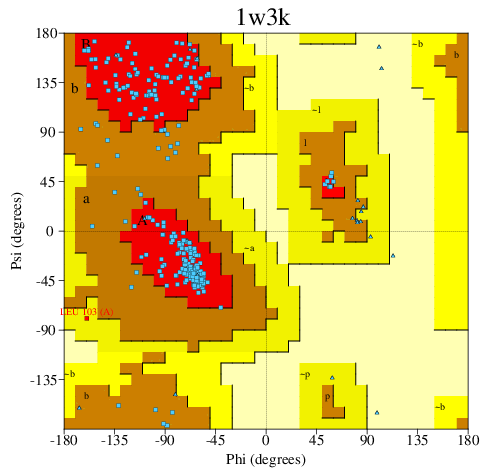
PROCHECK
|
|
|
|
|
|
Headers
|
|
|
|
References
|
|
|
|
|
|

|
|
O85465
(GUN5_SALAG) -
Endoglucanase 5A from Salipaludibacillus agaradhaerens
|
|
|
|
Seq:
Struc:
|
|
|
|
400 a.a.
300 a.a.
|
|

|

|

|
|
|
|
|
|
|
|
|
|
|
Key: |
|
 |
Secondary structure |
|
 |
CATH domain |
|
|
|
|
|
|
|
|
|
|
|
|
|
Enzyme class:
|
|
E.C.3.2.1.4
- cellulase.
|
|
|
|
|
|
|
Reaction:
|
|
Endohydrolysis of 1,4-beta-D-glucosidic linkages in cellulose, lichenin and cereal beta-D-glucans.
|
|
|
|
|
|
|
|
|
|
|
|
|
|
|
|
|
|
 |
|
|
|
|
|
|
| |
|
DOI no:
|
J Biol Chem
279:49236-49242
(2004)
|
|
PubMed id:
|
|
|
|
|
|
| |
|
Structural, thermodynamic, and kinetic analyses of tetrahydrooxazine-derived inhibitors bound to beta-glucosidases.
|
|
T.M.Gloster,
J.M.Macdonald,
C.A.Tarling,
R.V.Stick,
S.G.Withers,
G.J.Davies.
|
|
|
|
|
| |
ABSTRACT
|
|
|
|
| |
|
|
The understanding of transition state mimicry in glycoside hydrolysis is
increasingly important both in the quest for novel specific therapeutic agents
and for the deduction of enzyme function and mechanism. To aid comprehension,
inhibitors can be characterized through kinetic, thermodynamic, and structural
dissection to build an "inhibition profile." Here we dissect the
binding of a tetrahydrooxazine inhibitor and its derivatives, which display Ki
values around 500 nm. X-ray structures with both a beta-glucosidase, at 2 A
resolution, and an endoglucanase at atomic (approximately 1 A) resolution reveal
similar interactions between the tetrahydrooxazine inhibitor and both enzymes.
Kinetic analyses reveal the pH dependence of kcat/Km and 1/Ki with both enzyme
systems, and isothermal titration calorimetry unveils the enthalpic and entropic
contributions to beta-glucosidase inhibition. The pH dependence of enzyme
activity mirrored that of 1/Ki in both enzymes, unlike the cases of isofagomine
and 1-deoxynojirimycin that have been characterized previously. Calorimetric
dissection reveals a large favorable enthalpy that is partially offset by an
unfavorable entropy upon binding. In terms of the similar profile for the pH
dependence of 1/Ki and the pH dependence of kcat/Km, the significant enthalpy of
binding when compared with other glycosidase inhibitors, and the tight binding
at the optimal pH of the enzymes tested, tetrahydrooxazine and its derivatives
are a significantly better class of glycosidase inhibitor than previously
assumed.
|
|
|
|
|
|
| |
Selected figure(s)
|
|
|
|
| |
|
|

|
|

|
|
Figure 2.
FIG. 2. Aza sugar glycosidase inhibitors.
|
|
Figure 4.
FIG. 4. Divergent (wall-eyed) stereo ball-and-stick
representation of TmGH1 active site residues interacting with 1
(a) and Cel5 active site residues interacting with 2 (b). The
observed electron density for the maximum likelihood weighted
2F[obs] - F[calc] map is contoured at 1  ( (  0.25 electrons Å-3)
for TmGH1 and 2.5 ( 1.16 electrons Å-3)
for Cel5A; these figures were drawn using BOBSCRIPT (31). 0.25 electrons Å-3)
for TmGH1 and 2.5 ( 1.16 electrons Å-3)
for Cel5A; these figures were drawn using BOBSCRIPT (31).
|
|
|
|
|
|
| |
The above figures are
reprinted
by permission from the ASBMB:
J Biol Chem
(2004,
279,
49236-49242)
copyright 2004.
|
|
| |
Figures were
selected
by an automated process.
|
|
|
|
|
|
|
|
|
|
|
|
|
|
|
|
 |
 |
 |
|
Literature references that cite this PDB file's key reference
|
|
|
| |
PubMed id
|
|
Reference
|
|
|
|
|
|
S.Khan,
T.Pozzo,
M.Megyeri,
S.Lindahl,
A.Sundin,
C.Turner,
and
E.N.Karlsson
(2011).
Aglycone specificity of Thermotoga neapolitana β-glucosidase 1A modified by mutagenesis, leading to increased catalytic efficiency in quercetin-3-glucoside hydrolysis.
|
| |
BMC Biochem,
12,
11.
|
|
|
|
|
|
|
D.A.Kuntz,
S.Nakayama,
K.Shea,
H.Hori,
Y.Uto,
H.Nagasawa,
and
D.R.Rose
(2010).
Structural investigation of the binding of 5-substituted swainsonine analogues to Golgi alpha-mannosidase II.
|
| |
Chembiochem,
11,
673-680.
|
|
|
PDB codes:
|
|
|
|
|
|
|
|
E.Hardiman,
M.Gibbs,
R.Reeves,
and
P.Bergquist
(2010).
Directed evolution of a thermophilic beta-glucosidase for cellulosic bioethanol production.
|
| |
Appl Biochem Biotechnol,
161,
301-312.
|
|
|
|
|
|
|
L.Lin,
X.Meng,
P.Liu,
Y.Hong,
G.Wu,
X.Huang,
C.Li,
J.Dong,
L.Xiao,
and
Z.Liu
(2009).
Improved catalytic efficiency of endo-beta-1,4-glucanase from Bacillus subtilis BME-15 by directed evolution.
|
| |
Appl Microbiol Biotechnol,
82,
671-679.
|
|
|
|
|
|
|
A.D.Hill,
and
P.J.Reilly
(2008).
A Gibbs free energy correlation for automated docking of carbohydrates.
|
| |
J Comput Chem,
29,
1131-1141.
|
|
|
|
|
|
|
F.A.Shaikh,
and
S.G.Withers
(2008).
Teaching old enzymes new tricks: engineering and evolution of glycosidases and glycosyl transferases for improved glycoside synthesis.
|
| |
Biochem Cell Biol,
86,
169-177.
|
|
|
|
|
|
|
A.Ababou,
and
J.E.Ladbury
(2006).
Survey of the year 2004: literature on applications of isothermal titration calorimetry.
|
| |
J Mol Recognit,
19,
79-89.
|
|
|
|
|
|
|
L.Dolecková-Maresová,
M.Pavlík,
M.Horn,
and
M.Mares
(2005).
De novo design of alpha-amylase inhibitor: a small linear mimetic of macromolecular proteinaceous ligands.
|
| |
Chem Biol,
12,
1349-1357.
|
|
|
|
|
|
The most recent references are shown first.
Citation data come partly from CiteXplore and partly
from an automated harvesting procedure. Note that this is likely to be
only a partial list as not all journals are covered by
either method. However, we are continually building up the citation data
so more and more references will be included with time.
Where a reference describes a PDB structure, the PDB
codes are
shown on the right.
|
|


 Links
Links


